Premium
Dick Cheney: The man whose legacy was defined by the Iraq war
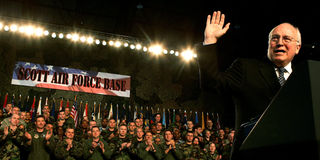
US Vice President Dick Cheney speaks to Air Force personnel at Scott Air Force Base in Illinois March 21, 2006.

Dick Cheney, one of the most important figures in America’s neo-conservative movement, has died at the age of 84. Cheney had a long career in government and was considered by many as one of the most powerful vice-presidents in US history.
Cheney started his career in politics in 1968 in the office of William Steiger, a Republican representative from Wisconsin, before joining the staff of Donald Rumsfeld, who was at the time the director of the Office of Economic Opportunity. By 1974, Cheney was brought on to the team of Gerald Ford, who had assumed the US presidency that year following the resignation of Richard Nixon. He followed Rumsfeld as Ford’s White House chief of staff in 1975, at the age of 34.
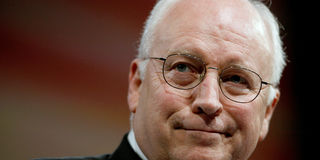
US Vice President Dick Cheney addresses the American Israel Public Affairs Committee (AIPAC) Policy Conference 2007 in Washington March 12, 2007.


Cheney then went on to spend over a decade serving as a member of the House of Representatives. He represented a district in Wyoming until 1989 when he was appointed secretary of defense by the then-president, George H.W. Bush.
This experience would prove critical to Cheney’s subsequent selection as running mate by Bush’s son, George W. Bush, for his 2000 presidential campaign as the Republican candidate. Bush Jr. went on to win that election, and his partnership with Cheney would ultimately prove incredibly significant in reshaping US foreign policy in the Middle East.
After the 9/11 terrorist attacks in 2001, the neo-conservative movement gained momentum in Washington and found an ally in Cheney. He was a founding signatory of the so-called Project for the New American Century, which became a major forum for neo-conservative thinking. The goal was to promote US interests – namely spreading democracy abroad – through a bold deployment of military power.
This interventionist foreign policy culminated in the 2003 US invasion of Iraq. Considered by some to be a shadow president, Cheney had a huge influence over Bush Jr. He reportedly played a major role in convincing Bush to go to war in Iraq.
Cheney expressed no regrets about this decision, calling critics of the war “spineless” in 2005. But a majority of Americans considered this decision to be a grave error.
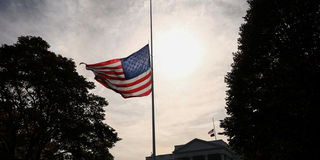
A US flag flies at half-staff following the death of former US Vice President Dick Cheney, at the White House in Washington, DC, US, November 4, 2025.
The war is estimated to have cost the US well over US$1 trillion (£800 billion), and as much as US$3 trillion when taking the wider regional conflict it sparked into account. The war also led to the deaths of as many as 600,000 Iraqi civilians, according to an estimate published by the Lancet medical journal.
There were also questions about whether Cheney had a conflict of interest. He had previously served as the chief executive of Halliburton, a company that won billions of dollars in US military contracts to restore Iraq’s oil sector – this included some of the biggest military logistics contracts in history. Cheney was even accused of coordinating preferential awarding of contracts to the company, though he and Halliburton denied it.
He was also accused of circumventing due process, constitutional checks and congressional oversight during his time as vice-president. A prominent example of this was his involvement in a programme to intercept domestic communications without a judicial warrant.
Cheney was also widely disliked in the intelligence community. Many of these people resented the way he undermined the CIA by, for example, instructing subordinates in the agency to transmit raw intelligence directly to his office.
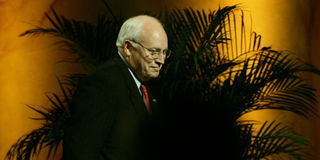
US Vice President Dick Cheney walks on stage to deliver remarks at a reception held in honour of Rep. John Dingell (D-MI), currently the longest-serving member of the House of Representatives, in Washington October 26, 2005.
Change of heart?
Given that Cheney believed executive power needed to be expanded, there was a degree of irony in his decision to endorse the Democratic candidate, Kamala Harris, in the 2024 presidential election. The winner of that election, Donald Trump, also favours an executive unencumbered by institutions.
But Cheney clearly had his limits. While Bush Jr. was reticent to publicly attack Trump, Cheney became one of his harshest critics. This was especially so after Liz Cheney, his daughter and a now former congresswoman, voted to impeach Trump after the insurrection of January 6 2021, which made her enemy number one in Trump’s eyes.
However, some critics claim that it was Cheney’s shadow presidency that paved the way for Trump’s aggressive expansion of the executive power of the presidency. Along the way, he wielded the power of the vice-presidency in a way not been seen before or, arguably, since.

US Vice President Dick Cheney listens to President George W. Bush make a statement about the war supplemental funding bill and then answer questions from the press in the Rose Garden at the White House in Washington, April 3, 2007.
Cheney was not just powerful but prone to operating clandestinely, even creating an independent operation inside the White House. All of this helped fuel mistrust of the government.
As Cheney advanced in age, his stances seemed to be softening from the Darth Vader image he had embraced as vice-president. More than half of the multi-million fortune that Cheney gained from selling his Halliburton stock options, for example, was donated to the Cardiac Institute at George Washington University.
Cheney, who survived five heart attacks and eventually a heart transplant, was seen a political survivor. But the Republican party that he had led in the shadows has been transformed. Once a towering figure in the conservative movement, today his brand of conservatism is a relic of the past.
Written by Natasha Lindstaedt
Professor in the Department of Government, University of Essex