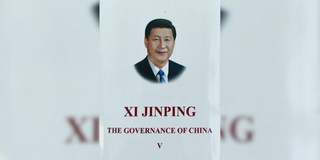
The governance of China is often a complex subject for foreign students eager to understand how this ancient civilisation has managed to stay on course despite its mammoth size.
Yet an easier explainer is found in Xi Jinping: The Governance of China , a compendium of speeches, statements, and policy reviews spanning recent decades.
Now in its fifth volume, the latest edition contains spoken and written works of Chinese President Xi Jinping, who is also the General Secretary of the Communist Party of China (CPC) Central Committee, covering the period from May 2, 2022 to December 20, 2024.
It tells the story of China’s steps towards becoming a modern socialist country centred on its people, while simultaneously building useful friendships abroad and challenging harmful hegemonic practices. It is also about reforming institutions at home to enable continued development.
China, sometimes nicknamed by scholars as the ‘Middle Kingdom’, is an old civilisation. Its modern story is one of rising from poverty and isolation to wealth and influence. The journey in between has been fraught with challenges, including the shameful episode of colonisation.
Like the previous four volumes, the latest edition offers insights into approaches for building the Global South, including Africa, by learning from China’s experience rather than copying it. It is a story of how countries can build their civilisations and modernity based on local realities.
William Kabogo, Kenya's cabinet Secretary for Information, Communications and the Digital Economy, speaks at a forum on the English edition of the fifth volume of "Xi Jinping: The Governance of China" in Nairobi on December 1, 2025.
Photo credit: Pool
China has declared its readiness to strengthen cooperation with African countries, using its own experience and expertise to assist. There are five stand‑out lessons for Africa:
Modernisation must focus on the people. Without them, it will be meaningless and unsustainable.Modernisation must be backed by a culture of quality. China is building its image abroad, especially in Africa, as the ‘factory of the world’. It is relied upon to produce high‑quality products that people in both China and Africa can trust. This commitment to quality is also reflected in the work ethic of the Chinese as they construct roads and bridges across Africa.Modernisation must begin with the basics. High‑quality education and food production are essential to maintain a healthy and productive population. China is focused on ensuring its 1.4 billion people have access to high‑quality food through deliberate scientific research to support decision‑making in agriculture. The result is steadily improving production.Harmony between humanity and nature. China has learnt that to continue benefiting from natural habitats, humans must protect them. Xi Jinping described this as ‘ecological civilisation’, saying: “Lucid waters and lush mountains are invaluable assets.” Protecting the environment ensures continued harvests for all.Strong institutions are vital. Nothing is more important to any polity than the strength of its institutions. China’s lesson over the years is that a country which fails to invest in strengthening institutions may struggle to achieve its goals. In China, equal emphasis has been placed on building a strong private sector and robust governance institutions, capable of providing policy guidance and investing in the country’s long‑term objectives.
China recognises that its success can inspire other peoples, including those in Africa. This may explain why, this year, it is investing in as many as 600 cultural events to promote exchanges between Africans and Chinese. At home, Beijing is building strong cultural confidence by clearly documenting its journey.
Abroad, it has proposed strengthening cooperation with African countries by advancing four major global initiatives on development, security, and technology, while promoting key partnership actions for modernisation.