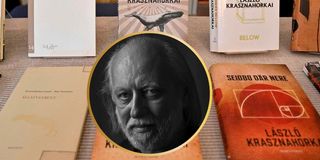
Imagine reading a novel that is 400 pages long but is a single sentence from start to finish.
That thought should not be left in the realm of imagination because it precisely describes one of the books by László Krasznahorkai, the 71-year-old Hungarian who was announced as the winner of the 2025 Nobel Prize in Literature on Thursday.
His book, Herscht 07769, is just a single sentence, and that has left readers with varying opinions.
A November 2024 critique by the Washington Post stated that it is “written in a single sentence that sprawls over 400 pages, interrupted only by the occasional semicolon”.
“It's unusual style disrupts the ordinary literary mechanics of time,” the paper added, describing Krasznahorkai as a genius.
While announcing him as the winner, the Nobel Committee made reference to his long-sentence style.
“Krasznahorkai's prose has developed towards the flowing syntax with long, winding sentences devoid of full stops that has become his signature,” said the statement written by Anders Olsson, the chair of the Nobel Committee.
In a 2018 interview, Krasznahorkai said his long sentences were inspired by a Hungarian writer he looked up to.
“Traditionally, Hungarian prose writers, like Zsigmond Móricz, composed in short sentences. But not [the late Gyula] Krúdy, my only beloved writer from the history of Hungarian prose literature,” he said in an interview published on the blog of Theodoros Grigoriadis, a literature writer and teacher.
“He used sentences differently from any other prose writer. He always sounded like a slightly drunk man who is very melancholy, who has no illusions about life, who is very strong but whose strength is entirely unnecessary. But Krúdy wasn’t a literary ideal for me. Krúdy was a person for me, a legend who gave me some power when I decided I would write something,” he added.
Indian journalist Tulika Bhatnagar, reacting to Krasznahorkai’s win, posted on Facebook that the laureate’s writing “isn’t for hurried readers”.
“His long, spiralling sentences demand patience, but reward it with depth few writers achieve. It feels right that the Nobel Prize in Literature this year recognises a writer who never chased popularity, only precision,” she posted.
South African Coenraad Visser, who posted on Facebook that he has read Krasznahorkai, noted: “His sentences are long. One sentence can stretch over several pages.”
The Nobel Committee stated that Krasznahorkai’s first novel Sátántangó, published in 1985, “was a literary sensation in Hungary and the author’s breakthrough work”.
Discussing some of his works, which have earned the description of “apocalyptic epics”, the Nobel Committee chair noted: “László Krasznahorkai is a great epic writer in the Central European tradition that extends through Kafka to Thomas Bernhard, and is characterised by absurdism and grotesque excess. But there are more strings to his bow, and he soon looks to the East in adopting a more contemplative, finely calibrated tone. The result is a string of works inspired by the deep-seated impressions left by his journeys to China and Japan.”
Krasznahorkai has at least 22 literary works to his name written in Hungarian. They were released between 1985 and 2024.
Fifteen of those have been translated to English, bearing titles like The Melancholy of Resistance (1998); The Last Wolf and Herman (2016); The World Goes On (2017); A Mountain to the North, a Lake to the South, Paths to the West, a River to the East (2021); and the title that is just a sentence—Herscht 07769: A Novel (2024). Others have been translated into French, German, among other languages.
Reacting to his win, he told the Nobel Committee: “I’m very proud to be in the line of some really great writers and poets.”
Krasznahorkai, the Nobel Committee stated, was born in 1954 in the small town of Gyula in southeast Hungary, near the Romanian border.
“A similar remote rural area is the scene of Krasznahorkai’s first novel, Sátántangó,” it noted.