Aliyah Makena’s unlikely path to the Youth Olympics
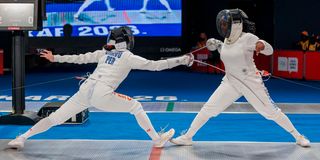
Kenya's Aliyah Makena (right) bouts Astrid Bravo of Peru in women's fencing Épée individual round of 16 at the 2026 Dakar Youth Olympic Games on November 10, 2026.

What you need to know:
- Makena competed in the women’s individual épée event, finishing 13th overall after progressing from the group stage.
- Her father, James Kamau, says the family had to put other commitments aside to travel to Senegal and support their daughter.
In Dakar
Two years ago, Aliyah Makena knew nothing about fencing.
The sport was introduced at her school by a coach in 2024, and Makena volunteered to learn it. Little did she know then that that decision would take her to the Olympics.


At 15, Makena represented Kenya at the Dakar 2026 Youth Olympic Games in Senegal. She competed in the women’s individual épée event, finishing 13th overall after progressing from the group stage to the round of 16.
Her outing in Dakar was not without challenges. She came up against opponents with different techniques and styles, some of which she had never encountered before.
“The group stage was tough. Some techniques, I wasn’t ready for,” Makena said.
She left Dakar determined to establish herself as an elite fencer.
“I have accomplished my goal of making a statement outside because I feel like now they know, okay, now there’s Kenya. Kenya does fencing. It’s not only seniors, other people are coming,” she said.
Her parents have followed her journey to the Youth Olympics while supporting her development.
Her father, James Kamau, says the family had to put other commitments aside to travel to Senegal and support their daughter.
“The Olympics is a lifetime achievement, and we are very, very excited to be here as Olympic parents,” he said.
For Kamau, the decision to support Makena came naturally. He recalls how she returned home from school excited about the new sport she was engaging in.
They encouraged her to pursue it, although the family soon discovered that supporting a young fencer in Kenya is not easy.
One of the biggest challenges has been the limited number of competitions and athletes competing in fencing locally. This makes it difficult for Makena to find regular training partners and opponents.
Equipment is another hurdle. The sport requires specialised gear, much of which is not readily available locally. The cost of acquiring the equipment and travelling abroad for competitive exposure has placed an additional financial burden on the family.
Kamau points out that the surface used for fencing at international competitions is different from what his daughter is accustomed to in Kenya.
The country does not have an aluminium piste, the specialised strip on which fencing bouts are conducted.
Consequently, athletes sometimes have to adjust to unfamiliar conditions when they arrive at major competitions. Despite these challenges, the family is determined to keep going.
The plan is to expose her to more competitions, where she can face different opponents, build confidence, and learn from athletes with greater experience.
Makena’s coach, Georgina Mukami, believes the responsibility of developing fencing in Kenya must extend beyond individual families.
For Mukami, the biggest lesson from Dakar is the need for consistency, both in training and competition. She believes Kenyan fencers need more opportunities to compete against quality opposition before travelling for major international events.
Makena wants more young Kenyans to pick up fencing and believes her experience can help open the door for others.
Follow our WhatsApp channel for breaking news updates and more stories like this.