For the next nine days, everybody who is anybody in athletics will converge on Tokyo to compete in throwing, jumping, and running as the World Athletics Championships returns to Tokyo after 34 years.
Excitement has gripped Tokyo as more than 2,000 athletes from 200 teams arrive to compete for medals in 49 disciplines from today till September 21.
Kenya will be represented at the championship by a team of 61 athletes, captained by 2015 javelin world champion Julius Yego.
First held in 1991, the biennial championship turns 20 this year. Winners are awarded medals, an juicy prize money from a purse of $8.5 million (about Sh1.1 billion).
Gold medallists will pocket $70,000 (Sh9,045,732), silver medallists $35,000 (Sh4,522,866) and bronze medallist $22,000 (Sh2,842,944) The fourth, fifth, sixth, seventh and eighth placed will also be rewarded with $16,000 (Sh2,067,595, Sh1,421,472 ($11,000), $7,000 (Sh904,573), $7,000 (Sh775,348) and $5,000 (Sh646,123) respectively..
An athlete who breaks a world record will get a bonus of $100,000 (Sh12,922,474).
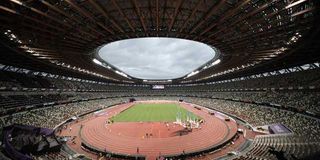
The championships will take place in Tokyo, primarily at the Japan National Stadium.
Road events, including the marathon and race walks, will be staged on courses around Tokyo, and will end at the Japan National Stadium.
The big names at the championship include world and Olympic Games 100 metres champion Noah Lilles of the United States of America, multiple Olympics, world champions Shelly-Anne Fraser-Pryce and Faith Chepng’etich, multiple Olympics and world pole vault champion Armand ‘Mondo’ Duplantis from Sweden, Olympics 5,000m and 10,000m champion Beatrice Chebet from Kenya.
Japan is hosting the senior track and field event for the third time, having first hosted it in 1991 in Tokyo, followed by the 2007 edition in Osaka.
But this year,’s edition has a special feeling. When Tokyo won the bid to host the 2020 Olympic Games on September 12, 2013, Tokyo residents poured out on the streets to celebrate.
Tokyo’s successful bid showcased Japan's technological advancements and highlighted its successful infrastructure development.
Japan had hosted the Olympics for the first time in 1964 in Tokyo where men’s 800m runner Wilson Kiprugut Chumo became the first Kenyan to win an Olympics medal.
The Japanese capital city would make no less than four unsuccessful bids to host the Games before nailing the 2020 edition.
The Middle East economic powerhouse went about building the National Stadium in Tokyo that was completed in 2019.
Then Covid-19 pandemic struck, and the Games were delayed for a year before being held behind closed doors.
This denied Tokyo residents an opportunity to showcase the brand new 67,750-seater stadium to the world. In a sense, the 2025 World Athletics Championships offer Tokyo an opportunity to show the world what they have.
Yesterday, World Athletics President Sebastian Coe was joined by Mitsugi Ogata, President of the Local Organising Committee, and Yuko Arimori, World Athletics Council Member and President of the Japan Association of Athletics Federations at the pre-championship press conference in Tokyo.
All the three remembered 2021 when the National Stadium welcomed the world’s best athletes for an Olympic Games that had no spectators.
“When this stadium hosted the Olympic Games without spectators, it highlighted the magnitude and significance of fans,” Ogata said. “Starting tomorrow, and for the next nine days, we'll welcome the world to a packed national stadium.
Seb Coe said 50,000 tickets have been sold to fans.
"I'm pleased, for very obvious reasons, to be here again as Tokyo prepares to welcome not only the world's best athletes but also thousands of spectators. We have sold 500,000 tickets, and many nights have sold out, though there are still some tickets available,” Coe said.
During 238th World Athletics Council Meeting in Tokyo on Tuesday and Wednesday, Coe said a robust financial position, a strong brand identity, a people strategy, excellent communication, and transparency had spurred growth and innovation at World Athletics.
Baseball is the most popular sport in Japan, followed by football and martial arts like sumo, but fans are sure to fill the National Stadium over the next nine days.