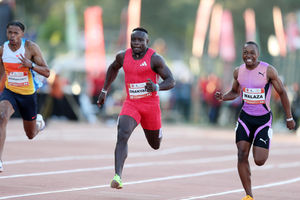
The organisers of the seventh edition of Kip Keino Classic, scheduled for April 24 at the Nyayo National Stadium, have elicited excitement and debate with interesting changes to the event.
Just what do they want to achieve by introducing the wavelight technology, a trackside light emitting diode (Led) pacing system for the first time at the World Athletics Continental Tour Gold event that will be held at night?
The wavelight technology was used for the first time at the 2018 FBK Games in Hengelo, the Netherlands.
Interestingly, wavelight was derived from the Mexican wave owing to the similar wavy motion of the lights that are installed along the inside rail of the track.
Faith Kipyegon wins the women's 1,500m in a world record 3:48.68 during the 50th Prefontaine Classic at Hayward Field on July 5, 2025 at Eugene, USA.
Photo credit: Kirby Lee | Reuters
Kip Keino Classic competition director Kennedy Tanui reckons that human pacesetters can do much, but they cannot beat the wavelight technology.
“We want fast times at our event, being the second of the 11 gold tour events this year,” said Tanui, adding that the technology will focus mainly on 100m, 200m, 800m, 1,500m and 10,000m.
“No one has called for any record, but we want to set that mood.”
Two-time Olympic marathon champion Eliud Kipchoge reckoned that technology acts as a pacemaker to enable athletes to push their limits.
“It’s great to see the technology assisting the sportsmen and women. It brings satisfaction to all those involved, especially athletes,” said Kipchoge, who was paced by wavelight (green lasers from a pace car) to break the 2-hour barrier in the INEOS 1:59 Challenge running 1:59:40 in Vienna, Austria, on October 12, 2019.
“The world of sport is about partnerships and technology has connected the sports enthusiasts from athletes, coaches, managers, organisers, sponsors and the fans,” said Kipchoge. He welcomed the use of the wavelight at the Kip Keino Classic.
Mary Moraa, who set a new world record in 600m at the ISTAF Berlin in a time of 1:21.63 on September 1, 2024, in Germany, said: “After pacesetters drop, some early, wavelight helps to keep the pace. It helped me,” said Moraa, the Commonwealth Games 800m champion.
Faith Kipyegon was paced by the wavelight to break the women’s 1,500m world record at the Florence Diamond League on June 2, 2023, and the Women’s one-mile world record at the Diamond League Herculis meet at the Louis II Stadium, Monaco on July 21, 2023.
The Olympic and world 10,000m and 5,000m champion Beatrice Chebet set a new women’s 10,000m world record of 28:54.14 on May 25, 2024 while Ugandan Joshua Cheptegi to set the men’s 5,000m world record (12:35.36) in Monaco in August 2020, and the 10,000m world record (26:11.00) in Valencia in October 2020, all assisted by wavelight on the track..
Ethiopia's Letsenbet Gidey (right) follows Kenyan pacemaker Beatrice Chepkoech and the wavelight pace lights on her way to breaking the 5000m world record in Valencia on October 7, 2020.
Photo credit: Pool | Global Sports Communication
The technology was developed by Elfried Keers, the SPORT Technology owner, a specialist in sports lighting from the Netherlands.
“We created a lamp-based pacing system which sat under the track drainage cover facing upwards,” Keers said on the World Athletics website. “The lights lit up, which allowed runners to appreciate the speed at which they were running.”
However, its fellow Dutch and former distance runner Jos Hermens, who is considered the pioneer of the wavelight technology.
Hermens, the Chief Executive Officer (CEO) of one of the leading sport management agencies, Global Sports Communication, and an enthusiast of modern technology in sports, used lights to break the one-hour world record in Papendal, the Netherlands, on May 1, 1976.
He used two lights; two lights, on the start, finish, and halfway point to control a perfect even pace during his one hour run. Two volunteers manually switched on the light every 68.5 seconds for 52.5 laps. That is how Hermens broke the world record with a distance of 20 kilometres and 944metres.
Briton Mo Farah holds the 21,330 world record set using the wavelight technology on September 4, 2020.
World Athletics President Sebastian Coe approved the use of wavelight at the 2018 FBK Games in Hengelo, saying: “The world of athletics needs change. We need daring organisers, who are not afraid to try out new ways, new innovations.”
The innovation has two values: one to enable the athletes to better target a specific pace or target time and, and secondly, to add greater value to the spectator experience.