The Confederation of African Football (CAF), which organises the continent’s flagship football tournament, the Africa Cup of Nations (Afcon), has set high standards for stadiums and training facilities earmarked for staging the tournament.
Kenya, Uganda and Tanzania are in a race against time to meet rigorous requirements in order to co-host the 2027 Afcon finals. The 36th edition of the continental showpiece is scheduled to be held in June and July 2027.
Here, Nation Sport breaks down the “minimum sports facilities requirements” for the Afcon, detailed in a report, which CAF recently sent to Kenya, Uganda and Tanzania after February’s round of inspection.
CAF explains that these standards draw from the 2025 Afcon finals held in Morocco in December and January.
The 2025 Afcon, held in Morocco from December 21, 2025, to January 18, 2026, has been widely praised as one of the best editions in the tournament’s history.
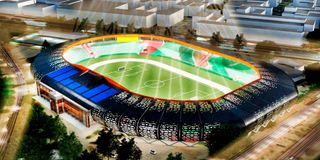
With regards to match venues, CAF requires the host nation to provide six stadiums, along with one reserve stadium. At least two of the stadiums must have a minimum capacity of 40,000 spectators, while each of the remaining venues should accommodate not less than 20,000 fans.
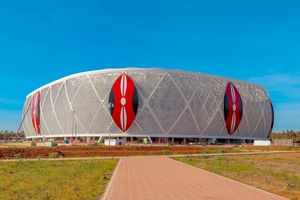
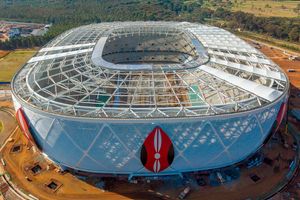
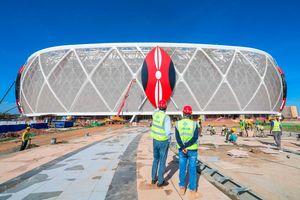
An exterior view of the under-construction 60,000-seater Raila Odinga Talanta Stadium in Nairobi, which will be one of the venues of the 2027 Africa Cup of Nations tournament.
Photo credit: Sila Kiplagat | Nation Media Group
The two 40,000-capacity stadiums must each have a modern natural grass pitch with a proper drainage system, automatic irrigation, full maintenance equipment, and Fifa –approved sports equipment.
The stadiums must be equipped with at least two high-definition giant screens, LED advertising boards installed around the pitch perimeter, and a professional public address (PA) system compliant with international standards for sporting competitions and event operations.
The lighting at the venues should be between 2,500 and 3,000lux compliant with broadcast standards, and have four player dressing rooms of equal size.
Each stadium must have two referee dressing rooms, including facilities suitable for female referees, a press conference room with 100 to 200 seats, media centre with a minimum capacity of 100 seats, media tribune with at least 300 seats including 10 commentators positions accommodating three seats each, 120 desk positions for written press, 130 free seating positions for media and 20 observers seats.
The stadiums should also have a presidential area with seating and a private lounge, VVIP and VIP areas each with seating, and a private lounge for at least 250 and 500 persons respectively.
The two stadiums should also have hospitality facilities, including a minimum of 12 skyboxes, each with 16 seats, and hospital lounges accommodating at least 500 guests.
The stadiums hosting CAF competitions must also comply with requirements relating to safety and security (Venue Operations Centre, access control, among other things).
The Venue Operations Centre (VOC) is a room strategically positioned with a clear view of the stadium bowl, and is big enough to accommodate all safety and security representatives with operational command responsibility for safety and security services on match day.
The other safety and security requirements that the stadiums must meet are broadcast infrastructure, medical facilities, competition operations, IT infrastructure (internet, networks), media facilities, volunteer programmes areas, and technical infrastructure (electricity, generators, among others).
While similar technical standards apply to all four of the 20,000-capacity stadiums and the reserve stadium, they are adjusted to suit each stadium’s size.
With Kenya, Uganda and Tanzania co-hosting the 2027 Afcon, each country is expected to provide at least two stadiums that meet CAF’s standards. However, each of the three countries has proposed more than two stadiums.
A view of a section of Moi International Sports Centre, Kasarani.
Photo credit: Sila Kiplagat | Nation Media Group
In Kenya, the 48,000-seater Moi International Sports Centre (MISC), Kasarani, and 60,000-seater Talanta Sports City are the designated match venues for the 2027 Afcon. Kipchoge Keino Stadium in Eldoret is the other venue which Kenya is constructing as an alternative match venue for the tournament.
Tanzania has presented the Benjamin Mkapa Stadium (60,000), Samia Suluhu Stadium (30,000) in Arusha, Fumba Stadium (36,500) in Zanzibar, and Amaan Stadium (15,000) also in Zanzibar. Uganda has proposed Hoima City Stadium (20,000), Mandela National Stadium (45,000) and Akii Bua Stadium (20,000) in Lira. However, none of the proposed match venues across the three countries currently meet CAF standards for Afcon, with most undergoing refurbishment.
On training venues, CAF requires the host nation to provide between 24 and 28 facilities. This is to ensure that each team participating in the tournament has its own training pitch. Two of the training pitches must be reserved for referees.
CAF explains that if the tournament is hosted across multiple countries, at least one referee training pitch must be provided in each country.
Changing rooms at Nyayo National Stadium on June 3, 2020.
The requirements for training pitches are secured and protected from public view, be of the same surface type and dimensions as the competition pitches, have a minimum lighting of 500 lux, feature a dedicated team drop-off parking area, include two dressing rooms with 25 lockers each, have team benches and shelters, provide separate access for media and include training equipment and sports equipment.
CAF adds that the training facilities must operate primarily on generator power, with the national electricity grid used as a backup.
Further, the continental football governing body “strongly recommends” the establishment of spectator stands in the training facilities.
Kenya has presented 11 training sites, namely: MISC Kasarani Annex “A” and “B”, Nyayo National Stadium, Ulinzi Sports Complex, Police Sacco Stadium, Kenya Utalii Sports Ground, Kenya Academy of Sports “A” and “B” and Talanta Annex 1, 2 and 3.
Similar to match venues, none of the training facilities across the three countries currently meet the CAF standards for Afcon.