Window for fast marathons closing due to climate change, report says
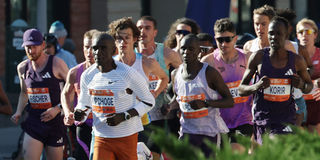
Kenya's Eliud Kipchoge in action during the New York City Marathon men's elite race on November 2, 202.

London
Climate change is narrowing the window for record-breaking performances at the world’s top marathons, according to new research released on November 1.
Concerned elite athletes say rising temperatures are reshaping the sport with some city marathons more impacted than others. Berlin’s event last month was raced in unseasonal temperatures of 75 degrees Fahrenheit.


A report by US-based non-profit Climate Central finds that 86 percent of 221 global marathons analysed on their 2025 dates are expected to see a decline in the odds of optimal running conditions by 2045, including all seven Abbott World Marathon Majors. The report was released a day before the 2025 New York City Marathon which was run on November 2.
The New York City Marathon was the last event in this season’s seven Abbott World Marathon Majors (WMM) races made up seven of the biggest and most prestigious marathon races. The other races in the series are Tokyo Marathon (March2), Boston Marathon (April 21), London Marathon (April 27), Sydney Marathon (August 31), Berlin Marathon (September 21) and Chicago Marathon (October 12).
Mhairi Maclennan, the fastest British female finisher at the 2024 London Marathon, said the findings reflect a growing challenge for elite runners.
“At the elite level, conditions make or break a performance,” Maclennan said. “We train day in, day out for years and manage every aspect of our lives to race our best, only for that elusive target to drift further away as ideal temperatures become rarer.
“Climate change isn’t just about races becoming harder; it’s about knowing that record-breaking performances could soon be out of reach if conditions keep getting hotter.”
The report identifies a ‘sweet spot’ for marathon temperatures that supports peak performance. For elite runners, men do best in cooler conditions (on average, 4 degrees Celsius or 39 degrees Fahrenheit) and women do better at warmer temperatures (10 C, 50 F).

Kenya's Hellen Obiri crosses the line to win the women's elite race at the New York City Marathon on November 2, 2025.
The report, however, warns that global warming is making those conditions increasingly hard to find.
Ideal temperatures
Tokyo currently offers the highest likelihood of ideal temperatures for elite male runners (69 percent), but is also projected to see the steepest decline by 2045. The 2025 Berlin and Tokyo Marathons were cited as examples of how heat waves have already pushed race-day temperatures beyond peak performance thresholds, although starting races earlier in the day can modestly improve conditions.
Former world record holder Catherine Ndereba said the sport was already adapting.
“Climate change has altered the marathon,” said Kenya’s Ndereba, a two-time world champion and four-time Boston winner. “Dehydration is a real risk, and simple miscalculations can end a race before it begins. Every step now carries a message — that if we don’t take care of our planet, even our strongest strides will fall short.”
Ibrahim Hussein, the first Kenyan to win both the New York and Boston Marathons, echoed the sentiment.
“The climate is part of the course now,” Hussein said. “If we don’t protect it, the records of the future and the enjoyment for all become less and less likely.”
Meanwhile, sprint great Carl Lewis says he does not think the controversial Enhanced Games will be successful and the American is not keen to lend it any oxygen either.
The Enhanced Games, which allows athletes to use performance-enhancing drugs to elicit ‘superhuman’ performances, has stirred the still water of traditional sports and attracted Olympic medallists such as American sprinter Fred Kerley and British swimmer Ben Proud. (Reuters)
“I don’t think it’s going to be successful,” nine-times Olympic gold medallist Lewis, who was in India as brand ambassador of last Sunday’s Vedanta Delhi Half Marathon, told Reuters.
“I just don’t think people want to abandon faith in things that are right just for the sake of performance. It’s not just about competing. Sports is about doing the right thing.”
Six-times world champion swimmer Kyle Chalmers turned down a “life-changing” sum of money to join the Enhanced Games, the Australian swimmer revealed last month.
The World Anti-Doping Agency has slammed the event as “dangerous and irresponsible”, while athletes who joined it have faced backlash from fans and administrators.
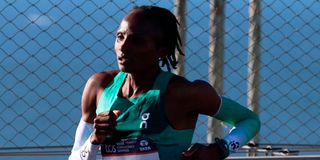
Kenya's Hellen Obiri competes the women's elite race during the New York City Marathon on November 3, 2024.
Enhanced Games has sued World Aquatics, USA Swimming and WADA alleging an illegal campaign to “crush” the event.
Lewis said it lacked “purpose and honour” and did not see it as a threat to the image or integrity of Olympic sports.
“I think we’re giving it more legs than it deserves,” he said.
Financially attractive
Lewis felt athletics at the top level was financially attractive and its leading athletes were less likely to fall to the lure of the Enhanced Games.
“There will always be people who’d like to do their own thing their own way and have their own motivation. Some people will be in enhanced sports not because of sports but because they think they can make money,” he added.
“The less oxygen we give to that subject and get that event, I think the more challenging it would be for them.”
The Enhanced Games have set their inaugural competition for May 2026 in Las Vegas, with athletics, swimming and weightlifting on the agenda.
Lewis’ collection of Olympic gold medals includes one stripped from drug cheat Ben Johnson at the 1988 Seoul Games.
The American was unsurprisingly pithy about why he thinks the Enhanced Games is a non-starter.
“I don’t think many athletes will compete,” he said.
“I don’t think any records will be broken because I don’t think the event is going to happen because I don’t think the money will be there because I don’t think people would support it.”
Follow our WhatsApp channel for breaking news updates and more stories like this.


