Hello

Your subscription is almost coming to an end. Don’t miss out on the great content on Nation.Africa

Ready to continue your informative journey with us?

Hello

Your premium access has ended, but the best of Nation.Africa is still within reach. Renew now to unlock exclusive stories and in-depth features.

Reclaim your full access. Click below to renew.

Robert Okaka
Caption for the landscape image:

Change tack or perish, boxer Okaka warns ‘Hit Squad’, peers

Scroll down to read the article

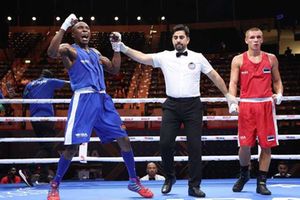
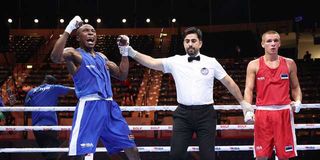
Robert Okaka of Kenya (left) celebrates after beating Vinogradov Anton of Estonia at the ongoing International Boxing Association (IBA) fight in Dubai.

Photo credit: File | Nation Media Group

Kenyan boxers must get international exposure and change tactics if they are to match opponents from the rest of the world, light heavyweight boxer, Robert Okaka has said.

Okaka, who on Wednesday lost to Russian Bizhamov Dzhambulat in the quarter-finals of International Boxing Association (IBA) Men’s World Championship in Dubai, has said the game has evolved and Kenyan boxers can no longer rely on power alone to win bouts on the international stage.
Okaka has said that the national boxing team, christened ‘Hit Squad’ will not thrive if the boxers continue competing only in Africa.

“I met a polished, intelligent and swift boxer in Dzhambulat, who used his reach to score. He didn’t have strong punches and was effective on scoring, but I struggled to reach my target,” two-time Africa bronze medallist Okaka said.

Okaka, 26, said Kenyan boxers must fight opponents in high caliber tournaments outside Africa to improve their approach in matches.

“Boxing has evolved globally. Boxers no longer use only power to win matches as we do in Kenya, and it’s from exposure that we can learn more.”

New Content Item (1)

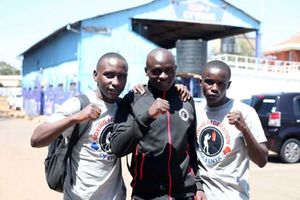
Kenya's 'Hit Squad' members at Chel'C Hotel in Nairobi before their departure on December 2, 2025, for International Boxing Association World Championship in Dubai.

Only three African boxers - Zambian duo of Patrick Chinyemba and Emmanuel Katemba, and Mali’s Djibril Traore - reached the medal bracket by storming the semi-finals of the championship held in Dubai.

The event attracted 428 boxers from 109 countries, among them 128 boxers from 34 African countries. Twelve boxers, among them Okaka, reached the quarterfinals.

Okaka became the first Kenyan to reach the quarter-final stage of a world championship since 1982. He earned Sh1.3m for the performance.

Okaka said he learnt a lot from the experience, and he is back to the drawing board ahead of next year’s Commonwealth Games. 

Experienced boxers

“I hope to fight at the 2026 Commonwealth Games, but my ultimate target is to qualify for 2028 Los Angeles Olympic Games,” Okaka, who was born and brought up in Jericho estate in Nairobi’s eastlands area, said.

Kenya’s Peter Abuti whose journey ended in the round of 32 when he lost to Toktosun Uulu Bakyt of Kyrgyzstan in the heavyweight contest, also echoed similar sentiments.

“His (Bakyt’s) southpaw stance really confused me but pick up from the second round, but it was already too late. I have boxed orthodox opponents the whole of my career,” said Abuti, adding that exposure to boxers with different stances is vital to an athlete.

“These are lessons…It was the first time I was meeting a southpaw. Perhaps it could have been different had I met many others before,” explained Abuti, who was making his second appearance at the championship.

Kenya’s head coach Benjamin Musa’s 13-man team to the championship had nine debutants.

“The target for the experienced boxers was to medal, which we didn’t achieve,” said Musa. 

“We needed them to show competitiveness, win, and advance further in the competition, which some did.”