A spectacular drones show, three course dinner, open bar and an open-air music concert at Dubai’s exquisite Emirates Golf Club brought the curtains down on the 23rd IBA Men’s World Boxing Championships here at the weekend with Russia dominating the two-week tournament’s finals.
An avocado-based Cold Mezze Platter for starters, Oriental Mixed Grill main course featuring Shish Taouk, Shish Kebab, Kofta Kebab alongside Oriental Rice and Orange Date Cake served with Caramel Ice Cream for dessert were on the menu on an unusually cool Dubai night as the International Boxing Federation celebrated its “Golden Era” with the sumptuous crowning of the 14 days of action on the lawns on the 36-hole golf club that combines the “Majlis” and “Faldo” courses.
Of the 13 gold medals on offer under the floodlights at the Dubai Duty Free Tennis Stadium some 25 kilometres away from the golf club, Russia, who had 12 finalists, panned seven gold medals in what turned up to be more of a Russian national championship than a global contest.
With $300,000 (Sh39 million) on offer for gold medallists, $150,000 (Sh19.5 million) for silver and $75,000 (Sh9.75 million), the boxers from Moscow banked a total of $2,925,000 (Sh380 million, of which the boxers will take half the amount with the remaining half shared at 25 percent each between the Russian Boxing Federation and the boxers’ coaches in the IBA’s new rewards structure at the tournament that attracted 428 boxers from 118 nations.
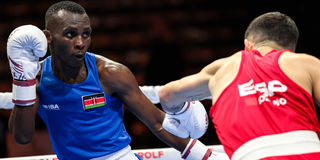
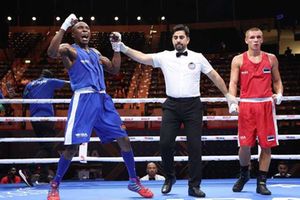
A ringside official on the Kenyan corner during light welterweight Caleb Wandera's fight against Lucas Mariano Villalba of Argentina during International Boxing Association Men's World Boxing Championship on December 6, 2025 at the Dubai Duty Free Tennis Stadium.
Photo credit: IBA
The new structure also sees all quarter-finalists earn $10,000 (Sh1.3 million) each.
“Hit Squad” light heavyweight Robert Okaka made the quarters, going home with Sh650,000 of the Sh1.3 million amount, the Boxing Federation of Kenya earning Sh325,000 and Head Coach Benjamin Musa and his corner taking Sh325,000.
Africa had three boxers in the semis, with Zambia providing two - flyweight Patrick Chiyemba and light welterweight Emmanuel Katema – with Mali’s middleweight Djibril Traore the third.
The Zambians lost in the semis to Russia’s Bair Batlaev and Kyrgyzstan’s Omar Livaza, respectively, while Mali’s Traore fell to Russia’s Ismael Mutsolgov.
Kenya has never won a medal at these championships since 1978, when Stephen Muchoki struck gold in the light flyweight division in Belgrade after having won silver at the inaugural edition in 1974 in Havana.
Kenyan boxing reached dizzy heights at the 1988 Seoul Olympic Games when Robert Wangila became Africa’s first gold medalist when he defeated Frenchman Laurent Boudouani in the welterweight final, with Chris “Bingwa” Sande bagging a bronze in the middleweight after losing in the semi-finals to eventual champion, Germany’s Henry Maske.
Before that, Kenya’s other Olympic medalists were Philip Waruinge (1968 bronze, 1972 silver), Dick Tiger Murunga (1972 bronze), Samuel Mbugua (1972 bronze) and Ibrahim “Surf” Bilali (1984 bronze).
Since the Seoul success, Kenya hasn’t stepped onto the Olympic boxing podium with the sport’s standards having plummeted courtesy of lack of equipment and training venues, compounded with technical challenges that have seen Kenyan boxers fail to adapt to the modern computer scoring system.
Filipino boxing legend Manny “PacMan” Pacquiao at the IBA Congress in Dubai on December 13, 2025.
Photo credit: IBA
Famous boxing training venues such as Nairobi’s Muthurwa Social Hall, popularly known as “Dallas”, where the late Wangila honed his skills, Kaloleni Social Halls, Nakuru’s “Madison Square Garden”, Makongeni Social Hall remain dilapidated while recreational facilities in the city’s working-class estates, such as Jericho, Kariokor, Pumwani, Ziwani, Bahati, Shauri Moyo, to mention but a few, have either been grabbed or converted to commercial use.
Besides the death of these once-famous boxing talent factories, the demise of top-class competition among corporates also contributed a great deal to the sport’s falling standards.
In the 1970s through to the early 1990s, for instance, the state corporations’ KECOSO (Kenya Communications Sports Organisation) Games drew talented boxers from parastatals such as Kenya Railways, Kenya Posts and Telecommunication Company (now Postal Corporation of Kenya), Kenya Airways and Kenya Ports Authority.
This is where Kenyan internationals, including 1984 Commonwealth heavyweight champion Ahmed Omar Kasongo, 1987 All Africa Games light welterweight champion David “DK” Kamau, heavyweight Olympian Harold Obunga (all Postal Corporation of Kenya) and Kenya Railways’ middleweight Alois “Les Les” Muiruri, polished their craft.
Kenya Breweries Limited was also a credible nursery for Kenya’s elite boxers, including Wangila, 1987 All Africa Games Medalists John “Duran” Wanjau, Patrick “Mont” Waweru, Mohammed “Body” Orungi, Ibrahim “Surf” Bilali, Chris Odera, Maurice Maina, alongside David “Giant” Anyim and Joseph Akhasamba.
Reduced sports budgets following the early 1990s’ Structural Adjustment Programmes virtually killed boxing in the corporations through reduced funding for sports, while blue-chip companies like KBL also felt the financial burden, leaving only the Police and Kenya Defence Forces consistent with support for the sport.
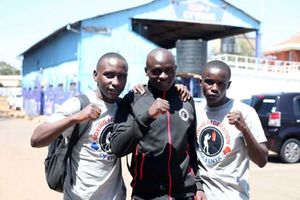
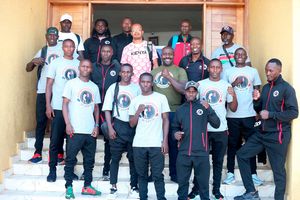
But with the current “Hit Squad” that did duty in Dubai, a fine blend of youth and experience, coach Benjamin Musa believes there’s hope, but more work to be done ahead of the qualification process for the Los Angeles 2028 Olympic Games with the boxers requiring more ring time and technical support.
“It was a great experience, especially for the debutants who showed good maturity, composure, resilience and competitiveness. We had modest success in the championship, where we won some bouts, advanced further and got into the prize money bracket. It was a great exposure for our team, too,” Musa said.
International Boxing Federation President Umar Kremlev addresses the IBA Ordinary Congress in Dubai on Saturday, December 13, 2025.
Photo credit: IBA
“We need a year-round strength and conditioning training as opposed to during camps only, and for consistency, we need to have many training camps with the more established boxing nations and more international exposure to improve our ring craft and ring generalship,” the coach added.
A weak national league and nonchalant rewards scheme for boxers haven’t made things any easier, with the Boxing Federation of Kenya struggling to garner sponsorship for their programmes.
“The league can be more exhilarating if incentives for winners are introduced,” the federation’s Secretary General, David Munuhe, concedes, but adds that since they took office, they have been pushing to build capacity and focusing on talent development.
“Courses for coaches, referees and judges have been conducted several times, and we have more international officials now. There is a junior and youth programme that happens every school holiday to tap new talents.”
At the Dubai Championships, “One Man Ngori” Okaka became the first Kenyan to reach the quarters since Ibrahim “Surf” Bilali and Kenya Breweries fighter Hussein “Juba” Khalili at the Munich edition in 1982.
Okaka believes Kenya should focus on technique more than brute “ugali” force to keep up with the Joneses.
“They are more skilled here, and it needs focus to counter these opponents… in Africa, it’s about using the power of “ugali” - brute force - but here they use power and skills. We have tried as Team Kenya, and its good we made it to the quarters. We now need more skills to box beyond Africa. With better skills, we shall certainly perform better,” he observed after his loss to eventual champion Dzhambulat Bizhamov of Russia.
Also, while Kenyans are part-time boxers, their opponents here box full time for a living, a factor that also placed the “Hit Squad” as a disadvantage.
Cruiserweight Chrispine Ochanda, who lost to Andrei Chiriakov of Moldova in the preliminaries, is a gym instructor in Eastleigh, Nairobi, while featherweight Paul Omondi only took up the sport after getting tired of being bullied in Kibra, and minimumweight Silas Onyango is a boda boda rider in Dandora.
“I’ll have to balance between training time and work so that I can be somewhere, because work is important as that’s where I eke out my living,” Ochanda observed.
“I’m grateful to God because this is the first time I’m at a World Championship and I aimed to come here and put up a good show – I didn’t want to come all the way from Kenya to fail,” Omondi reacted after his bout that had students from Nairobi’s Light International School, Lavington, on a study tour here, cheering at ringside.
Boda boda rider Onyango, who depends on a hired motorcycle to eke out a living, hopes he can stabilise financially to fully focus on the sport. He was outpointed by Sri Lanka’s Danil Hasika Tissaaratchy in the Round of 32 here.
“The allowances that I’ve earned out of this tournament will help me take care of my family, as nothing is coming through at the end of the month, and I need to pay for house rent and other needs,” Onyango appreciated.
Boxing Federation of Kenya President Anthony “Jamal” Ombok Otieno was at the Dubai championships and attended the IBA Ordinary Congress where IBA boss Kremlev announced a new “World Cup” team event with a prize purse of $10 million (Sh1.3 billion) and continental competitions with a prize kitty of $1 million (Sh130 million) each, incentives that will hasten the “Hit Squad” trip back to the drawing board.
Ombok also hopes his grassroots “Ndondi Mashinani” initiative will help spur the revival of Kenyan boxing.
‘Hit Squad’ full results at the IBA Men’s Word Boxing Championships:
Minimumweight, 46-48kgs: Sylus Onyango lost to Danil Hasika Tissaaratchy (Sri Lanka);
Flyweight, 48-51kgs: Kelvin Maina Michira lost to Daniyal Sabit (Kazakhstan);
Bantamweight, 51-54kgs: Shaffi Bakari lost to Rafael Lozano Serrano (Spain);
Welterweight, 63.5-67kgs: Wiseman Kavondo lost to Hovhannes Bachkov (Armenia);
Middleweight, 71-75kgs: Edwin Okongo lost to Kapuler Ishchenko Miroslav (Israel);
Cruiserweight, 80-86kg: Chrispine Ochanda lost to Andrei Chiriakov (Moldova);
Heavyweight, 86-92kg: Peter Abuti lost to Bakyt Ululu Toktosun (Kyrgyzstan);
Super heavyweight, 92kgs plus: Clinton Macharia lost to Smiahlikau Uladzislau (Belarus)
Light welter, 60-63.5kgs: Caleb Wandera lost to Lucas Mariano Villalba (Argentina);
Light Middleweight, 67-71kgs: Boniface Mogunde lost to Sarkan Aliyev (Azerbaijan);
Lightweight, 57-60kgs: Washington Wandera lost to Matvejs Prokudins (Latvia);
Featherweight, 54-57kgs: Paul Omondi lost to Armando R. Sigauque; (Mozambique);
Light heavyweight, 75-80kgs: Robert Okaka lost to Bizhamov Dzhambulat (Russia).