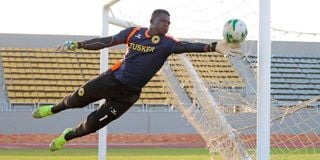
A goalkeeper diving to save a shot is the archetypal image of football’s loneliest job. Even Google agrees. Search “goalkeeper” on Google and the page will load with hundreds of images of goalkeepers in a myriad of diving poses.
Some dives have taken an iconic status in the sport and epitomise goalkeeping excellence. Think of England’s Gordon Banks diving low to his right to deny an already jubilant Pele when England played Brazil in a 1970 Fifa World Cup group stage match that the Selecao won 1-0. The save, a fingertip flick of a downward header over the bar, is widely regarded as the “save of the century”.
For contemporary football fans, there are few saves that can be as enthralling as former Manchester United goalkeeper David De Gea saving a top-corner bound free kick from his Spanish compatriot Juan Mata when Chelsea drew 3-3 with the Red Devils in an English Premier League match that was played at the Stamford Bridge on February 5, 2012.
Manchester United goalkeeper David de Gea dives to save a shot from Arsenal's German-born Bosnian defender Sead Kolasinac during an English Premier League match at the Emirates Stadium in London on December 2, 2017.
Photo credit: AFP
Beyond its excellence, the save sparked passionate talk among goalkeeping enthusiasts on De Gea making the save using his top hand. De Gea had dived high to his left but he used his right hand to make the save, demonstrating mystifying athleticism that elevated his diving technique to a work of art.
Saves like those of Banks and De Gea illustrate why a goalkeeper diving to save a shot is a sight to behold. Yet, when the effort is futile, questions always arise on their diving technique, timing, and the hand they tried to use to make the save.
Such questions suggest that beyond the artistic beauty of goalkeeping diving, there is science behind it and, a goalkeeper diving to make a low hand or top hand save is a matter of preference, rather than prescribed practices which goalkeeping aficionados frequently preach about.
“Use the top hand to save high shots to the sides. Use the low hand to save low and medium-height shots to the sides,” so goes a guideline that is oft-touted as a fundamental tenet of diving in goalkeeping.
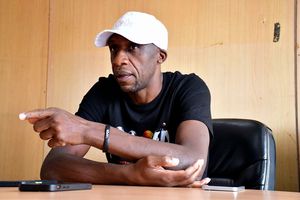
However, insights from goalkeeping coaches Moeneeb Jacobs of Harambee Stars and Wilson Obungu of Sofapaka render the principle unreliable in practice because of the dynamic challenges that goalkeepers encounter in the line of duty.
Wilson Obungu in action during a Kenyan Premier League match between Sofapaka and Sony Sugar at Nairobi City Stadium on October 23, 2009.
Photo credit: File | Nation Media Group
“It is all down to split-second decisions that goalkeepers make before attempting a save,” Jacobs, a former South Africa and Orlando Pirates goalkeeper, says.
“They just use the hand that gives them the longest reach,” Moeneeb adds as he demonstrates goalkeeping postures and scenarios that prove a point explained by Obungu.
“The decision to make a top hand or low hand save depends on the speed of the ball and the goalkeeper’s posture and position when the shot is taken,” Obungu says.
“Position and posture influence which of the goalkeeper’s feet has his power step. The power step is what generates the leap for the dive. The speed of the ball makes a goalkeeper decide quickly which hand will give him a better reach. In the end, those factors determine whether he will make a low hand or top hand save,” Obungu adds as he provides more insight on the factors that inform the split-second decisions goalkeepers make.
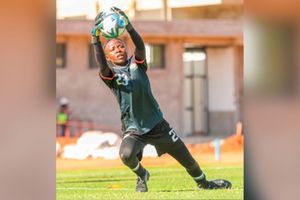
The views of Kakamega Homeboyz goalkeeper Edwin Mukolwe, who has kept two clean sheets in three SportPesa League matches this season, align with the insights shared by Jacobs and Obungu.
Perfecting diving techniques
“Theoretically, I am supposed to save high shots using my top hand and use my low hand to stop low and medium height shots. However, in match situations, it is instincts, and not theoretical knowledge, that prevails. The ball can swerve, take an awkward bounce, or get deflected when I am mid flight. That alone can force me to switch the hand I will use to make a save,” Mukolwe says.
Mukolwe further describes diving as an action that fully tests the limits of a human being’s range of motion.
“Diving is a physically demanding activity and beyond perfecting technique, there is also focus on practising safe landing to reduce risk of injury,” Mukolwe says.
Emphasising on the significance of perfecting diving techniques, Jacobs says: “A lot of focus should go into technique, not just making a save. Good technique is important and it must be trained all the time so that it becomes a habit. A goalkeeper can make a save but if they do bad habits, they fail to stop a goal in some situations because their technique is poor.”
Commenting on safety of goalkeepers during diving, Obungu states that goalkeeper trainers should ensure their goalkeepers are properly dressed and also ensure that practice is done on safe ground.
Sofapaka goalkeeper Wilson Obungu dives to make a save during a Kenyan Premier League match at Nairobi City Stadium .
Photo credit: File | Nation Media Group
“It is unfortunate that in Kenya we do not have many good pitches for playing and training. That poses more risk of injury to goalkeepers,” he says.
“Their surface is artificial and that makes landing after dives harder than on a natural playing surface. Goalkeepers also spend a lot of time squatting and leaping and doing so on artificial surfaces increases load on ankle and knee joints. This issue of unsafe pitches really needs to be looked into,” Mukolwe says before adding that even though goalkeepers are adequately trained to land safely after diving, they still absorb a lot of impact after landing on the ground.
In his autobiography One, former Denmark and Manchester United goalkeeper Peter Schmeichel estimated that goalkeepers dive 6,000 to 7,000 times in a year, absorbing impacts that leave them feeling pain for days. Schmeichel also laments about being unable to do some physical activities because of pain to his back, shoulders, and spine.
Mukolwe is wary of such hazards of goalkeeping. “There are days I get home and sleep until the following day because my body is sore. I also take ice baths to reduce soreness after a day of throwing myself to the ground,” he says.
Jacobs and Obungu also understand those risks and say they can be reduced by goalkeeper trainers scheduling practice sessions of their goalkeepers properly.
“Training sessions for goalkeepers are very intense. After such sessions, you will see us walking funny the following day because of the pain we are in,” Jacobs says.
“You never want your goalkeeper to be in pain on match day. Therefore, training sessions for goalkeepers should be scheduled in such a way that its intensity reduces as match day approaches. It should incorporate sessions for fitness, tactical, and technical training, and recovery,” Obungu says.
Ultimately, a goalkeeping diving to save a shot will remain the illustrative image of the playing position. Yet, behind and beyond those few seconds of fame, there will be hours of pain and sweat that will always stay out of focus.