Kenya, Tanzania, and Uganda are back to the drawing board after suffering quarterfinal exits in 2024 African Nations Championship (Chan), the competition they are co-hosting.
Their losses to Madagascar, Morocco, and Senegal respectively showed that they still have a lot of work to do before dominating African football.
As they review their performance in the competition, reading Simon Kuper’s and Stefan Szymanski’s book ‘Soccernomics’ can provide lessons on how they can rise to dominate the sport in the near future.
In the book, Kuper and Szymanski share fascinating insights to explain why some nations are better at football than others. They attribute the dominance of successful football nations to a combination of two of the following three factors: a high population, a high national income, and a robust football network.
Having a high population, Kuper and Szymanski argue, means a large pool to draw football talent from. A high national income translates to increased ability to fund football development, and a robust football network means having access to information and knowledge about current and transformative best practices and trends in the sport.
Borrowing from their observation can create a basis for explaining why East African countries struggle at football – Kenya, Uganda, and Tanzania lack a robust football network and have not invested enough in football development. The three countries are currently co-hosting Chan 2024 and are also the hosts of Afcon 2027. Their quarterfinal exits at Chan 2024.
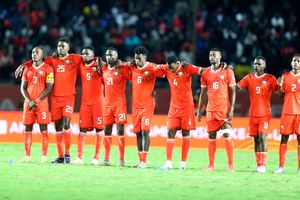
Ugandan players celebrate at the final whistle after holding South Africa to a 3-3 draw in their final Group 'C' match of the 2024 African Nations Championship at Nelson Mandela National Stadium in Namboole, Kampala, on August 188, 2025.
Photo credit: Pool
Looking at it theoretically, on population alone, the trio should be qualifying for every edition of the African Cup of Nations and the Fifa World Cup. Per the United Nations’ World Population Prospects data for 2024, Kenya (7th), Tanzania (5th), and Uganda (9th) rank in the top 10 of Africa’s most populous countries with estimated population figures of 55.3 million, 66.6 million, and 48.6 million people, respectively.
The fact that Afcon has been a 24-team competition since 2019 means that three countries are not maximising on the potential of their population to dominate African football. The region has combined for only six appearances at Afcon since 2019 instead of 12.
The three countries competed at 2019 Afcon before watching 2021 Afcon on TV. Tanzania then bounced back to secure back-to-back qualification to 2023 Afcon and 2025 Afcon. Uganda ended a six-year hiatus by joining Tanzania in qualifying for 2025 Afcon. Kenya will not make an appearance in the competition until 2027 on home soil when they co-host the tournament with Uganda and Tanzania.
Also, the fact that starting from 2026 Africa is guaranteed nine automatic qualification slots at the Fifa World Cup means that the three East African countries should be easily claiming three of those tickets. However, looking at the current 2026 Fifa World Cup qualifier standings, Kenya is virtually out of contention while Tanzania and Uganda carry remote hopes of qualifying through the play-offs.
Looking at the International Monetary Fund’s ranking of African economies by their 2025 estimates for the Gross Domestic Product (GDP) of African countries, qualification for every edition of the African Cup of Nations should still be comfortably within reach of Kenya, Uganda, and Tanzania.
The IMF ranks Kenya, Tanzania, and Uganda as having Africa’s 6th, 11th, and 13th best performing economies, respectively, meaning that Kenya also ticks two boxes for being regulars at the Fifa World Cup.
Evidently, Kenya, Tanzania, and Uganda have populations that can sustain football dominance. However, their biggest challenge towards achieving this has been their continuous failure in making the strength of their economies, at least by African standards, work in their favour in ticking the third box – creating a robust football network.
Tanzania’s Mohamed Hussein Zimbwe (right) plays against Madagascar in Group ‘B’ match of 2024 African Nations Championships at Benjamin Mkapa National Stadium in Dar es Salaam on August 9, 2025.
Photo credit: Mwananchi
Geographically, East Africa is isolated from nations that are leaders in information and knowledge about the best practices in the growth and development of football. For context, Kenya shares a border with Ethiopia, Somalia, South Sudan, Tanzania, and Uganda. Out of these five countries, neither has competed at the Fifa World Cup and only Ethiopia has won Afcon (in 1962), while Somalia and South Sudan have never competed at Afcon. In fact, Somalia, ravaged by war, has never played a home match since October 1985.
Further, Kenya’s neighbours also share borders with few countries that are known for their football prowess. Also, most of those countries have been affected by wars and humanitarian crises.
Looking at the ranking of African countries by their population and GDP, shows how much Kenya, Tanzania, and Uganda have been disadvantaged by their isolation from strong footballing nations, hence hindering the easy transfer of information and knowledge that can accelerate the development of their football.
There are 16 African countries with a population of more than 30 million people. Out of those, only Angola, Kenya, Madagascar, Mozambique, Tanzania, and Uganda have never won Afcon. Excluding southern Africans Angola, the other five countries are on the eastern side of Africa. Looking at World Cup qualification, the latter five in that list of the odd-ones out are joined by Ethiopia and Sudan, who, obviously, are in eastern Africa. Angola featured at the World Cup in 2006.
The list of Africa’s best-performing 16 economies tells an almost similar story. Among them, only Angola, Kenya, North Africans Libya, Tanzania, and Uganda have never won Afcon. When it comes to World Cup qualification, the list remains with five countries as Angola makes way for Ethiopia.
If anything, out of the 15 countries that have won Afcon and the 13 African countries that have qualified for the Fifa World Cup, Senegal and South Africa are the only ones that do not share a land or maritime border with an Afcon winner or a country that has qualified for the World Cup. Senegal ranks 25th in Africa in terms of population and 18th in terms of GDP but its location in West Africa and relations with its former colonial master, France, has enabled it to establish networks that have furnished them with knowledge to grow and develop their football.
In the countries it colonised, the French applied the policy of assimilation. That contributed to countries under their dominion having closer ties with France and establishing a diaspora in Europe. The Senegalese diaspora in France and Europe has contributed to the growth and development of football in Senegal through the transfer of knowledge and expertise. East African countries, who were colonised by the British, could not establish such connections and networks as a result of the British’s divide and rule policy.
Still, South Africa, who were isolated from African football until 1992 during the final days of the Apartheid policy, have invested heavily in sports infrastructure and acquisition of knowledge.
Strong footballing nations
Already, years of isolation from strong footballing nations, has seen Kenya, Tanzania, and Uganda, and their leading football clubs, hiring foreign coaches. In recent years, particularly in the case of Kenya, fielding players of Kenyan descent born abroad is slowly becoming the norm as the three countries hope to bridge the gap in talent between them and dominant football nations in Africa.
South Africa is a case study on how the three East African countries can use the strength of their economy to improve their sports infrastructure and invest in knowledge and expertise that can grow their football. In a way, that would mean the three countries investing in foreign connections and networks to build the capacity of their local coaches and technical bench officials as well as improve their sports infrastructure.
That will create more local experts who will continuously create new knowledge to develop the sport. The creation of new knowledge will attract focus on East Africa and as a result, the establishment of more connections and networks with strong footballing nations.
The profiles of most Afcon-winning and World Cup-winning nations show that a country is as good at football as its neighbours. Kenya, Tanzania, and Uganda can maintain the rivalry on the pitch but off it, they should work together to create connections and networks that can help them grow the region’s football.
This process will definitely require funds but, by African standards, the three countries have economies that can support that process. Otherwise, their relatively high populations will continue to make East Africa the hub of untapped football talent.