Kenyan top flight football clubs, it appears, are proficient in the language of announcing the sacking and hiring of coaches. Going by an analysis of 151 managerial changes that have taken place in the Kenyan Premier League since 2015, it would not be far-fetched to believe the clubs keep a managerial-change template document in their stationery.
The phrase ‘coaches come and go’ has normalised Kenyan clubs’ appetite for firing and hiring coaches. The 2025/26 season is barely a month old and Bandari FC have already exercised an apt use of that saying, announcing two managerial changes in just one week.
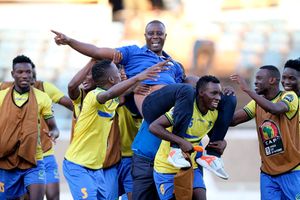
They sacked Ken Odhiambo on Tuesday and unveiled his replacement, Moroccan Mohammed Borji, on Monday. In between, former Harambee Stars striker John Baraza served as the interim coach, delivering the club’s first league victory in six months when they beat visitors Murang’a Seal 3-1 on Saturday.
Moroccan national Mohamed Borji when he was unveiled as the new head coach of Bandari FC on October 6, 2025.
Photo credit: Kevin Odit | Nation Media Group
One more managerial change will see Bandari join AFC Leopards (2018 and 2020/21), Gor Mahia (2024/25), Kenya Police (2023/4), Mathare (2022/23), and Muhoroni Youth (2017) in making three appointments in one season.
Gor’s three managerial changes in the 2024/25 league season were among 17 witnessed in that period. Only the 2023/24 (16), 2018 (14), and 2018/19 (13) seasons came close to seeing as many changes.
The changes analysed focus on the coaches that the current top flight clubs have hired and released since the start of the 2015 season. Managerial changes that took place when a club was playing in the second tier were only considered in cases where a club was relegated then promoted to the top flight during that period, like in the case of Kakamega Homeboyz, KCB, Mathare United, and Posta Rangers.
Over that period, Bidco United (promoted in 2020) and Kariobangi Sharks (promoted in 2017) are the only clubs to have stuck with one coach since earning promotion to the top flight. William Muluya is almost clocking a decade as coach of Kariobangi Sharks after joining the club in June 2016.
Kariobangi Sharks coach William Muluya with his players before pre-season friendly match against Bidco FC at Camp Toyoyo ground in Nairobi on August 27, 2022.
Photo credit: Chris Omollo | Nation Media Group
Anthony Akhulia has remained at Bidco United since June 2017. Beyond those clubs, with the exception of Shabana, coaches seem to last longer at corporate teams and community clubs with a fan base. Mathare United leads in proving that patience is not just a girl’s name in Zimbabwe. On average, a Mathare United coach spends 408 days at the club before being shown the door.
The league average in that regard is 305 days and including the three aforementioned clubs, only Ulinzi Stars (382 days), Tusker (360 days), KCB (346 days), Shabana (329 days), Posta Rangers (328 days), Sofapaka (315 days), Bandari (311 days), and Kakamega Homeboyz (310 days) lie above the mean.
It is not surprising that Gor Mahia (221 days), AFC Leopards (205 days), and Kenya Police (194 days) lie below the mean. Coaches are under more pressure to perform at those clubs owing to their history and mass following (in the case of AFC Leopards and Gor Mahia) and financial backing.
Those factors perhaps explain why Leopards and Gor have had the most managerial changes – 18 each – since 2015. Bandari (15 coaches) and Sofapaka (14 coaches) also rank high in that list. Tusker FC (with eight coaches appointed in 10 years) is the most stable club for a Kenyan Premier League coach. KCB follows with 10 appointments in as many years.
The high turnover of coaches at Leopards and Gor has led to the coining of jokes such as, ‘Always Firing Coaches’ (meaning of AFC’s initials), and ‘a Gor Mahia coach must invest in good running shoes just in case he will need to out sprint irate K’Ogalo fans.’ Kenya Police have had eight coaches since earning promotion to the top flight in 2021, a joint-record with Gor for the number of managerial changes that have taken place since then.
Kenya Police’s coaching changes attest to the ambitions of a restless management that demands trophies after funding the club to the tune of over Sh100 million per season.
Some changes have occurred due to coaches resigning over pay disputes. This has seen clubs such as AFC Leopards, Gor Mahia, and Sofapaka being reported to Fifa by foreign coaches that they had hired. These coaches usually have short stints than native coaches, who are likely to tolerate tough working conditions that include financially constrained clubs.
On average, foreign coaches have lasted 257 days at a club, compared to 322 days for Kenyan ones. Belgian Patrick Aussems is the longest serving foreign coach in the period under review. He spent 881 days at Ingwe. He later won a Sh20 million payout case against the club he filed with Fifa over breach of contract.
Tusker FC coach Robert Matano shouts instructions at his players during a KPL match with Gor Mahia at Ruaraka Grounds in Nairobi on July 8, 2021.
Photo credit: Sila Kiplagat | Nation Media Group
Besides Akhulia and Muluya, Kenyan coaches who have spent at least 1,000 days at a club are Robert Matano (2,277 days at Tusker and 1,010 at Ulinzi Stars), Zedekiah Otieno (1,494 days at KCB), Stanley Okumbi (1,357 days at Mathare), Francis Kimanzi (1,319 days at Mathare), and Twahir Muhiddin (1,238 days at Bandari).
As evidenced by Mathare (three changes in 2022/23) and Muhoroni Youth (three changes in 2017), the threat of relegation can lead a club to changing its technical bench several times in a season.
Interestingly, some coaches lost their jobs after their replacements had been Trojan-horsed as technical directors or assistant coaches. For instance, Mwalala Mwalala replaced Muyoti Muyoti at Kakamega Homeboyz in August 2021 after first being appointed as the latter’s assistant.
Still, looking at the 151 managerial changes analysed, another interesting pattern emerges – that of certain coaches who are always on the move and others who have been consigned to be interim coaches or fire-fighters.
John Baraza (seven appointments), John Kamau (six appointments), Ken Odhiambo (five appointments), Sammy ‘Pamzo’ Omollo (six appointments), and Zedekiah Otieno (six appointments) are the kings of the Kenyan Premier League coaching merry-go-round.
Baraza has been interim coach at two clubs – Bandari and Sofapaka. Kamau has been in and out of Mathare United twice, and also at Posta Rangers. Omollo is Posta Rangers’ prodigal son – they have appointed him thrice. Odhiambo has had four stints at Bandari, as many times as Twahir Muhiddin.
At Ulinzi Stars, managerial changes are presented as military deployments which have on numerous occasions seen Danstan Nyaudo and Benjamin Nyangweso replacing each other, or others, as coaches.
The CAF ‘A’ coaching licence has also made some coaches like Anthony Kimani, Salim Ali, and Sammy Omollo more marketable. Clubs having CAF assignments have occasionally turned to them to stand on the touchline on behalf of their actual coaches.
Ultimately, Bandari’s sacking of Odhiambo has kicked off yet another season of the managerial merry-go-round spinning hard in Kenyan top flight football.
Before Bandari sacked Odhiambo, the grapevine was rife with speculations of three other clubs contemplating sacking their coaches after a poor start to the 2025/26 season. Only time will tell how those coaches will fare in the coaching musical chairs game when the music stops.