Jack Oguda, the Chief Executive Officer of Kenya Premier League, was born left-handed but a pangram made him right-handed.
A pangram is a sentence that uses every letter of the alphabet at least once. They are used to demonstrate the appearance of fonts, aid typing practice on QWERTY keyboards, and improve handwriting.
The most well-known pangram is the phrase, “the quick brown fox jumps over the lazy dog”. It is that pangram that made Oguda right-handed.
His father, former Luo Union right-back Alex Oguda, appreciated the importance of having a neat handwriting and he purposed to make his six children ambassadors of elegant cursive script.
Jack Oguda, the Chief Executive Officer of Kenya Premier League.
Photo credit: File | Nation Media Group
As such, handwriting attained a dominical status in the Oguda household and its practice as a Sunday tradition in their home came with some dos and don’ts, all strictly enforced by the Senior Oguda, whom his children affectionately call “Alex the Lion”.
Every Sunday, without fail, under their father’s supervision, Jack and his siblings undertook a handwriting exercise which involved writing “the quick brown fox jumps over the lazy dog” several times.
Their writing had to imitate a sample handwriting provided by their father and while drilling its mastery, the Senior Oguda always urged Jack to write with his right hand.
“Write with your right hand,” Oguda, with laughter, recalls his father instructing him back then.
As such, that handwriting exercise ended up suppressing dominance of his left-hand, leaving him with mixed laterality of handedness and footedness.
Mixed laterality, or cross dominance, describes a situation where a person’s dominant ear, eye, foot, and hand are not on the same side of their body.
In Oguda’s case, he is right-handed despite being left-footed and there are many other former and current footballers who exhibit that, or a similar phenomenon.
Like Oguda; Ashley Cole, Gareth Bale, David Silva, Iker Casillas, Lionel Messi, Patrice Evra, Raul, Robin van Persie, Ryan Giggs, among others are left-footed footballers who are right-handed.
Left-footed but right-handed (from left): Gareth Bale, Lionel Messi and Ashley Cole.
Photo credit: File Pictures
That list can also include the Late Diego Maradona. Even though he did not have a football career like those mentioned, Oguda is well remembered for scoring Mathare United’s winning goal in their 2-1 victory over AFC Leopards in the 2000 Moi Golden Cup final.
Other footballers like Cesc Fabregas, Franck Ribery, Kevin de Bruyne, Rio Ferdinand, and Ruud van Nistelrooy mirror the phenomenon by being right-footed footballers who are left-handed.
Right-footed but left-handed (from left): Rio Ferdinand, Franck Ribery and Cesc Febregas.
Photo credit: File Pictures
The exhibition of cross dominance by footballers tends to fascinate football fans as the general assumption always is that a player’s dominant hand is on the same side of their body as their dominant leg. It always leaves them wondering what brought about their cross dominance.
Oguda’s case is one that can be easily explained by reference to numerous studies that have documented the perception of left-handedness in Africa and Asia cultures and Christian and Islamic religions.
In those cultures and religions, there are activities that are looked down upon when done with the left hand. These include eating, giving a handshake, and handing over money or an item.
Cultural and religious norms
However, it must be noted that Oguda did not explicitly attribute his right-handedness due to his father wishing to uphold cultural and religious norms.
Still, however much culture and religion can be relied upon for plausible explanations on an individual being right-handed but left-footed; they offer no refuge in some cases.
Two of such cases are those of Shabana right-back Nicholas Meja and his brother, FC Talanta left-back Herit Mungai.
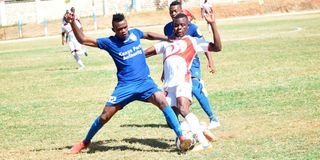
Omar Moussa (right) of Sofapaka tussles for the ball with Herit Mungai of Posta Rangers during a Kenyan Premier League match at Machakos Kenyatta Stadium in Machakos County.
Photo credit: Chris Omollo | Nation Media Group
Meja is left-handed but right-footed while Mungai is a left-footed footballer who writes with his right hand.
Both state that there is no special reason for their cross dominance. Their mixed laterality came naturally to them.
“I have always been this way. I play football with my right foot and do everything with my left hand, including eating,” Meja, the elder of the two, says.
“My right foot is not that weak. I use it for passing but I cross and shoot with my left foot,” Mungai says before adding that it was his brother who encouraged him to use his left foot more.
Sofapaka goalkeeper coach Wilson Obungu, who knows the two players well, described their situation as “crazy”.
However, a conversation with him unearthed another theory that could explain cross dominance in footballers, particularly wingers and fullbacks.
For instance, a player may opt to become a left-back or a left winger if they struggle to assert themselves at right-back or right wing due to stiff competition. Hence the switch forces them to use their left foot more and if they are right-handed, they start to manifest cross dominance.
Gor Mahia chairman Ambrose Rachier is one who would have manifested cross dominance for such a reason had his switch to left back materialised in him becoming a left-footed player.
Gor Mahia FC chairman Ambrose Rachier casts his vote during the club's elections for new office bearers at Nyayo National Stadium in Nairobi on April 13, 2025.
Photo credit: Chris Omollo | Nation Media Group
“I used to play left back, but I always used my right foot because my left foot was not effective enough,” Rachier, who starred in the position for his school teams at the Alliance High School and the University of Madagascar, says.
“I played left back because there were no natural lefties to play in that position,” he adds.
With the two theories proving inconclusive, one can be nudged to believe that medicine and science can provide definitive reasons for cross dominance in individuals. However, that is not really the case.
Robert Okinyi Tabu, a neurosurgeon finds the phenomenon fascinating but not one that can interest neurosurgeons as it has “no clinical significance” for their medical specialty.
Neurosurgery is mainly concerned with diagnosis and treatment of diseases or disorders of the nervous system. Cross dominance is not one of them.
Boaz Rop, a neurophysiologist, considers the phenomenon as food for thought for his area of medical specialty. He describes the situation as “niche”, one that is only manifested by few people in a population.