Rwanda’s capital, Kigali, will provide a very familiar setting for Kenya’s first ever meeting with Estonia in football.
It will seem home away from home for coach Benni McCarthy’s Harambee Stars as they take on the northern European nation in a 2026 Fifa Series match from 7pm on Friday (Kenyan time)at the renovated Amahoro Stadium.
The winner of the match will play the winner of the fixture between hosts Rwanda and Grenada in the final of the four-team friendly tournament on Monday at the same stadium. The final will be preceded by a third-place playoff between the losers.
The match against Estonia will mark Kenya’s 17th visit to Kigali. The previous 16 matches – consisting of 1999 and 2001 Cecafa Senior Challenge Cup matches and other encounters against Rwanda and South Sudan – yielded nine wins, five draws, and two losses for Harambee Stars.
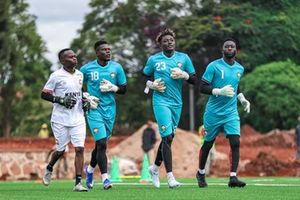
Harambee Stars physiotherapist Musa Hamisi leads players in a work-out during their training session at the Nyayo Stadium, Nairobi, on November 11, 2025.
Photo credit: Chris Omollo | Nation
Harambee Stars head to tonight’s encounter having lost their past three matches, the last of which was a humiliating 8-0 loss to Senegal in a friendly match played in November 2025 in Turkey.
“Obviously, the last game, that was not Kenya,” Harambee Stars coach Benni McCarthy said on Monday of how Harambee Stars played against the Lions of Teranga.
"The South African, speaking at the Nyayo National Stadium ahead of Harambee Stars’ first training session for tonight’s fixture, further described Harambee Stars’ squad for that match as “experimental”.
The loss to Senegal was Harambee Stars’ worst defeat since losing 9-0 to Zambia in 1978, prompting McCarthy to vow, “from that mistake, we do not want to experiment again with young and new players.”
“These friendly matches give us an opportunity for us to rectify and make people forget about our last match because we are as good as our last match,” McCarthy added.
As far as a team being as good as its last match is concerned, Estonia arrived in Rwanda on the back of a 4-2 friendly win over Cyprus in November. That victory ended a seven-match winless streak for the Blueshirts, as the Estonian national football team is popularly known.
Estonia, ranked 15 places lower than Kenya at position 128 in the latest Fifa rankings, will be playing an African team for the sixth time in their history.
Their first two such meetings ended in stalemates against Egypt (2-2 in 1998 and 3-3 in 2001) before securing wins Equatorial Guinea (3-0 in 2009) and Angola (1-0 in 2009).
Their last meeting against an African team ended in a 3-1 loss against Morocco in 2018. The match against Harambee Stars’ will be Estonia’s second on African soil. Their first such outing was in Egypt in 2001.
Despite the lack of previous meeting between Kenya and Estonia, Estonia’s goalkeeper coach, Mart Poom, may strike as a familiar face to Harambee Stars coach Benni McCarthy. Mart Poom featured in the English Premier League for Arsenal, Derby County, and Sunderland.
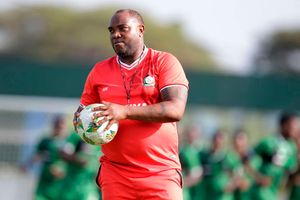
Harambee Stars walk off the pitch after a training session at Lycee Classique Cocody, in Abidjan on October 12, 2025.
Photo credit: Pool
He was on the bench for Arsenal when the Gunners eliminated Blackburn Rovers from the FA Cup in 2007. McCarthy featured in that match as a substitute for Blackburn. Poom, whose son Markus is in Estonia’s squad for the match against Harambee Stars, is considered one of his country’s best ever footballers.
Poom, whose international career lasted 17 years, made the first of his 120 caps for Estonia in a historic friendly match against Slovenia on June 3, 1992.
The match, which ended 1-1, was Estonia’s first international football in 52 years, coming soon after the restoration of their independence in 1991 following 51 years of occupation by first Germany (1941-1944) and then the Soviet Union (1944-1991).
English writer Jonathan Wilson, writing for Financial Times in 2007, stated that during that period Estonians viewed football as a symbol of oppression and in regarding the sport as “the Russian game”, Estonians instead busied themselves with basketball, cycling, and cross-country skiing.
Wilson further noted how, in 2007, Estonians’ lack of interest in football manifested in their league matches have an average attendance of 88 spectators while basketball matches and cross-country skiing events attracted thousands of fans.
Simon Kuper, another British author, explained in his book “Football Against the Enemy” how the return of Estonia to international football in 1992 did so with “ethnic hatred”. Kuper described Estonia instituting a quota on number of Estonian players of Russian origin can be included to the national team squad.
Kuper further noted that native Estonians insisted that such players should prove their fluency in Estonian to be considered for a national team call-up.
Such circumstances, as Kuper and Wilson argued, set up Estonia to be underachievers in football.
If anything, Estonians’ lack of ambition and seriousness on the football pitch, has led to funny situations which are contextualized by a popular Estonian phrase, “ainuit Estonia” – “only in Estonia”. Paul Simpson, writing for FourFourTwo magazine in 2015, described it better – “Estonia has a rare flair for making the wrong kind of football history”.
In 1997, Estonia refused to play visiting Scotland in a 1998 Fifa World Cup qualifier because they did not like calibre of floodlights in their own national stadium. Fifa, for some reason, ordered a replay of match, which ended 0-0, in Monaco.
In 2009, Jaanis Kriska, playing for Kuressaare during an 8-0 loss to Levadia Tallin scored one of the fastest own goals in football history. His poor back pass saw Levadia Tallin take a 1-0 lead after 14 seconds before even touching the ball.
In 2013, Kuressaare upgraded their antics. Their co-owner, Aivar Pohlak, refereed one of their matches while assisted by his daughter and future son-in-law. Kuressaare, who featured Pohlak’s son in that match, won 1-0.
In 2014, Estonia was subjected to ridicule after drawing 0-0 with minnows San Marino, who ended a run of 61 consecutive losses with that result. Still, this is not say that Estonia lacks ability to be formidable opponents. They have defeated countries like Croatia (3-0 in 2017), Norway (1-0 in 2014), Uruguay (2-0 in 2011), Serbia (3-1 in 2010), and Belgium (2-0 in 2009) in the past.
Yet, for the sake of Harambee Stars’ pride, who have also frequently suffered ridicule for being underachievers, hopefully the Estonia that steps out of the Amahoro Stadium on Friday will be the one that serves a wrong kind of football history.