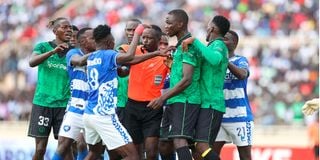
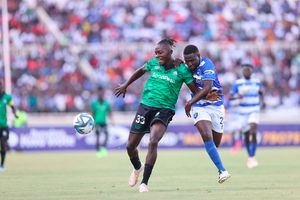
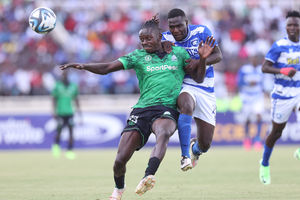
Editorial rules prescribed writing “Mashemeji” derby in quotes when the Daily Nation first used the phrase on July 21, 2011, to describe a football encounter between Kenya’s age-old rivals, AFC Leopards and Gor Mahia.
“Mashemeji” is a Kiswahili word meaning in-laws, and the Daily Nation is an English language publication. As such, non-English words, according to house style, are either written with quotation marks or italicized. Also, it was a newly coined phrase, unfamiliar to the audience.
The term “Mashemeji” derby had sneaked into the Nation newsroom and the Daily Nation page from stadium and online banter between AFC Leopards and Gor Mahia.
“There is more than just three points at stake, there is pride that the two sets of fans have dubbed “Mashemeji” derby. Luos, most of whom support Gor Mahia, and Luhyas, who support AFC Leopards, consider themselves in-laws,” read the day’s derby story published in the Daily Nation , on July 21, 2011.
Fans of AFC Leopards and Gor Mahia sing and dance along Moi Avenue on June 1, 2022 before a Madaraka Day Cup between the two teams in Nairobi.
Photo credit: File | Nation Media Group
On the day of the match, three days later, the Daily Nation set the tone.
“Sabre rattling “in-laws” warm up for grand battle at Nyayo,” read the headline of the match.
“Interactive website Facebook is replete with fierce exchanges between the two sets of fans who call each other “mashemeji”.
The term explains the close ties between the two communities, which, author Kenyatta Otieno explains in his book Kavirondo: The Story of Luos and Luhyas
With time, “Mashemeji” derby assumed popular acceptance as the label of Kenyan football’s most intense rivalry.
Yet, it is unlikely that the term, now part of Kenyan football lexicon, would have taken root had events preceding the July 24, 2011 clash between the two foes not taken place.
Gor Mahia fans unfurl a giant portrait of club patron Raila Odinga during the SportPesa League match against Kenya Police FC at Nyayo National Stadium on November 9, 2025.
Photo credit: Chris Omollo | Nation Media Group
The match was initially scheduled to be played on June 12, 2011, but was postponed thrice due to the unavailability of the Nyayo National Stadium. The intervening period saw Gor Mahia sign lethal Congolese forward Demonde Selenge from AFC Leopards, the kind of acquisition that rattles one side while the other side chortles in glee.
Facebook was seven years old at the time, and Twitter, launched in 2006, was starting to welcome Kenya’s pioneer cohorts on the platform. Kenyan football fans were joining digital communities, whose formations coincided with the rekindling of the hype of AFC Leopards-Gor Mahia matches following the former’s return to the top flight in 2009 and the latter’s ambitious title charge in 2010.
It is these digital platforms that provided a bigger outlet for banter between the fans and forged friendships across the blue-green divide.
Those online interactions stirred fans to create unique identities for themselves, their teams, and eventually come up with a label for matches between AFC Leopards and Gor Mahia.
Ingwe Fan Magazine June 2011 edition had an article naming the Gor/AFC clash “Il Klasiki”, a term borrowed from Spain’s “El Clasico” -- the name given to the meeting between Barcelona and Real Madrid.
Yet, Ingwe Fan Magazine’s attempt to name the clash was not in vain. They had already planted the idea in people’s minds. The magazine was published to hype the derby meeting that was scheduled for June 12, 2011. The fixture’s three postponements and Selenga’s move to Gor Mahia kept that conversation alive.
The previous meeting between the clubs in October 2010 was marred by a deadly stampede that resulted in the death of seven fans. Hence, even as they traded barbs online, fans of both clubs were haunted by the disaster. This resulted in the fans of the two clubs organizing joint events aimed at promoting peaceful interactions.
This, in turn laid the foundation for the exchange of friendly banter between the two sets of fans. Soon, online conversations between them were replete with AFC Leopards and Gor Mahia fans calling each other “shemeji” – “In-law”.
That cordial taunting birthed the “Mashemeji’’ derby, hence giving the fixture an identity that preceded and transcended the sport itself, a tag deeply rooted in the history of Luhya-Luo interactions.
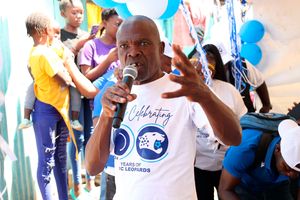
AFC Leopards fans during the club's 60th anniversary celebrations at Nyayo National Stadium in Nairobi on March 24, 2024.
Photo credit: File | Nation Media Group
Social media continued to play a key role in popularizing the term, bulldozing its essence past critics who disapproved of it as regionalizing a contest that should have national, if not continental and global appeal.
Some critics advocated for “Nairobi” derby, a suggestion, which during a conversation with Tom Bwana, a staunch Gor Mahia fan and one of the key proponents of the “Mashemeji’’ label, scoffed at.
“Mashemeji derby is authentic and unique. Geographic identifiers like “Nairobi’’ derby do not make sense because Luos and Luhyas do not come from Nairobi. “Il Klasiki” was a miss because it lacked cultural connection,” Bwana said.
When promoting “Il Klasiki”, Ingwe Fan magazine had the intention of giving the derby a unique label to save the fixture from being identified by hackneyed terms like “The Big Clash” or AFC Leopards and Gor Mahia simply being referred to as “traditional archrivals.”
And so, Mashemeji derby it is.