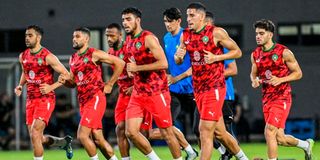
Morocco is one of the favourites to win the 2024 African Nations Championship (Chan) that will be held in Kenya, Tanzania and Uganda.
The two-time winners of the competition are in Group “A” alongside co-hosts Kenya, fellow two-time winners DR Congo, 2011 runner-ups Angola, and Zambia.
The North African country, geographically, is at the periphery of Africa, but in recent years, it has firmly established itself as the centre of football operations on the continent.
Their pivoting to achieving that status started taking shape in 2017, but the foundation was laid in 2009 after they failed to qualify for the 2010 Fifa World Cup in South Africa and 2010 Afcon in Angola.
Morocco finished bottom in a final round qualifying group that also contained Cameroon, Gabon, and Togo. They did not win a single match and suffered losses at home to Cameroon and Gabon. The 2-1 defeat to Gabon in Casablanca on March 28, 2009, was perhaps the most consequential in shaping Moroccan football to what it is currently.
Four days after that loss to Gabon, the Royal Morocco Football Federation (Rmff) announced that its then-president, General Hosni Benslimane, would not stand for re-election in April of that year.
Benslimane was later replaced by Ali Fassi Fihri, who started rather shakily.
Morocco's defender #2 Achraf Hakimi (left) celebrates with teammates after scoring his team's first goal during the Africa Cup of Nations (CAN) 2024 group F football match between Morocco and DR Congo at Stade Laurent Pokou in San Pedro on January 21, 2024.
Photo credit: File | AFP
While Morocco qualified for the 2012 and 2013 African Cup of Nations, they did not progress beyond the group stages in both tournaments and also failed to qualify for the 2014 Fifa World Cup.
However, it was during the tenure of Fihri that the Mohammed VI Football Academy in Sale opened its doors in September 2010. The academy, modelled on France’s Clairefontaine Academy, cost 140 million Moroccan dirhams (about Sh2 billion) to set up and was constructed with the support of the Moroccan government. The academy – equipped with state-of-the-art training facilities, a school, and a hospital – offers extensive football training alongside a structured academic programme to boys aged 13-18.
Mohammed VI Football Academy
By 2017, Morocco had established similar facilities in five regions and in July 2022, the Fifa website quoted Fouzi Lekjaa, the current president of the Rmff, stating that Morocco was overseeing more such developments across the country’s 12 regions.
Morocco football boss Fouzi Lekjaa.
Photo credit: Pool
The setting up of the Mohammed VI Football Academy in Sale heralded a bright future for Moroccan football but it was under Lekjaa, a high-ranking civil servant who succeeded Fihri as Rmff president in 2014, that Morocco started leveraging on their advanced sporting infrastructure and developments in other sectors of the economy to dominate African football on and off the pitch.
Still, there was another false start. In November 2014, CAF stripped Morocco of the rights to host Afcon 2015 after it requested the tournament’s postponement due to the Ebola virus epidemic in West Africa.
CAF, while later awarding hosting rights to Equatorial Guinea, also banned Morocco from participating in the competition’s two subsequent editions, Afcon 2017 and 2019. CAF also fined Morocco $1m and demanded that Morocco pay $9 m in compensation for losses they had incurred.
Morocco later appealed against the bans and the fines at the Court of Arbitration for Sports (CAS) and CAS ruled in their favour in April 2015, while also reducing their fine to $50 000.
That conflict with CAF also proved to be an eye-opener for Morocco. It made them realise the importance of having representation in CAF’s Executive Committee – a platform they can use to lobby for their sporting interests and Morocco’s diplomatic and political agendas.
It was time for another pivot and the moment arrived in 2017 when the Malagasy Ahmad Ahmad replaced the Late Issa Hayatou as CAF President, hence ending the Cameroonian’s 29-year reign. Lekjaa seized the occasion and became CAF’s third vice-president, a position that earned him and Morocco a seat in CAF’s expanded Executive Committee, whose membership had increased from 15 to 23 members.
Lekjaa’s victory in that regard ended Morocco’s 15-year absence from the CAF Executive Committee and they have maintained that seat since then. Earlier that year, in January 2017, Morocco had made a significant step in enhancing its relationship with other African states by returning to the African Union (AU) after a 32-year hiatus.
Hence, it was in 2017 that Morocco started to assert itself in African and world football, not just on the pitch but off it. They have since employed football as a soft power tool to boost their tourism industry and advance their sporting interests and diplomatic and political agendas.
Through football, Morocco has positioned itself as a popular tourist destination. According to a January 2025 report by Business Insider Africa, Morocco overtook Egypt as Africa’s most visited country after receiving 17.4 million visitors in 2024. Egypt slipped to second place after welcoming 15.7 million tourists.
In September 2017, after Kenya lost the 2018 Chan hosting rights due to poor preparations, Morocco made amends for failing to host Afcon 2015 by bidding, and winning to replace Kenya as hosts. Morocco went on to win that tournament, hence ending a 42-year trophy drought at the senior level in CAF competitions for national teams since their maiden Afcon triumph in 1976. Morocco went on to defend their Chan title in 2021 in Cameroon and will be looking to become the first country to win the tournament thrice in this year’s edition.
Since 2017, Morocco has hosted more CAF competitions than any other country. This has been greatly aided by their state-of-the-art training facilities, top-notch transport infrastructure, and abundance of high-end hotels and quality accommodation facilities.
Including Chan 2018, the country has also hosted Wafcon 2022 and Wafcon 2024. They finished second in both tournaments but have another chance to make amends next year when they host Wafcon 2026. They also hosted, and won, the inaugural edition of the Women’s Futsal African Cup of Nations in 2025.
At youth level, Morocco hosted, and won, U-17 Afcon in 2025 and U-23 Afcon in 2023, which they also won.
Between 1994 and 2010, Morocco lost five bids to host the Fifa World Cup but in the 2020s, they have finally proven their mettle to host international football tournaments. They hosted the 2022 Fifa Club World Cup and are slated to host the next five Fifa U-17 Women’s World Cup. Above all, together with Portugal and Spain, they are one of the co-hosts of the 2030 Fifa World Cup.
Their investment in national and regional academies has contributed greatly to their on-pitch success at club and national in this period. The country qualified for the 2018 Fifa World Cup and became the first African country and Arab nation to reach the tournament’s semi-finals at Qatar 2022.
At club level, Moroccan clubs have played in 11 CAF Champions League and CAF Confederations Cup finals in the 18 editions of the two competitions since 2017, winning the former twice and the latter five times.
Beyond hosting tournaments and winning trophies, Morocco’s federation, aided by its annual budget of 1 billion Moroccan dirham (Sh14 billion), had, according to a December 2022 report by Reuters, by then signed partnership agreements with 47 African federations. Through these agreements, Morocco commits to support their peers in training their staff, building sports infrastructure, organising friendly matches, and offering countries that do not have CAF-approved stadiums venues to host their home matches.
The Rmff signed one such partnership agreement with Kenya earlier this year and their impact in advancing Morocco’s interests at CAF cannot be underestimated.
For instance, following a campaign by Lekjaa, in March 2021, during the 43rd CAF General Assembly held in Rabat, CAF approved an amendment to Article 4 of its statutes which now limits admission for CAF membership to only countries that are recognised as independent and are members of the United Nations.
Hence, following the amendment, the non-self-governing territory of Western Sahara, which is occupied by Morocco and the Algeria-backed Polisario Front, cannot participate in CAF activities, translating to a diplomatic and political win for Morocco.
At the same meeting, Lekjaa, who is also the current Finance Minister of Morocco, was elected to the Fifa Council, becoming the first Moroccan to earn the position. In March 2025, Lekjaa was re-elected to the Fifa Council after garnering 49 out 53 votes, hence underlining his and Morocco’s influence in African football.
Morocco also scored favourable rulings in their recent disputes with Algeria and Algeria football clubs. In 2023, CAF did not punish Morocco for withdrawing from Chan 2022 – hosted by Algeria – after Algeria rejected their request to fly into their country directly. Algeria had closed its airspace to Moroccan flights in 2021 due to political tensions between them and Morocco over the independence of Western Sahara.
In April 2024, when Moroccan club RS Berkane met Algeria’s USM Alger in the semi-finals of the 2023-24 CAF Confederations Cup; CAF awarded Berkane a 6-0 aggregate victory after the two encounters between the two clubs failed to kick off.
RS Berkane players pose for a group photo prior to a past match. PHOTO | COURTESY |
In the first leg, Algerian authorities confiscated Berkane’s jerseys which featured a territorial map of Morocco that included Western Sahara. Berkane refused to play in another jersey and the match was abandoned. CAF later awarded a 3-0 victory to Berkane but despite that, USM Alger travelled to Berkane for the second leg. However, they refused to play the match because Berkane insisted on lining up while wearing the controversial jerseys. Once again, CAF awarded a 3-0 victory to Berkane.
USM Alger and the Algerian federation appealed CAF’s decisions to CAS who, in February 2025, ruled that Berkane were in breach of CAF’s Equipment Regulations by wearing jerseys that conveyed content of a political nature. However, CAS also ruled that their decision had no effect on the results of the 2023-24 CAF Confederations Cup, which Zamalek had already won after defeating Berkane in the final played in May 2024.
Algeria, who are in Group “C” with tournament co-hosts Uganda, Guinea, Niger, and South Africa, may meet Morocco in the knock-out stages of Chan 2024, hence providing a clash that will be infused with the diplomatic and political tensions that still exist between the two nations. Whether or not that encounter will come to pass, there is no denying that Morocco sees football as more than just a sport for them and 2024 Chan is another stage for them to prove that.