When Fifa awarded the 2026 World Cup to a triad of North American hosts, the footballing world imagined a continental carnival. Three nations, one sprawling tournament, and a global pilgrimage of fans ready to paint cities in the colours of their flags. It was supposed to be a celebration of unity, since football is the world’s most democratic language.
But football, like life, rarely sticks to the script.
Mexico, one of the tournament’s proud hosts, now finds itself wrestling with a wave of violence following the killing of Nemesio Oseguera Cervantes, better known as El Mencho, the elusive and feared leader of the Jalisco New Generation Cartel (CJNG). His death, instead of closing a bloody chapter, has cracked open a new one.
Guadalajara, a jewel of Mexican culture and a primary host city for the 2026 tournament, has spent the last few days looking less like a sporting Mecca and more like a combat zone. Following the confirmation of El Mencho’s death, the CJNG unleashed a ‘Red Alert’ of retaliation. About 25 National Guard members were killed in coordinated ambushes and 85 roadblocks erected across 20 states using torched vehicles.
There was panic at Guadalajara International Airport, where travellers were filmed sprinting for cover as gunfire echoed near the terminals. Rival factions are also scrambling for territory, splinter groups are flexing their muscles, and ordinary Mexicans are once again caught in the crossfire. The 13 matches scheduled for Mexico (in Mexico City, Monterrey, and Guadalajara) are now shrouded in a thick fog of war.
In sports, we talk about momentum. In Mexican criminology, they talk about the ‘Culiacanazo’; the explosive, asymmetric violence that occurs when a cartel head is lopped off. Experts warn that the death of El Mencho creates a power vacuum more dangerous than his presence.
The CJNG is estimated to have 19,000 members across 21 states. They are not a team that retreats after losing their captain; they are a hydra that grows two more heads, each more desperate and violent than the last. For a fan traveling from Africa or Europe, the risk is the internal war between lieutenants vying for the throne.
And as the smoke rises, so does global anxiety.
The world’s football fans, those dreamers who save for years to attend a World Cup, are watching Mexico with a mixture of admiration and dread. The country’s football heritage is unquestionable. Its stadiums are cathedrals. Its people, famously warm. But its security situation is now a riddle wrapped in gunfire, and the timing could not be worse.
World Cups are logistical marvels, requiring stability, predictability, and a sense of safety. Other than the matches, fans buy the promise of adventure without peril. Mexico’s current turbulence threatens that promise. In several states, violence has spiked. Roadblocks, arson attacks, and clashes with security forces have become unsettlingly common. These are tremors of a deeper instability.
For Fifa, this is a nightmare scenario. For fans, it is a dilemma. Do you risk it? Do you take your children? Do you trust that the situation will calm down by June? Football fans are passionate, but they are not reckless. Even the most devoted supporter knows that a World Cup trip is supposed to be a memory, not a gamble.
Freshly printed copies of the newspaper PM bearing the headline "US mapped ‘El Mencho’ and Mexico delivered the final blow, Caught between two fires," are seen at a printing facility, following the killing of drug lord Nemesio Oseguera, known as 'El Mencho,' in a military operation on Sunday, in Ciudad Juarez, Mexico, February 22, 2026.
Photo credit: Jose Luis Gonzalez | Reuters
Imagine a Kenyan family planning their first trip to North America. Or a group of Senegalese or Ghanaian supporters who have already mapped out their pub-to-stadium routes. Or English fans, those indefatigable lovers of the beautiful game, who have saved for years to witness football’s grandest spectacle. Now imagine them scrolling through headlines about cartel shoot-outs, burned vehicles blocking highways, and military deployments in tourist corridors.
The romance of the World Cup begins to wilt. Travel advisories are already shifting. Insurance premiums are rising. Online forums are buzzing with questions that Fifa cannot easily answer. Is Guadalajara safe? What about Monterrey? Will the violence spread to Mexico City? These are not idle worries. They are the early signs of a potential turnout imbalance, one that could leave Mexican stadiums less vibrant than their North American counterparts. It would be a tragedy for the tournament’s spirit.
Mexico hosted the World Cup in 1970 and 1986, two editions etched into football folklore. Pelé’s last dance. Maradona’s Hand of God. The Azteca’s roar echoing into eternity. Mexico knows how to host a World Cup. It knows how to turn football into poetry. But poetry struggles to flourish in a climate of fear. Tourism is the lifeblood of any World Cup host. Hotels, restaurants, transport companies, local vendors, and entire cities depend on the influx of visitors. A dip in turnout is a financial wound.
Fear is expensive. It taxes the imagination before it taxes the wallet. Mexico’s government now faces a delicate balancing act to reassure the world without downplaying the seriousness of the situation. Security operations have intensified. High-profile arrests are being made. Military presence has increased in key regions.
But cartels are not easily deterred. They are adaptive, decentralised, and deeply entrenched. The death of a kingpin does not end the game; it reshuffles the board. The government must convince the world that it can guarantee safety, not just in stadiums, but in the spaces between airports, highways, hotels, nightlife districts, fan zones. A World Cup is a festival. And festivals require freedom.
Football thrives on emotion. It is the sport of spontaneity, of strangers hugging in the stands, of chants rising like smoke into the night sky. But emotion cannot flourish under the shadow of violence. Fans do not want to look over their shoulders. They do not want to calculate risk. They want to lose themselves in the moment. If Mexico cannot offer that sense of ease, even temporarily, the magic of the World Cup vanishes.
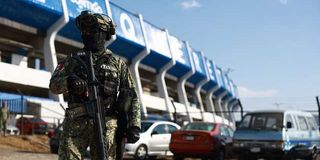
The Akron Stadium, one of the venues for the 2026 FIFA World Cup and scheduled to host four matches at this summer's tournament, after a military operation in Jalisco state in which Mexican drug lord Nemesio Oseguera, known as “El Mencho,” was killed, in Guadalajara, Mexico, February 23, 2026.
Photo credit: Gabriel Trujillo | Reuters
As it stands, the 2026 World Cup remains a tri-nation event. But El Mencho has left a bloody legacy that may achieve what no rival team could: emptying the stands of the world’s greatest stadium. Mexico is a land of sunlight and song, of Diego Rivera’s murals and Hugo Sánchez’s volleys. It deserves this World Cup. But as the military patrols the perimeter of Estadio Akron in Guadalajara, the beautiful game feels tragically small against the backdrop of a nation’s agony.
For the fans, the choice is no longer about which jersey to wear, but whether the risk of the trip is worth the reward of a goal. The most dangerous opponent in 2026 won't be on the pitch, it will be the ghost of El Mencho, still haunting the highways of Mexico.