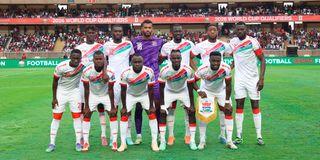
Gambian team posing at Kasarani Stadium in Nairobi before playing against Harambee Stars in the World Cup qualifier on September 5, 2025.
The Gambia is the smallest country in mainland Africa. It is almost nine times smaller than Turkana County. Its population of 2.4 million people is less than that of Kenya’s most populous counties – Nairobi (4.3 million people) and Kiambu (2.6 million).
Yet, despite its small size, The Gambia has 250 footballers playing professionally in Asia, Europe, and North America. Out of those 250 players – as The Gambia’s coach Johnathan McKinstry revealed during a press briefing held at the Kasarani Annex on Tuesday last week ahead of the Scorpions’ first training session before defeating Harambee Stars 3-1 in a 2026 Fifa World Cup qualifier played at Kasarani on September 5 – an overwhelming 220 of them were born in The Gambia.
“Most Gambian players seal moves to Europe before they are 18,” McKinstry, who coached Gor Mahia for two years before taking over as coach of The Gambia in June 2024, also explained the phenomenon further.
The Gambia national football coach Jonathan McKinstry speaks to the media during his team's training at the Moi International Sports Centre, Kasarani, on September 2 2025.
McKinstry also stated that the mass exodus of young Gambian footballers for opportunities abroad leaves its domestic league lacking experienced players who can be relied on. “The departures leave the Gambian league with very young players who are not experienced enough to dislodge professional players plying their trade abroad from the national team,” McKinstry said.
Amadou Tamba, a Gambian sports journalist, attributes the phenomenon to hard work and the country’s love for football which sustains its production of talented footballers.
“Gambians love football and the country is immensely blessed with raw talent. The sport is played by children and adults all over the country,” Tamba told Nation Sport in an exclusive interview.
Read: 2026 World Cup qualifiers: Harambee Stars bounce back to thrash Seychelles 5-0
Tamba also reckons watching European football on television increases the urge by Gambian footballers to seal moves abroad. “Watching football on European television makes young Gambian footballers yearn to play at such levels of the game,” Tamba says.
As such, the Gambian league, despite its semi-professional status as Tamba describes, is replete with competitive and hard-working budding footballers carving a path to Europe.
Such is the drive and hunger to succeed that even third division clubs in The Gambia are exporting players to Europe. “Sibanor United play in the third tier but this year one of their players, Francis Gomez, was snapped up by AC Horsens of Denmark,” Tamba said.
Tamba narrated that Sibanor had scouted Gomez from a zonal competition that is part of a larger nationwide football tournament. “That competition gives exposure to so many players. Clubs scout for talent there,” Tamba says.
The Gambia national football players train at the Moi International Sports Centre on September 2, 2025, ahead of their 2016 World Cup Group F qualifying match against Kenya’s Harambee Stars at the same venue.
As they plot their moves to Europe, these players integrate into The Gambia’s robust youth system which is responsible for the country making a name for itself in youth football competitions in Africa in recent years. The Gambia’s investment in youth football has reaped big rewards for the country.
The Gambia won the Afcon U17 in 2005 and 2009 and competed in the Fifa U17 World Cup in those years. Recently, they have finished third and second in the 2021 and 2023 Afcon U20 tournaments respectively. They also competed at the Fifa U20 World Cup in 2007 and 2023.
“The Gambia has been taking youth football seriously and the federation has ensured players who represent the country at youth level transition to the senior team,” Tamba reveals.
The Gambia’s squad for its 2026 Fifa World Cup qualifiers against Kenya and Burundi (on September 9) carried evidence of that. Three of the players who started for the Scorpions against Kenya on Friday were in the Gambia U20 team that lost 2-0 to Senegal in the 2023 Afcon U20 final. The three are Alagie Saine, Mahmudu Bajo, and Sainey Sanyang. A fourth one – Adama Bojang – was a second half substitute. The team’s captain, Omar Colley, was in the Gambia team that won Afcon U17 in 2009.
The Gambia’s youth system has also been responsible for the country’s back-to-back Afcon qualification in 2021 and 2023 and the proliferation of its players in European leagues.
“Previously, we did not have that many players featuring in European leagues and competitions like the Uefa Europa League and the Uefa Conference League. Now we have players who play for clubs that play in such competitions. Until Yankuba Minteh joined Brighton and Hove Albion, the only Gambian to play in the English Premier League was Modou Barrow for Swansea,” Tamba says.
Tamba also credits the success of Gambia’s youth system to its coaches, whose training is facilitated by the coaches’ body in collaboration with football clubs and the federation. “It is Gambian coaches who trained and nurtured the talents of these players from a young age,” Tamba says.
McKinstry, as Tamba further added, has also played an active role in supporting local coaches. “Immediately after signing his contract with the federation, he went to watch a first division match and since then he has had sessions with Gambian coaches across all tiers.”
Still, Tamba feels that Gambian football is operating below its full potential. “We lack quality playing pitches and that has hindered us from nurturing even more players. If we get better pitches in plenty, the quality of players we produce will certainly improve,” Tamba says.