Hello

Your subscription is almost coming to an end. Don’t miss out on the great content on Nation.Africa

Ready to continue your informative journey with us?

Hello

Your premium access has ended, but the best of Nation.Africa is still within reach. Renew now to unlock exclusive stories and in-depth features.

Reclaim your full access. Click below to renew.

Caption for the landscape image:

Let Baba Dogo grounds be, local community pleads

Scroll down to read the article

Children train at Baba Dogo ground in Ruaraka on Wednesday.

Photo credit: Geoffrey Anene | Nation Media Group

The first thing that strikes you when you visit Baba Dogo football grounds in Ruaraka Constituency, Nairobi is the relentless activity.

A row of shops made of iron sheets line the road, behind which lies the historic playground where many a Kenyan football star honed their skills.
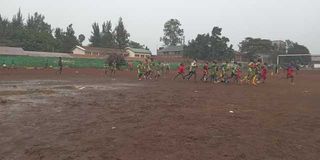
Several teams use the ground at the same time every day, all day.

This dusty (muddy in the rainy season) field has produced players such as Michael Olunga, Austin Odhiambo, Geoffrey Kokoyo, Collins Okoth, Alphonce Omija, Peter Nzuki, and Tyson Otieno.

Odhiambo and Omija have impressed for Harambee Stars at the 2024 African Nations Championship co-hosted by Kenya, Tanzania, and Uganda.

After Kenya beat Zambia 1-0 in final Group ‘A’ match on Sunday, Odhiambo appealed to President William Ruto to fulfil an earlier promise made to the midfielder to upgrade the grounds.

Historical

Baba Dogo grounds pre-dates Kenya’s independence, and is home to close to 10 senior teams and more than 20 junior sides that train there daily.

Children train at Baba Dogo ground in Ruaraka on Wednesday.

Photo credit: Geoffrey Anene | Nation Media Group

These teams include Baba Dogo United, Lucky Summer SC, EPZ, Christian Family, Peptang, and Mathare River, together with Rodney Strikers, who run youth development programmes from under-7 to under-17.

Yet, the survival of this football nursery has been in jeopardy for some time.

Ownership tussle

Baba Dogo ground borders Kenafric Industries, a company that has laid claim to the land.

The thriving community facility is now caught in a tug-of-war between residents and the private developer.

The friction escalated on June 13, 2025, when bulldozers, backed by heavy police rolled to the ground flattening shops, changing rooms, and toilets, and uprooting goalposts.

“We were tear-gassed, and many were injured. For three days, we fought to stop the demolition, but they dug trenches preparing to build a wall,” recalls taxi driver and resident, Dennis Muchiri.

Muchiri, who has lived and worked around the grounds since 2010, raised his children on the pitch. “I’ve brought my children here; one plays under-12, the other under-8.

This ground nurtures talent and keeps children focused,” observes Muchiri.

For him and many others, the ground represents not just a football field, but a home to talent, community businesses like the demolished Madam Lucy’s Hotel, and a space that anchors social life of Baba Dogo, Kariadudu, Kasabuni, Laundry, Riverside, Muthure, and Lucky Summer residents.

Chan fan zone

Now designated as one of the 13 Chan fan zones in Nairobi, the impact of Baba Dogo ground is best told through its players.

Midfielder Tyson Otieno,29, remembers sharpening his skills at Rodney Strikers and Baba Dogo United before joining Football Kenya Federation Premier League sides Mathare United.

He later played for Wazito, Kariobangi Sharks, and eventually Kenya Police.

His younger brother, international Austin Odhiambo,25, also started out with Rodney Strikers and Baba Dogo United before moving to AFC Leopards then Gor Mahia.

“These ground gave us everything. I pray it continues producing talent. I now coach young players here, from under-7 to under-17,” said Otieno.

“When I was young, I believed this was a community ground. That’s why it hurts to see private developers claim it.”

Otieno recalls how President William Ruto intervened after his brother Austin raised the plight of Baba Dogo directly. “I only have one request, Mr President. I want you to look into the issue of our pitch,” Odhiambo pleaded after Kenya’s 1-0 win over Zambia in their Group “A” match.

The President assured him: “Don’t worry, I’ll sort that out, even if it means using my funds.”

Despite its reputation, Baba Dogo ground lacks basic infrastructure.

The only toilets and changing rooms were demolished during the June invasion. Players change in the open. There is no tap water.

In case of a call of nature, users of the grounds have to rush out across the road or neighbouring homes to relieve themselves. Otieno also says the area needs a gym. “Young people need proper conditioning. But most importantly, we need footballs.

A team with 40 players should train with 30 to 40 balls, but here you will find a whole squad sharing two balls. At Rodney Strikers, we go through 60 to 70 balls a year because of the many categories.”

Otieno says exposure is another major challenge. “There is immense talent here, but without this ground, it will be difficult for players to break through,” said Otieno.

Fifteen-year-old centre-back Michael Oduor from Rodney Strikers and Baba Dogo Primary School sees the grounds as a safe haven. “It keeps us from drugs and crime. We look up to players like Austine Odhiambo and Omija. Their success shows hard work pays, and we can also represent Kenya one day.”

Exposure opportunity

For another young player like Lucky Summer SC’s Rashid Wanjala, Baba Dogo is the bridge between talent and opportunity.

These ground has given me exposure, and I believe I can go far. Without it, we wouldn’t be athletes. These grounds have helped us tap our talent. Losing them would kill our dreams,” said Wanjala.

“We need the pitch fenced and gated to stop land grabbers. We also need toilets and drinking water,” says Wanjala.

For the community, the demolitions were a betrayal. Muchiri recalls how the invasion not only destroyed the football ecosystem, but also livelihoods. Businesses, electricity lines, and access roads were disrupted, and residents faced police violence while defending their field.

“We went to court and even got orders, but Kenafric continued with trenches. It was only the President’s intervention that stopped them.”

Said Otieno: “A player is as good as the practice he does. Without these ground, training stops, and dreams die. That is why the community fought back. I believe these ground has been here for nearly 100 years and belongs to the people who use it for football.”

For now, the muddy pitch continue to echo with the laughter and shouts of young players, chasing football dreams.

The fight for Baba Dogo is far from over. But every kick of the ball, every dribble in the mud and dust, is a reminder that this community will not surrender its cradle of football talent.