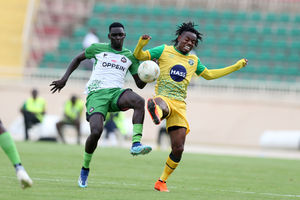
The encounter between Kenya Police FC and Somalia’s Mogadishu City Club in the preliminary qualifying round of the 2025/26 CAF Champions League bristles with a strong football connection between the two countries.
It is so unlike 1980 and 1981, the only other occasions before this year that Kenyan and Somali clubs have met in CAF competitions.
Back then, Gor Mahia eliminated Horseed 2-0 on aggregate in the 1980 African Cup of Champion Clubs (now the CAF Champions League) and 3-1 on aggregate the 1981 African Cup Winners’ Cup (now the CAF Confederations Cup).
Now, Kenya Police, competing in the CAF Champions League for the first time in their history, look set to extend that dominance of Kenyan clubs over their Somali counterparts in CAF competitions. The law enforcers lead the 11-time Somali top flight champions 3-1 heading to the second leg at Nyayo National Stadium today at 4pm.
The first leg of their encounter took place on September 20 and it was also played at the Nyayo National Stadium after Mogadishu City Club opted to host the match in Nairobi due to Somalia lacking a CAF-approved match venue.
Beyond the match showcasing of the strength of the Somali diaspora in Kenya that was marred by unsettling incidents of Mogadishu City Club fans engaging in heated arguments with Kenya Police FC fans, fighting among themselves, harassing Kenyan women, and desecrating the Kenyan flag, the match was also celebrated as a homecoming for the coach and several players of the club based in Somalia’s capital.
Their coach, 27-year-old Abdirahman Ali Abubakar, was born in Eastleigh’s Section Three area. He studied at New Pumwani Primary School and Eastleigh High School and did his coaching badges in Kenya under the guidance of former Mathare United coaches Francis Kimanzi and Salim Ali.
Mogadishu City Club is the third club Abubakar is coaching in Somalia, after stints with Horseed and Elman. Abubakar maintains a strong connection with Eastleigh where he is involved in the running of the Global Youth Academy.
With him at the club nicknamed “Minishiibiyo”, meaning Municipality officers, are three Kenyan players – goalkeeper Innocent Lihasi and midfielders Mark Khadohi and Telvin Maina.
Lihasi featured for Zetech Titans, Darajani Gogo, Murang’a Seal, and Kibera Black Stars before crossing the border to Somalia.
Likewise, Maina also joined Mogadishu City Club from Kibera Black Stars. Before transferring to the reigning Somali Premier League champions, Khadohi had stints with Mathare United, Kisumu All Stars, and Modern Coast Rangers. Khadohi and Maina were part of Mogadishu’s championship-winning squad last season.
Dekedaha, the reigning Somali Cup champions, also have Kenyan connection to boast of. The club, which has progressed to the final qualifying round of the 2025/26 CAF Confederations Cup after overcoming Sudan’s Al Zamala in their preliminary qualifier whose first leg they hosted at Nyayo last Sunday, are led by former Kajiado FC coach, Abdirahman Hashi Hussein.
Hashi also previously coached Walalaha FC, a grassroots football club in Eastleigh, and in August this year, he partnered with Abubakar to conduct a five-day grassroots football coaching course in Marsabit in collaboration with the Football Kenya Federation (FKF) and the FKF Marsabit County Branch.
Oyoo has played in Somalia since 2020, when he joined military team Horseed FC after playing for a plethora of Kenyan clubs – Sony Sugar, Tusker, KCB, Chemelil Sugar, Nakumatt, and Bandari FC.
The Kenyan cohorts at Mogadishu City Club and Dekedaha are among many of their compatriots and foreigners who have trooped to Somalia for greener pastures after their football experienced a revival in the early 2010s after years of civil war.
Their league was re-launched in 2011 and registered such a quick growth that by 2015, Somali television stations – the Somali National Television and Universal TV – started broadcasting Somali Premier League matches.
To attract viewership, the league matches were spread from Monday to Friday so as not to be in direct competition with screening of European league football matches, which command popular following in Somalia.
This scheduling of matches, coupled with low ticket prices, saw Somali Premier League matches bulging with crowds of 3,000 to 4,000 people, as chronicled in David Goldblatt’s The Age of Football: The Global Game in the Twenty-first Century.
The Somali Premier League clubs, all based in Mogadishu, soon became competitive in the continental transfer market after attracting sponsorship from local petroleum companies and shipping firms. Dekedaha signed a sponsorship deal with shipping firm Albeyrak while Hass Petroleum invested in Banadir.
As a result, Somali clubs could afford to offer competitive salaries that had players and coaches from Kenya, Uganda, and West Africa trooping to their country for opportunities.
The interlude (2011 – 2015) was marked by the revival of one of Somalia’s oldest clubs in 2012 – Jeenyo which was founded in 2012. In 2013, Nation Link Telcom ended a two-year deal with Somalia Football Federation (SFF) to sponsor the Somali Premier League.
Also in 2013, Fifa conducted a development course in Somalia, their first activity in the country since 1988 when they ceased operations in that country due to insecurity. By then, the SFF was already receiving grants from Fifa which they used to renovate the Banadir Stadium and construct new grounds.
That revival of Somali football in that period also resulted in the country producing three Fifa-accredited assistant referees – Hamza Abdi and Bashir Suleiman in 2013 and Mahad Ali Mahamud in 2014. This pioneering cohort was soon joined by Omar Abdulkadir Artan in 2018, Somalia's first Fifa-accredited referee who has been appointed to officiate matches at the 2025 Fifa U20 World Cup in Chile that kicked off on Saturday.
Somali clubs have featured in these competitions since then save for the 2022-23 season when they did not enter a team in the CAF Champions League and the CAF Confederations Cup.