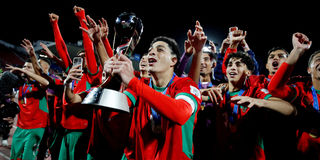
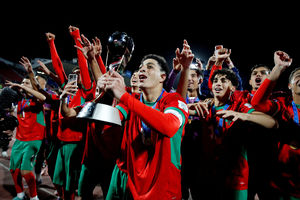
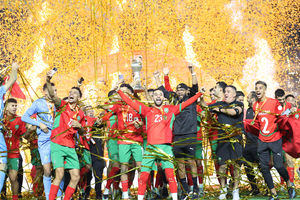
On Sunday, October 19, Morocco made history by stunning global football giants Argentina 2-0 in the final to join Ghana as the only African nations that have won the Fifa Under-20 World Cup in the tournament’s 48-year history.
Playing before a crowd of 43,253 at the Estadio Nacional Julio Martinez Pradanos, a first-half double strike by Yassir Zabiri of Portuguese top-tier club Famalicao – one from a stunning, curling free-kick and another a typical poacher’s strike from inside the six-yard box – saw Morocco go past six-time champions Argentina to lift their first ever global title.
Coached by Mohamed Ouahbi, the “Atlas Lions Cubs” players also dominated the tournament’s awards with the final’s man-of-the-match Zabiri taking the “Golden Boot” as the highest scorer with five goals and “Silver Ball” as the tournament’s second-best player behind team-mate and “Golden Ball” winner, Watford FC winger Othmane Maamane.
Morocco's Hossam Essadak holds the trophy as he celebrates with teammates after winning the FIFA U-20 World Cup.
Photo credit: Reuters
Zabiri is one of the products of the Moroccan Football Federation (FRMF) development programme that also saw the “Atlas Lions” qualify for the semi-finals of the 2022 Fifa World Cup in Qatar and win bronze at last year’s Paris Olympics.
There has since been further success for the Maghreb nation as, two months ago, the “Atlas Lions”, under the tutelage of 48-year-old coach Tarik Sektioui, an ex-FC Porto (Portugal), AZ Alkmaar (Netherlands), and AJ Auxerre (France) winger, lifted the Africa Nations Championship (Chan) trophy for an unprecedented third time after back-to-back victories in 2018 and 2020, defeating Madagascar 3-2 in a pulsating final at Nairobi’s Moi International Sports Centre, Kasarani.
Morocco players celebrate after winning the 2024 Chan trophy at Moi International Sports Centre, Kasarani, on August 30, 2025.
Photo credit: Sila Kiplagat | Nation Media Group
And just days later, Morocco became the first African nation to punch their ticket to next year’s Fifa World Cup Finals to be jointly hosted by the USA, Canada and Mexico with a resounding 5-0 pounding of Niger.
The Morocco vs Niger match also celebrated the unveiling of the magnificent Prince Moulay Abdellah Sports Complex in Rabat, one of the centre-piece venues for Morocco’s hosting of the 2030 Fifa World Cup Finals which they will stage jointly with Spain and Portugal.
The North African nation intends to use six stadiums for the 2030 Fifa World Cup Finals in Rabat, Benslimane, Marrakech, Tangier, Fes and Agadir.
Against Niger, Morocco attracted some 68,500 spectators at the Prince Moulay Abdellah Sports Complex that will also host the opening game of this year’s Africa Cup of Nations finals between the home nation and Comoros on December 21 and the final on January 18, 2026.
But in stark contract of the football success, Morocco has in the recent past witnessed fierce anti-government protests with citizens demanding immediate reforms to healthcare, education and the jobs market.
The wave of legitimate protests has been led by Morocco’s Generation Z — the very generation entrusted with shaping the country’s future.
Confronted with what they see as systemic barriers that hinder access to opportunities and stifle their capacity to contribute meaningfully to national progress, these young citizens have mobilized across multiple cities, demanding a radical recalibration of governmental priorities.
Their plea is both urgent and just: to channel investment into healthcare and education — two pillars of a nation currently in critical condition — before allocating billions to global spectacles such as the World Cup or the construction of opulent stadiums.
Yet, rather than responding with dialogue and empathy, the authorities chose the path of repression. Peaceful calls for reform were met with batons and humiliation — a tragic substitution of violence for understanding.
“I will never forget the haunting words of a father whose son lost both legs during a demonstration: ‘He dreamed of building this country with his own hands… now he must learn to walk again before he can stand for its future.’ Such stories are not isolated incidents; they are stark reminders of the human cost when power silences rather than listens,” a Moroccan professional, who preferred anonymity, said, terming the GenZ demands as “imperative.”
“To me, the demands of these protesters are not merely reasonable — they are imperative. To prioritize international prestige over domestic wellbeing is akin to gilding a collapsing structure: the façade may dazzle for a time, but the decay beneath will inevitably resurface, more destructive than before.
“True national progress is not measured by the grandeur of our stadiums but by the strength of our classrooms, the accessibility of our hospitals, and the dignity afforded to every citizen.”
Reda Hafdane, a Moroccan industrial engineer, agrees, with a touch of philosophy: “As the renowned reformist Mustafa Kamel once said, ‘A nation is not built by stone and steel, but by the will of its people and the wisdom of its leaders.’ Morocco’s youth have shown the will — it is now up to those in power to show the wisdom. And for that to happen, the cycle of violence must end — on all sides — and be replaced by dialogue, justice, and a shared commitment to a more equitable future.”
Moroccan journalist Oumaima Oirdane looks at both sides while offering her reactions to Nation Sport .
“I think Morocco hosting AFCON (2025) and the World Cup (2030) is a huge moment for us. It shows how far the country has come and how much potential we have. Of course, people also want to see that the same energy go into hospitals, schools, and job opportunities, which is completely valid.
“Personally, I have full trust in His Majesty King Mohammed VI’s vision, especially after his recent speech. He made it clear that development has to reach every Moroccan, not just be about big projects. I believe this momentum can really push the country forward on all levels, not just in sports,” she adds in sentiments shared by a Moroccan journalism student who only referred to herself as “Z.L.” for fear of intimidation.
The North African nation will use nine stadiums across six cities for this December’s Africa Cup of Nations (Afcon) Finals, a tournament which the three East African nations of Kenya, Uganda and Tanzania will be hard-pressed to replicate, or even improve on, when they host the Afcon Finals for the first time under the “Pamoja” umbrella in 2027.
Fifa president Gianni Infantino presents a medal to Morocco's Yassir Zabiri during the trophy presentation after the FIFA U-20 World Cup final Estadio Nacional Julio Martinez Pradanos, Santiago, Chile - October 19, 2025.
Photo credit: Reuters
Morocco’s unprecedented Under-20 success, Chan triumph and World Cup qualification came hot on the heels of club success by RS Berkane who warded off Tanzania’s Simba SC in May to win the CAF Confederation Cup for the third time following previous triumphs in 2020 and 2022.
Interestingly, just two players from Morocco’s Chan-winning squad in Nairobi were retained for the World Cup qualifier against Niger, further demonstrating the North African nation’s depth of talent and promise for the future which, coupled with their impeccable infrastructure, makes Morocco the rising nation to watch in global football.
Moroccan players take selfies with the 2024 African Nations Championship trophy after defeating Madagascar 3-2 in the final at Kasarani, Nairobi, on August 30, 2025
Photo credit: Chris Omollo | Nation Media Group
The backbone of Morocco’s recent success on the pitch is certainly the Mohammed VI Football Complex in Rabat-Sale, a 22-minute easy drive some 15 kilometres from central Rabat across the Bou Regreg River.
The complex has invariably been described as the “Jewel of Moroccan football,” a steady production line of talented players, among them Yassir Zabiri, the star in the Chile final.
After lifting the Chan trophy in Nairobi, Morocco’s coach Sektioui attributed the success largely to the facilities and foundation his team enjoyed at the Rabat academy.
The 15-year-old, $65 million (Sh8.5 billion) facility, the brainchild of Morocco’s sports-loving ruler, King Mohammed VI, “is the house of football in Africa and in the world,” the academy’s Director Hassan Kharbouch tells ‘Nation Sport’ after taking us round the massive complex recently.
The five-star senior team hotel and training ground at the Mohammed VI Football Academy in Rabat.
Photo credit: Elias Makori | Nation Media Group
“It covers 35 hectares with 11 football pitches, five hotels with a 500-bed capacity and with one medical centre,” Kharbouch summarizes the eco-friendly-systems-powered facility that also boasts a 7,500 metres square sports medicine centre. The complex has a school where teenage girls are trained for seven years in academic programmes, life skills and football.
Since the complex and academy opened in 2009, a lot of emphasis has been laid on the women’s game with the women’s league professionalized in 2020 and the Moroccan federation covers 70 percent of the clubs’ costs.
Morocco qualified for the 2023 Women’s World Cup, becoming the first North African to accomplish the feat, with King Mohammed VI celebrating the development of the women’s game when he granted audience in July this year to the national women’s team that lost to Nigeria in the women’s Afcon, led by skipper and tournament top scorer Ghizlane Chebba.
So expansive is the well laid-out Rabat academy (which has most recently hosted top clubs including Real Madrid and Bayern Munich for pre-season camps) that one needs a golf cart to move around from end-to end across well thought-out concrete and tarmac roads.
The Mohammed VI Football Complex – whose features also include a five-star hotel for the senior national team, a 221-seat auditorium, an Olympic-size swimming pool and an indoor football field - is part of the Royal Moroccan Football Federation (FRMF) national football development programme that has 145 football pitches in its 13 regional centres across the Maghreb nation.
“We have 27 (Moroccan) national teams, male and female, training here and we also organize international matches in the complex. This year alone, some 172 international matches have been penciled for the complex, because we also have partnerships with many African national associations and others from Europe and South Africa” Kharbouch adds.
The facility also organizes many workshops and seminars for both world football governing body, Fifa, and the Confederation of African Football (Caf).
The new Fifa Africa office at the Mohammed VI Football Academy in Rabat.
Photo credit: Elias Makori | Nation Media Group
Meanwhile, Morocco’s Prime Minister Aziz Akhannouch has since said he is open to dialogue as the “Genz 212 Protests” - named after Morocco’s international dialling code – continue to rise as the nation struggles with an employment rate of 36 percent in rural areas and 47 percent in urban settings.
In mitigation, a Cabinet meeting on October 19 – overshadowed by the U20 victory the same day - launched the 2026 Finance Bill which seeks to prioritise “creating jobs for young people" and “promoting education and health sectors with greater speed”.
Announcing the plans, King Mohammed VI said 140 billion dirhams (about Sh2 trillion) would be allocated to health and education in the new budget, the monarch fiercely defending the country’s investment in football and the hosting of the 2030 Fifa World Cup.
“There should be no contradiction or rivalry between major national projects and social programmes, as long as the goal is to develop the country and improve the living conditions of citizens,” King Mohammed VI said.
Soon after his election into office last December, one of Football Kenya Federation (FKF) President Hussein Mohammed’s first moves was to sign a Memorandum of Understanding in March this year with Royal Moroccan Football Federation (FRMF) President Fouzi Lekjaa that will, inter alia, see the Kenyan federation take advantage of the facilities at the Sale academy.
“The agreement will focus on technical capacity building, football infrastructure development and exchange programmes to strengthen our football ecosystem,” the FKF said at the time.
The FKF President was also among African football chiefs present on July 26 this year when Fifa President Gianni Infantino opened the world football governing body’s first Africa regional office at the Mohammed VI Football Complex premises, a futuristic architectural masterpiece that’s also a strategic push by Morocco ahead of the 2030 World Cup.
The centre is an addition to Fifa’s similar regional centres in Paris (France), Miami (USA) and Jakarta (Indonesia) with Infantino saying it would “have a global impact on football.”
“The fantastic Mohammed VI Complex, named after the King of Morocco, has all the facilities to become the nerve centre of football development in Africa as Morocco hosts the CAF Africa Cup of Nations later this year, in addition to the next five editions of the Fifa U-17 Women’s World Cup and the 2030 Fifa World Cup,” Infantino said at the ceremony also attended by CAF President Patrice Motsepe on the sidelines of the 10th TotalEnergies CAF Women’s Africa Cup of Nations Final between Morocco and Nigeria which the “Super Falcons” won 3-2, stunning the hosts by coming from two goals behind to stage an amazing second half comeback.
The Mohammed VI Football Complex also hosted 10 national teams that were preparing for the Fifa Under-17 Women’s World Cup currently running in Morocco until November 8.
The new Fifa Africa office at the Mohammed VI Football Academy in Rabat.
Photo credit: Elias Makori | Nation Media Group
“We have 11 pitches and so each team has its own pitch to train on. The national under-17 teams that we have here include Spain, Mexico, Australia, New Zealand, the Netherlands and Switzerland… we are also preparing to host the men’s senior team to prepare for an international friendly match,” Kharbouch updated ‘Nation Sport’ on phone from Rabat recently.
In all, 27 Moroccan national football teams across all age groups and codes, men and women - also including futsal and beach football – utilize facilities at the impressive Mohammed VI Football Complex.
Nasser Larguet, who was in the pioneering team at the complex as Director between 2008 and 2014, is optimistic that the Mohammed VI Football Complex will push Morocco higher up the global football pecking order.
“In Africa, we don’t have confidence in ourselves, yet we can actually compete against nations from Europe and South America…,” he said in an interview last week.
“Morocco’s success in Chan is a result of what the Moroccan federation has been doing for the last 10 years in developing facilities and clubs. The federation has big programmes to help coaches of club academies. Most of the club coaches in Morocco are Moroccan and this has been a key to the success of Morocco at the Chan tournament.”
He sees the fine blend of structured player development, solid coaching programmes and development of infrastructure as key to the development of national teams.
“If you have good human resource and no facilities, you cannot achieve anything. Football also needs pitches and developed medical programmes… if you don’t give importance to facility development, it’s hard to succeed.”
With the current upward trajectory, Larguet sees Morocco fighting for the World Cup title in 2023.
“The worst Morocco can do in 2030 is (reach) the semi-finals,” he predicts. “The current team is young with a mixture of big match experience with some players having featured in four Afcon tournaments and two World Cup finals like (Yassin) Bonou, (Sofyan) Amrabat, (Youssef) En-Nesyri, most of whom started with the team in 2015 and have competed at a high level in Africa and around the world.
Hassan Kharbouch, Director of the Mohammed VI Football Academy in Rabat.
Photo credit: Elias Makori | Nation Media Group
“Many in the team will be in their 30s and mature when Morocco hosts the World Cup finals in 2030 and capable of competing for the title.
“The federation has also done well in maintaining the same coach, Walid Regragui, for the last three or so years with the same players. Many African federations are impatient and keep Changing coaches which affects development of the national team.”
Kharbouch has also been hosting Morocco’s men’s under-17 team at the Mohammed VI Football Complex as they prepare for the Fifa Under-17 World Cup to be held in Qatar from November 3 to 27.
And the centre will continue its now famous tradition as the steady production line of Morocco’s endless stream of football talent even as the Genz 212 protests continue to gather steam.