In 1996, defender Sammy Omollo became the first Kenyan footballer to play in India’s top football league when he joined East Bengal FC who are based in Kolkata.
Omollo left East Bengal FC in 1998 for city rivals Mohun Bagan. But as far as football is concerned, tiny Manipur state has produced most of the players in India women’s squad that is currently in Kenya for the 2026 Fifa Series.
It was with much regret that renowned Indian journalist, Novy Kapadia, omitted a chapter on women’s football in Manipur in “Barefoot to Boots: The Many Lives of Indian Football.” Published in 2017, Kapadia’s book shares riveting descriptions of the glorious history and legacy of Indian football.
“I had a special section on women’s football in Manipur but due to shortage of space it had to be omitted,” Kapadia, who was considered India’s foremost football expert and commentator, wrote in the acknowledgements section of the book.
Kapadia died in 2021 at the age of 69 but the story of Indian football has continued to be told by others. Footballers from Manipur, particularly women, feature prominently in those stories.
Manipur is a north eastern Indian state which borders Myanmar. It is one of India’s smallest and least populous states. It has a land area of 22,327 square kilometres, making it almost equal to Kajiado, Kenya’s ninth largest county with an area of 21,293 square kilometres.
Yet, despite having a population of 3.2 million people, representing 0.25 per cent of India’s 1.4 billion population, Manipur consistently produces close to half of the players in India women’s national football team squads at senior and youth level.
Because of their consistent high representation in India women’s national football team squads, it is not surprising that female footballers from Manipur hold the appearances and goals record for the Blue Tigresses, as the India women’s national football team is popularly known as.
Before the still-active Ashalata Devi Loitongbam (100 caps) and Grace Dangmei (94 caps), Bembem Devi Oinam (82 caps) held the appearance record for the Blue Tigresses. Like Oinam, Loitongbam and Dangmei are also from Manipur.
Oinam, 46, is considered the best ever female footballer to have come from India. In 2017, she received the Arjuna Award, the second-highest sporting honour of India. The highest is the Major Dhyan Chand Khel Ratna Award. She made history as only the second Indian female footballer – after the West Bengal-born Shanti Mullick in 1983 – to receive the award. The other 32 recipients of the award are male.
Harambee Starlets players celebrate a goal against the Gambia in a first leg match of the final round of 2026 Women Africa Cup of Nations qualifiers at Nyayo National Stadium on October 24, 2025.
Photo credit: Sila Kiplagat | Nation Media Group
Bala Devi Ngangom, who is still playing, is the Blue Tigresses all-time top scorer with 48 goals in 58 appearances.
The current captain of the Blue Tigresses, Sweety Devi Ngangbam, is also from Manipur.
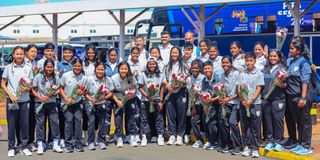
While Ngangom and Ngangbam are not in the Blue Tigresses squad that is currently in Kenya for the Fifa Women’s Series 2026, Crispin Chettri’s team of 22 players features eight players from Manipur. The eight players are: Babina Devi Lisham, Devi Maibam, Lynda Kom Serto, Martina Devi Thokchom, Nirmala Devi Phanjoubam, Priyangka Devi Naorem, Sarita Yumnam, and Shilky Devi Hemam.
“Manipur and the surrounding north eastern states in India have proper structured football compared to other states. Football is very active at the grassroots level there and the level of competition is also higher. They do not play much cricket like other states and even though their main sport is football, they are also more inclined to other sports like boxing,” Blue Tigresses coach Chettri said when asked why players from Manipur dominate squads of India women’s national football teams.
Chettri, 50, was speaking at the Nyayo National Stadium on Friday during the pre-match press conference for their encounter against the Harambee Starlets on Saturday.
An aerial view of Nyayo National Stadium.
Photo credit: File | Nation
Chettri, who was recently returned for a second spell as Blue Tigresses coach after the Costa Rican Amelia Valverde was sacked following India’s disastrous campaign at the 2026 AFC Women’s Asia Cup in March, also said that while Manipur and other north eastern states remain the hotbed of Indian football talent, the All India Football Federation (AIFF) is making effort to popularize the sport in other regions of India.
“Slowly, football is spreading all over India and we are getting players from different states. We are trying to get more states involved so that we have a bigger pool of talent and players with different physicality,” Chettri, who is not related to legendary Indian footballer Sunil Chetri, said.
Such is the prowess of female footballers from Manipur that their state women’s team has appeared in 28 of the 30 India women’s football state championship finals, winning a record 24 titles.
Writing in “Barefoot to Boots: The Many Lives of Indian Football”, Kapadia explained that while football had been a popular sport in Manipur since its introduction to the state in 1899 by a Christian missionary named Reverend William Pettigrew, it was a 2005 initiative by the AIFF which contributed to the significant growth of the sport in the conflict-and flood-prone region.
“Credit for the emergence of Manipur as a powerhouse in domestic football also goes to the AIFF. Due to insurgency and lack of industries, AIFF selected Manipur as one of the two states in India for the AFC Vision India Pilot Project on March 28, 2005. By following the strictures of the project, Manipur improved its basic football activities, management, youth projects and development of coaches. Above all, it helped the formation of clubs all over Manipur,” Kapadia noted in his book.
Also, in his book, Kapadia stated that players from Manipur succeed as professional footballers in India because “they are mentally tough and quickly adapt new cultures.”