Kenya Pipeline last won the African Women’s Volleyball Clubs Championships way back in 2005
Then, the current captain, Gladys Ekaru, was only six years old, while the senior-most player in the team, Noel Marambii, was 16, and the youngest squad member, Milcah Akinyi, was not even born. She is now 17 years old.
The team feels that this will be their year as they prepare to leave for the African championships that will be held in Cairo from April 11 to 24.
Kenya will also be represented by two-time champions KCB Bank and the Directorate of Criminal Investigations (DCI), who will be making their maiden appearance.
With 21 continental medals in their cabinet -- five gold, eight silver and seven bronze, Pipeline are easily Kenya’s most successful team in Africa. Notably, they are also the second most successful club on the continent after Al Ahly SC of Egypt, who have won 26 medals -- 10 gold, 12 silver and four bronze.
However, glory seems a faraway memory for Pipeline, which last celebrated a continental conquest in 2005 at Moi International Sports Centre, Kasarani in Nairobi.
The last seven editions have been particularly disappointing for the Kenyan champions. A story so close, yet so far. They won silver in 2023 and bronze in the other years.
Losing to Zamalek 3-2 (25-23, 26-28, 25-19, 24-26, 15-12) in the semi-finals last year in Abuja, Nigeria, with sloppy serves costing them in the decisive set, still lingers in their mind, painfully.
It’s that performance that is heavily motivating Kenya Pipeline. Their head coach, Geoffrey Omondi, Ekaru, and Marambii, reckon that simple basics like ball control at the crucial moments proved costly for them in previous years, especially last year.
Omondi revealed they are working on several areas of their play, including ball control, reception, speed and attack execution.
“Having been with the team for two seasons, I have diagnosed that we lose the game mainly due to ball control. We have had chances in our court but fail to make points out of it after a lack of control,” said Omondi, sounding wise for his 27 years, as he recalls how they lost to Zamalek in the fifth set of their semis duel.
Kenya Pipeline Women's Volleyball club players celebrate after winning KPC2@50 extravaganza at Kasarani Indoor arena on April 7, 2024.
Photo credit: Sila Kiplagat | Nation Media Group
“I still remember that moment like it was yesterday when we lost two points despite having a chance with the ball in our court to kill the game,” said Omondi. “Being in control will allow us to play ball for second and third touches. We have worked on that, and we are now better than we were before.”
“Overhead receptions are more accurate with float serves,” said Omondi knowingly.
Overhead reception in volleyball is a technique used to receive serves or passes using hands above the forehead, rather than a forearm platform, often allowing for better accuracy on high-trajectory balls.
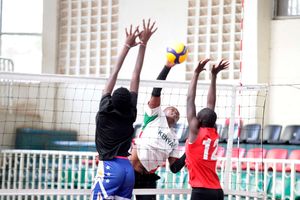
Omondi also revealed that they have upped the speed and execution of attack at the net so as to displace their opponents' blocks and split their defence.
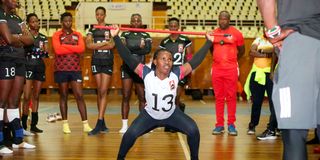
"We have also engaged specialists like strength and conditioning expert Jeff Onyango to improve players' mechanical functions and capabilities," said Omondi.
He revealed he had put five junior recruits under intense training and testing, and they withstood the examination superbly, thus adding to his team the required depth to challenge any team in Africa.
The players are Sharon Omondi and Milcah Akinyi, who are students at Aluor Girls Secondary School from Siaya County, Serena Busolo, who cleared the Kenya Certificate of Secondary Education at Bishop Sulumeti, Kakamega, last year, Valentine Jemutai, who finished school last year at Kwanthanze Secondary School, Machakos and Flavin Simiyu.
Ekaru, who has been with Pipeline since 2019, said they had picked valuable lessons from last year’s semi-final exit in Africa.
“We are now more cohesive and work really well as a team,” she said.
Murambii, who has played for Pipeline for 14 years, said the continental title has continued to escape them owing to technical hiccups, especially at the knock-out stage.
“We simply lose to our rivals, especially the Arab teams, which stick to basics and simple ball control. While we want to go for unique things, they just toss the ball around before finishing with simple touches,” said Murambii.
“We have worked on our mistakes. We are now ready to reclaim the continental title,” she said with menace.