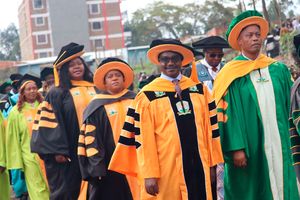
Budapest’s Semmelweis University is one of Central and Eastern Europe’s leading medical and health sciences institutions.
Founded in 1769, it is Hungary’s oldest continuously operating medical school, and temporary home to three Kenyan athletes - Tabitha Mailu, Kelly Daniel Otunga, and Grace None.
The three are judokas pursuing their medical degrees under the Stipendium Hungaricum Sports Scholarship Programme while targeting slots in Team Kenya for the 2028 Los Angeles Olympic Games.
Their scholarship opportunities were co-ordinated through the Kenya Judo Federation (KJF) and International Judo Federation (IJF) to ensure long-term athlete development beyond the tatami mat.
The daily routine for these student-athletes is a masterclass in temporal anatomy. At Semmelweis, a world-renowned European hub for medicine, the academic workload is notoriously unforgiving, yet the trio has found a symbiotic relationship between combat sports and clinical science.
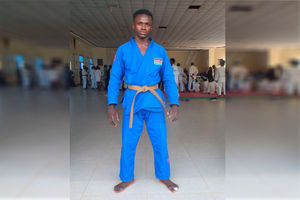
For Kelly Daniel Otunga, 20, a seven-time reigning Kenyan national champion in the under-66 kilogramme category, the core tenets of judo dictate his approach to patient care.
Having completed his secondary education at Kobala Mixed Secondary School in Homa Bay County before moving abroad, Otunga believes that the self-discipline, resilience, and self-control forged on the mats are the exact traits required when handling critical patient care during demanding hospital rotations.
“Judo has played a significant role in shaping the person I am today. It has taught me self-discipline, self-control, resilience, respect, and determination, both on and off the mat,” he explains in an exclusive interview with Nation Sport in Lipotvaros, Budapest, an elegant, upscale political and financial heart of Budapest, on the eastern bank of the Danube River, home to Michellin starred restaurants alongside Parliament Buildings, St Stephen’s Cathedral and Liberty Square.
“Beyond personal development, judo has opened doors to numerous life-changing opportunities that I might never have imagined. Through the sport, I have gained valuable experiences, built meaningful connections, and earned the opportunity to pursue higher education abroad,” he adds.
Grace None, 21, who made waves on the continent by capturing a bronze medal in the under-57 kg category at the 2024 Dakar Junior African Cup, echoes this synergy. An alumna of Nakeel Primary School in Ongata Rongai and Friends Samitsi Girls High School, she is specialising in physiotherapy.
For None, the human body is both a canvas for athletic perfection and a complex biological machine requiring precise maintenance.
“I am studying Nursing and Patient Care – Physiotherapy at Semmelweis University. Judo has taught me discipline, respect, resilience, self-control and how to balance sports with academics,” she says.
Like her colleagues Kelly and Grace, Tabitha Mailu, and alumna of Githunguri High School, sees the significance of the blend between her studies and judo in shaping her future career both in the sport and as a medic.
“My studies are helping me understand the human body, injury prevention, rehabilitation, and how to support people in recovering from injuries and improving their physical performance. I believe that combining my knowledge of physiotherapy with my experience as a judoka will allow me to make a meaningful contribution to the sporting community,” reflects Mailu, 28, who is studying for a Bachelor’s degree in Physiotherapy.
However, the trajectory to Los Angeles 2028 demands relentless participation in the IJF World Tour, which presents distinct administrative hurdles while training thousands of miles away from Nairobi.
Serving as the Diaspora Athletes’ Representative in Hungary, Otunga is leveraging his platform to champion the logistical needs of Kenyan judokas living and studying abroad.
The group is collectively calling on the KJF and the Ministry of Sports to streamline critical institutional backing, specifically regarding international licensing, IJF accreditation, and competition registration.
They emphasize that proper preparation and consistent international exposure are vital to improving their world rankings and making their country proud.
Having risen from local Kenyan classrooms to the lecture halls of Budapest, these medical martial artists have already proven they possess the grit to conquer both the mind and the body, ensuring that the future of Kenyan sports medicine is in remarkably precise hands.
And both KJF – headed by National Olympic Committee of Kenya Chairman Shadrack Maluki - and the Sports Ministry acknowledge these concerns, with Sports, Arts and Social Development Fund Chairman George Kithi, who met with the three student athletes in Budapest, pledging to unlock further assistance for the trio.
Sports Fund Chairman George Kithi with Kenya's Hungary-based judokas (from left) Tabitha Mailu, Grace None and Kelly Otunga in Budapest recently.
Photo credit: Elias Makori | Nation
“We have had insight on how their life is here. It is a good programme, but it’s not enough as there are many challenges… they need more facilitating and licensing in order to compete in more events in Europe and represent their country, and also get more skills they can transfer to others at home,” Kithi, himself a martial artist, said.
National Olympic Committee of Kenya Vice Chairman, Barnaba Korir, who also met with the judokas in Budapest, pledging to look into further support and funding for the scholarship beneficiaries to make them more competitive.
“As we prepare for Los Angeles 2028, we want to see the scholarship beneficiaries qualify for the LA Games and also beyond in Brisbane 2032 because they are still young and can compete in two Olympic cycles,” Korir, also a member of the Athletics Kenya executive committee said.
Kenya Judo Federation treasurer and national coach David Busolo is excited that the federation’s junior development programme is paying off and the sport spreading, including in the development of technical officials.
“We currently have seven qualified referees – two international and five continental. In terms of youth development, coaches like Lawrence Karisa Nyundo have pioneered cadet and junior programmes, departing from the past where judo was only developed within the uniformed forces,” Busolo explains.
The two international referees are Esther Kayume Ikiugu, a former East Africa under-63kg champion, and Peter Oyugi.
Ikiugu, of the Kenya Prisons Service, is currently one of Africa’s highest-ranking technical officials and the first Kenyan selected to referee at a World Judo event, writing history in Sarajevo (Bosnia and Herzegovina), by officiating at the World Judo Championships Veterans and Kata in September.
Busolo adds that the KJF strategy builds an African judo powerhouse by securing international academic scholarships for athletes' long-term livelihoods, certifying 25-plus local coaches and referees to eliminate reliance on expensive foreign staff, and leveraging government funding for elite tournament exposure.
Meanwhile, on the historic medical campus of Budapest’s Semmelweis University, the three Kenyan judokas are executing a flawless double-attack on the world stage, translating the principles of the tatami (traditional Japanese judo mats) - discipline, resilience, and maximum efficiency - into the demanding world of hospital rounds, anatomy labs, and clinical pathology.
Sports Fund Chairman George Kithi (right) and NOC-K Vice Chairman Barnaba Korir with Kenya's Hungary-based judokas (from left), Kelly Otunga, Tabitha Mailu and Grace None, in Budapest recently.
Photo credit: Elias Makori | Nation
While their immediate goal is athletic glory at the upcoming Olympic qualification events and the African Games, these trailblazers are already thinking far beyond the podium.
In alignment with the National Olympic Committee of Kenya, the trio is formulating a blueprint to revolutionize sports medicine back home, hoping to bridge the historical gap between local talent and elite medical backing.
Otunga envisions working directly with the Ministry responsible for Sports to pioneer an elite sports nursing framework that standardizes ringside emergency medicine and systemic athlete health tracking, while, None and Mailu plan to use their physiotherapy expertise to build accessible rehabilitation pathways, ensuring young grassroots athletes are not forced into early retirement by preventable joint and ligament damage.
“Additionally, I hope to use the knowledge, skills, and international experience I gain in Hungary to mentor and inspire young Kenyan athletes. I want them to understand that sports and education can go hand in hand and that, with determination and the right opportunities, they can achieve success both academically and athletically,” Otunga explains.
However, achieving these ambitions requires consistent international exposure, proper preparation, and institutional support, something he is grateful to have enjoyed.
Among the prominent Kenyan sports administrators who have gone through the rigorous Hungarian sports education system are newly-appointed Director of Sports Bernard Ouma, who completed post-graduate education in Budapest, and Kenya Academy of Sports Director, Doreen Odhiambo, who studied strategic high-performance systems and sports science research training programmes at the Hungarian University of Sports Science.
“What distinguishes sports studies in Hungary is the integration of sports research, evidence-based coaching and practical training, exemplified by some of the greatest sports universities like the Hungarian University of Sports Science, Semmelweis and its partnership with the International Judo Federation Academy -- an approach that offers Kenyan judokas, other athletes and coaches valuable opportunities to develop both as athletes and as future sports professionals,” notes Ouma, a revered middle-distance running coach whose doctorate studies in Budapest centred on Mulecular Exercise Physiology and Biomechanics.
By synthesizing the unforgiving discipline of the tatami with the precision of clinical science, Otunga, None, and Mailu are laying down a blueprint to revolutionize sports medicine back home in Kenya.