Munyegera and Noor Giga first Africans to finish gruelling race
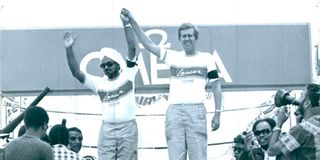
The 1976 Safari Rally Winner, Joginder Singh and David Doig the finishing ramp at Kenyatta Conference Centre.

What you need to know:
The 1969 Safari was the last of the old school events. Television coverage was about to get more organised. Datsun had identified the car it would enter in the Safari in years to come; the Datsun 1600SSS.
- Marshalls East Africa, the Peugeot franchise in the region, unveiled the futuristic Peugeot 504. They didn’t field it in that year’s Safari Rally but it became one of the most successful makes in the Safari Rally in the 70s.
He may have been bottom in 31st position in the 1969 East African Safari Rally, but his finish became the talk of an entire East African region for years that followed.
Sospeter Munyegera and Giga Noor Mohamed became the first Africans to finish the Safari 11 years after the first Africans attempted the Safari in 1958 without any impact.
Munyegera and Mohamed drove a Saab 95 D car. It is also the year Apollo II landed on the moon, construction of Hilton Hotel in Nairobi began, as well as the KICC.

Finishing the race was an aspect of “victory” that made Ugandans feel part of the Safari Rally after always failing to produce a winner, unlike Tanzania which had a pretty decent achievements record.
Tanzania had already twice produced a champion (Bert Shankland in 1966 and 67), and was looking forward to continue registering good results until a diplomatic tiff between Nairobi and Dar es Salaam saw all Tanzanian drivers barred from competing in Kenya that year.
Since then, any entry of an indigenous African driver was received with so much jubilation that when Peter Shiyukah and Eliud Thuku conquered the Safari Rally two years later, they became national heroes and an inspiration to dozens others in years to come.
Another unnoticed result was that of the 27th place finisher, Shekhar Mehta, in a Peugeot 204. Nobody took notice as all attention was on the top drivers. Mehta, still a citizen of Uganda, was beginning his career.
He was to claim his first Safari Rally victory in 1973 and went on to peak at the right time, winning again in 1979. He followed this victory with three more wins in 1980-82 for the Datsun/Nissan model.
Ford bounced back with the Taunus driven by Robin Hilyar and Jock Aird to claim victory in a year when rains failed to dampen the fighting spirit of the competitors after the historic results of only seven finishers the previous year.
Once again Joginder Singh, now an established national hero, pleased a growing legion of his fans by finishing second in a Volvo 142S navigated by Bharat Bhardwaj.
His results ahead of top European drivers again enhanced the invincibility of locals.
Jamal Din and M. Minhas completed the podium in a Datsun 1600SSS.
Bhardwaj was later to quit rallying and concentrate in management as the chair of the Safari Rally. It was under his watch the Safari grew in status and started to attract title sponsors in years to come.
This result was received positively in Japan from the motoring fraternity, and thus began the Datsun domination of the Safari, as balance of power shifted from continental Europe to the Orients.
The 1969 Safari was the last of the old school events. Television coverage was about to get more organised. Datsun had identified the car it would enter in the Safari in years to come; the Datsun 1600SSS.
Marshalls East Africa, the Peugeot franchise in the region, unveiled the futuristic Peugeot 504. They didn’t field it in that year’s Safari Rally but it became one of the most successful makes in the Safari Rally in the 70s.


