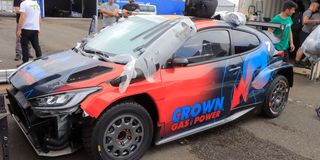
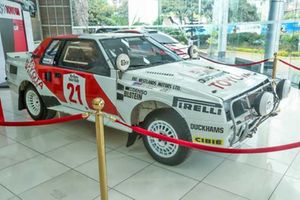
The 2026 WRC Safari Rally will close yet another chapter in automotive engineering.
The sleek, massively modified Rally1 car with massive rear spoiler, side skirts and mud guard, producing in excess of 380 Break Horse Power (bhp) - down from 514bhp in 2022-24 -- and, the precursor of the World Rally Car (WRC), will cease competing in the Federation Internationale de I’Automoble (FIA) World Rally Championships from next year.
FIA will retire the Rally1 formula from the World Rally Championship (WRC) calendar starting in 2027, and replace them with WRC27 machines, intent on reducing the cost of rallying.
A brand new Rally1 car today costs anything between Sh130 million and Sh160 million (about $1 million and $1.3 million).
The new WRC 27, by contrast, will be capped at €345 000 (about Sh51.5 million), which represents more than a 50 per cent cost reduction.
Savings are expected from the lower purchase price and longer‑lasting components, stricter crew limits, slimmer logistics chains and a greater reliance on remote engineering support.
Rally enthusiasts who have watched the 380-500bhp beasts roar across the African savannah in the last three years note how different they look from the Rally2 cars, which are second-tier in terms of technology and are limited to roughly 300bhp.
The Rallly2 cars exhibit a more gentle character compared to the fire-spitting, tyre-chewing monsters from Toyota, Hyundai and Ford.
Power will come from a 1.6‑litre turbocharged unit delivering roughly 290 bhp mated to a four‑wheel‑drive system and a five‑speed gearbox.
The suspension will adopt a double‑wishbone layout, while brakes and steering will be taken from the Rally2 rule book, creating a high performance yet more approachable platform. According to the FIA, the cars must fit inside a clearly defined envelope -- a length between 4,100mm and 4,300mm and a maximum width of 1,875mm -- giving designers enough latitude to innovate while staying within strict dimensional limits.
The regulations also embed “future‑proof” flexibility, allowing alternative power‑train concepts to be introduced later in the cycle.
Three‑time Safari champion and Toyota Gazoo Racing deputy principal Juha Kankkunen summed it up on Friday, saying it will be fascinating to watch the final Rally1 entries battle Kenya’s unforgiving terrain.
The exit of Rally1 is expected to broaden the sport’s appeal to additional manufacturers and independent tuners.
The WRC has struggled to keep a deep factory roster – only Toyota and Hyundai run full factory programmes today, while M‑Sport Ford now competes as a modest private team outfit.
In November 2024, the FIA convened a “Working Group” made up of motorsport veterans such as former Subaru World Rally Team director Dave Richards and championship winning co‑driver Robert Reid with a brief of making the premier class more attractive and affordable.
Richards, the man behind the iconic Subaru Impreza WRC runaway success and near cult figure, helped devise a set of cost-cutting measures.
The most consequential was the abandonment of the plug‑in hybrid system introduced in 2022. While well intentioned environmentally, the hybrid pushed Rally1 prices sky‑high and created a performance chasm between the different categories of cars.
Reducing the maximum output back to the pre‑2022 level of roughly 380 bhp was seen as an effort to narrow that gap last year.
Even after the price cut, only a handful of customers could afford these machines, which sprint from 0‑100 km/h in under 3.5 seconds on rugged terrain.
Toyota and Hyundai keep their cars off the market, and M‑Sport has sold just two Rally1 Ford Puma chassis – to Belgian‑based Greek businessman Jourdan Serderidis and Indonesian driver Putra Rizky.
By comparison, M‑Sport has delivered more than a thousand Rally2 Ford Fiesta units, the same model now piloted by 2023 Kenyan champion Jasmeet Chana, former African champion Karan Patel, and Uganda’s Yasin Nasser.
Priced at Sh30 million to Sh40 million, the cars sit alongside the Skoda Fabia Rally5, Hyundai i20 Rally2 and the latest Toyota entries.
The FIA also announced that the new regulations will collapse the current split between manufacturers and private tuners into a single “Constructor” category.
Under this banner, any entrant -- be it a global OEM or an independent shop -- will be responsible for design, build, homologation and marketing, a move intended to boost participation and sharpen competition.
Like their predecessors, the WRC27 cars will run on a 100 per cent fossil‑free fuel blend composed of synthetic and bio‑derived components – the first such mixture in an FIA world championship series.
The plug‑in hybrid, launched in 2022, proved too costly and failed to attract new manufacturers, leaving the championship heavily dependent on the trio of Toyota, Hyundai and the semi‑works M‑Sport Ford.
After the FIA introduced tighter safety rules at the Acropolis Rally in Greece (September 2022), the sole hybrid supplier, Compact Dynamics, raised its prices, delivering the final blow to the hybrid era.
Expensive technical requirements
By eliminating the hybrid and a host of other expensive technical requirements, the vehicle will cost considerably less.
This reduction could eventually permit manufacturers to sell or lease these machines to wealthy private customers – a stark departure from today’s rule that bars sales and forces manufacturers to run their own factory squads.
Rally1 cars were never built for sheer top‑speed; their gear ratios and hybrid boost were tuned for blistering acceleration out of tight bends.
The fastest stage speed on record – about 200 km/h – was set by Takamoto Katsuta during the 2021 Safari Rally Soysambu stage, where he covered a 193‑metre stretch in 38 seconds.
The new regulations also reshape the chassis, moving to a space‑frame construction that offers superior crash protection for driver and co‑driver compared with the older monocoque shells – a safety advantage highlighted by Toyota’s GR Yaris R1.
“Rally1 sits at the summit of the WRC. Since its debut in 2016, it has featured eye‑catching aerodynamics that pushed performance to extreme levels. Although the aero load was trimmed back in 2022, the addition of a hybrid power unit vaulted the total output to around 514 bhp, delivering far more power than any earlier specification,” said Azar Anwar.
He will know a thing or two about rally cars. He is a former Kenyan champion, University of Nairobi School of Engineering alumnus and rally engine developer whose Toyota Yaris GR Rally2 will be driven by Leonardo Varesse in this year’s Safari Rally.