Patrick Njiru is such a cool and admirable person. From his early days serving as a Catholic altar boy in Embu, he later became a coffee grower, and an entrepreneur. But he is better remembered as an astute rally driver.
Though he stepped away from competition more than 25 years ago, his legend lives on.
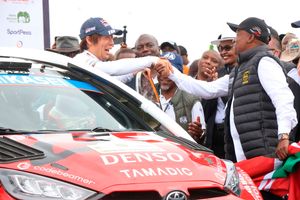
Known affectionately as “Patoo,” Njiru’s magnetic charm, which made him a fan favourite at the height of his career, was on full display last Sunday at the Toyota Gazoo Racing World Rally Team (TGR‑WRT) launch held at Cfao Mobility.
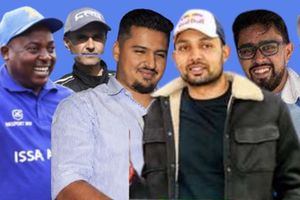
Njiru hogged the limelight amongst his peers, like three-time Safari champion Juha Kankkunen of Finland and athletics star and Africa’s fastest man Ferdinard Omanyala.
Njiru was among the founding members of a small advocacy group that lobbied the government through the Office of the President’s Principal Secretary Itea Muringo to return the Safari Rally to the World Rally Championship roster in 2013.
Their efforts culminated in the creation of the WRC Safari Rally Project in 2017, the foundation of the event we enjoy today.
In a previous interview, Kankkunen highlighted Njiru’s generosity, recalling trips to Njiru’s petrol station in Kibera, where many locals turned up to glimpse the motorsport stars.
Njiru, who owned that station, never hesitated to bring his foreign colleagues -- Ari Vatanen, Markku Alen, Carlos Sainz and Luis Moya -- into the heart of Kenya, giving them a taste of life far beyond five‑star hotels and the dusty rally routes.
In Kibera, he was a neighbourhood hero, second only to former MP and Prime Minister Raila Odinga.
“Juha loved Kenya and Kibera,” Njiru recalled, looking rather fit and younger than his 68 years.
Njiru’s path to becoming an altar boy was interrupted by the roar of rally cars over Runyenges Hills in the early 1970s. “My duties were often cut short by the sound of the rally, and sometimes the whole congregation would spill onto the road to cheer,” he said. “It felt like life on the other side was more exciting.”
He then swore he would one day get behind the wheel of a rally car, even though his father never owned a vehicle.
By age 12, Njiru had already slipped away although he still carried a rosary throughout his life.
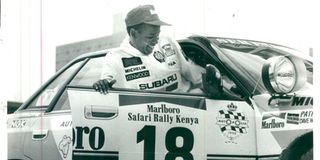
Patrick Njiru (centre) and co-driver Ricky Mathews (left) celebrate after finishing 12th in th 1993 Safari Rally in a Subaru Vivo car number 7 on April 12, 1993.
Photo credit: File | Nation Media Group
After completing secondary school education at St Paul’s Kevote Boys’ Secondary School, Njiru earned a scholarship to study mechanical engineering in Japan in 1980.
He returned with a diploma and a lifelong friendship with his Japanese mentor, Nuriyuki Koseki. He first worked for Westlands Motors, shifted to Mombasa briefly before deciding to start his own workshop and petrol station.
In 1987, Koseki, then involved in the creation of Subaru Tecnica International (STi), the competition department within Fuji Heavy Industries, offered Njiru a car after watching him labour over a Subaru hatchback he’d patched together at his first Caltex station opposite Safaricom House.
Koseki, who had spent two years helping build STi, invited Njiru -- who registered a Did Not Finish in his first Safari in 1984 -- to join the Subaru team.
In 1987, Njiru and Gavin Bannet piloted a Subaru Leone to 17th place, breaking an eight‑year streak where no African driver had completed the Safari Rally. That result unlocked a flood of commercial interest.
Marlboro signed him on a three‑year deal worth Sh250,000 per year (about Sh20 million today).
Nairobi’s Serena, Hilton, Caltex Oil (his station’s supplier), Panadol, Coca‑Cola, Kimbo, Daewoo, Pirelli Tyres, and Standard Chartered Bank all lined up lucrative sponsorships. He was the ultimate influencer known from Turkana to Lamu, Kisumu to the Somalia border.
Buoyed by that breakthrough, Subaru introduced the turbocharged Legacy in 1989, a move championed by Koseki, who persuaded Fuji Heavy Industries to prove the model’s durability by attempting the FIA 100,000km world endurance record.
From January 2 to January 21, 1989, three Japanese drivers drove the Legacy nonstop at the Arizona Test Center near Phoenix, covering 100,000 km at an average of 138.78 mph (223.35 kmh) over 447 hours 44 minutes 9.887 seconds for 18.5 days.
Pit stops occurred every two hours for driver changes and refuelling, while tyres were swapped every 96 hours (about 13,400 mi/21,600 km). The triumph convinced Koseki to debut the Legacy at the Safari Rally.
Koseki later invited Njiru to join the Subaru Motorsport Group as Fuji Heavy Industries prepared a full World Rally Championship programme for 1989. The partnership deepened, and by the early 1990s, Njiru’s performances behind a Subaru had become the stuff of legend.
Of the 27 drivers ever to compete for Subaru’s All‑Works team, seven were or became world champions, while two were Kenyans, namely, Njiru and Ian Duncan.
Both belong to an elite group of Subaru icons who helped turn the brand from an obscure name into a rally powerhouse, especially with the beloved Impreza STI/WRX, a car that inspired a near‑cult following worldwide.
In 1990, Subaru fielded six cars at the Safari under the leadership of Finnish ace Markku Alen. All Group A Subaru drivers retired except Kenya’s Jim Heather Hayes, who finished sixth overall.
World champion Juha Kankkunen (left) is received by Kenyan driving ace Patrick Njiru at the Jomo Kenyatta International Airport, Nairobi ahead of the Martini Safari Rally.
Photo credit: File | Nation Media Group
Njiru, a rapidly learning rookie who had clawed his way up from the back of the pack to finish eighth, became the first driver to complete the Safari in a Group N (standard‑spec) Legacy and the first of his four national titles sponsored by cigarette manufacturers Marlboro and several local companies.
Njiru sparked a Subaru mania in Kenya, championing the marque from 1984 until 1999.
By 1992, he was celebrated across the continent as a multiracial icon and was even chosen by South Africa’s newly‑formed “Rainbow Nation” as a symbol of reconciliation by inviting him to race in South Africa, finishing a respectable seventh in a Nissan Stanza.
In 1993, British American Tobacco (BAT) signed Njiru on a Sh750,000 a year contract, enabling him to contest the Safari in a tiny 990cc Subaru Vivio alongside Colin McRae.
His influence rippled through the burgeoning Kenyan middle class, driving demand for second‑hand Impreza WRX STI models imported from Japan and Europe.
When Subaru released the Impreza, Njiru, backed by full factory support, helped develop the car through the Kenya National Rally Championship (KNRC) that same year and raced in the WRC Safari in 1994.
In fact, Njiru, co-driven by Abdul Sidi, debuted the Subaru Impreza WRX Group N in the Safari, finishing a career best fourth overall in the 1994 Safari Rally -- the highest ever placement by an African driver.
His 1994 Safari effort coincided with Subaru’s shift in motorsport management from its in‑house team to the UK‑based Prodrive outfit, which would guide the brand into the upper echelons of the World Rally Championship.
Njiru is saddened by the gradual decline of rally sport in Kenya, arguing that it should be club‑driven. “If 15 clubs can only nurture three drivers, the Kenya National Rally Championship will never thrive,” he said.
He recalled negotiating his personal BAT sponsorship while also securing Sh30 million for the Safari Rally between 1995‑1997.
He later struck a similar deal for the Equator Rally via Caltex Oil and shared the proceeds with fellow drivers such as Paul Bailey, Kimathi Maingi and Tanveer Alam, who were part of his Sportsman Rally Team.
“Bro, you don’t eat alone,” Njiru reminded them. “For me to thrive, we needed more funded drivers and a healthy motorsport ecosystem that benefited everyone.”
He said that by now each club should have its own land and property where young drivers can be mentored. “I and like-minded people like Manoj Shah, built the Kenya Motorsports Club (KMSC) clubhouse in South C after being gifted land by former Nairobi PC Fred Waiganjo.”
He said that club-organised training rallies, of which he was a beneficiary, should be the starting point. “Today we need this approach, say a 60km training rally with standard cars. No services or support, and gradually graduate.
“In my time, our motorsport clubs were very strong. We had eight very good clubs: the Kenya Motorsport Club, East Africa Motorsport Club, Rift Valley Motorsport Club, Mombasa Motorsport Club, Western Kenya Motorsport Club and Simba Union Club, and they were very active,” said Njiru.
His total commitment is to his wife Esther, children and grandchildren. “Family is key, bro.”
Future? According to him, Kenya needs a strong motorsport pyramid -- training rallies, rally cross, class categories in the KNRC and good, progressive, visionary leadership. This will develop more drivers and have more Kenyans in the Safari Rally.