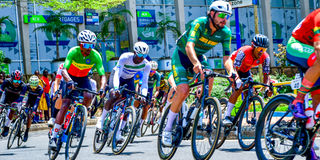
When the 2026 Africa Road Cycling Championships concluded in Kisumu last week, the stark reality of Kenyan cycling was laid bare: the host nation failed to secure a single podium finish across all senior and Under-23 categories.
The heartbreak, however, was not due to a lack of talent or grit, but a massive technology gap. While continental rivals glided on state-of-the-art, digitalised machines engineered for the World Tour, Kenyan riders were left fighting a losing battle on outdated, manual, and mismatched gear.
“Our bicycles are not the best. We are engaging with the relevant authorities to seek their support,” he said.
For instance, machines used by Kenyan riders were indeed inferior to the sleek bikes used by South African cyclists.
So, just how expensive is it to be a professional cyclist?
Mwangi, who is also the KCF chief executive, says a standard racing bike costs between $3,900 (Sh500,000) and $23,000 (Sh3 million), while riding apparel ranges from Sh50,000 to Sh90,000.
Professional bicycles cost between $1,500 (Sh195,000) and $15,000 (Sh1.95m) for the world pro tier. For example, Slovenian cyclist Tadej Pogačar rode the Colnago Y1Rs bike to victory in the 2025 and 2026 Tour de France.
Pogačar’s fleet of seven identical Colnago Y1Rs bikes cost a total of $136,675 (Sh17.8m), with each bike costing $19,525 (Sh2.53m). The frame alone costs around US$7,500 (Sh974,000).
Photo credit: Nation Media Group
Racing with UAE Team Emirates, Pogačar won the 2024 Tour de France on Colnago V4Rs, a versatile all-rounder race bike, before upgrading to the Y1Rs. The V4Rs Road and the Colnago TT1 for time trials cost $20,000 each (Sh2.6m)
Pogačar won both the 2020 and 2021 Tour de France races while riding a Colnago V3Rs carbon-fibre road bike. Each bike cost up to $12,000 (Sh1.6m).
It’s not just the bikes that are expensive. The attire that Pogačar wore during his racing season cost between $1,750 (Sh228,000) to $1,850 (240,000).
Pogačar’s kit consisted of specialised, rainbow-striped, signature-edition gear rather than standard team apparel.
The helmet cost $475 (Sh62,000), sunglasses $270 (Sh35,000), jersey $150 (Sh19,000), the bib shorts $260 (Sh34,000), the gloves and socks $60–80 (Sh8,000–10,000), and the 3D-knitted lace-up shoes $475 (Sh62,000). Back in Kisumu, Callum Ormiston from South Africa powered his Colnago V4Rs, a similar bike to the one Pogačar used to win the 2024 Tour de France.
South Africa’s Callum Ormiston celebrates after winning the men’s elite 153km road race during the 2026 CAC Road Cycling African Championships in Kisumu on October 25, 2026. Ormiston clocked three hours and 44 minutes to dethrone defending champion Merhawi Kudus of Eritrea.
Photo credit: Alex Odhiambo | Nation Media Group
“These bikes are beyond our reach, and that is what makes the difference,” said Cornelius Kemboi, who settled 36th, 10 minutes and 18 seconds behind the winner. Kemboi rode a 2015 Italian Kuota Rim Brake Road Bike which cost him Sh120,000. A new version now costs about Sh800,000.
“Mine is an old manual version, whereas the new one is digitalised with Bluetooth. The new Kuota and Colnago versions navigate the wind channel well,” said Kemboi.
He said they stand no chance against cyclists riding high-performance aero road bikes engineered for maximum speed, flat-to-rolling terrain and World Tour sprints, such as Colnago, Cervélo S5 and Cannondale SuperSix EVO 6.
Kemboi points out that he spends over Sh60,000 on competition kit and servicing his machine just to compete in one event per month. This includes Sh 30,000 for a jersey, Sh15,000 for shoes, and Sh10,000 for servicing his bike.
“That is very much on the lower side of the budget. The cost increases with more races per month,” said Kemboi, who has competed in 12 local events so far this year. “
A Kenyan cyclist competes in the Men’s Under-23 and Elite Road Race during the 2026 CAC Road Cycling African Championships in Kisumu, Kenya.
Kemboi reckons that it’s easier to acquire modern professional bikes from Dubai than to order them directly from the manufacturers, but heavy taxation at home makes things difficult.
“We need tax exemption on these competition bikes, and that’s where KCF needs to step in,” said Kemboi.
Kendra Masiga, who uses a Factor Bike donated by the Amani Team and fitted with gravel wheels, agrees that inferior equipment has been their main undoing over the years.
“There is no way I can use gravel wheels on the road and achieve good results,” said Masiga, the reigning national champion who represented Kenya at the Commonwealth Games in Glasgow, Scotland, in July this year, as well as at the World Championships.
He said that they need sponsorship to acquire good machines and compete abroad if Kenya is to achieve good results at an international level. “None of us in the national team has their own modern bike,” he said.
Evan Wangai reckons that a lack of equipment and proper nutrition, as well as inadequate support from the federation, are the reasons why Team Kenya has failed to perform over the years.
Wangai used a Pinarello Bolide bike, worth Sh1.5 million, for the time trial and a Pinarello F8 for road racing — both donated by two-time Olympic marathon champion Eliud Kipchoge. He said that cycling is a personal initiative that comes with many challenges.
“Basically, we use our own bicycles when representing the country, and were it not for Kipchoge, who donated several bikes to us after the 2019 Ineos 1:59 Challenge, we would be using inferior ones,” said Wangai, who is based in Kaptagat.
A cyclist from Zimbabwe’s national team competes during the 2026 CAC Road Cycling African Championships in Kisumu, Kenya.
Team Amani has some of the most expensive bikes, mainly Factor Bikes, ranging in price from $6,799 (Sh800,000) to over $15,000 (Sh1,945 million).
Wangai noted that nutrition plays a huge role in cycling, but this is an individual effort, even within Team Kenya.
“I spend close to Sh100,000 on nutrition, including a balanced diet and supplements. This is in addition to the competition gear, such as a helmet, shoes, and a jersey, which cost around Sh20,000, Sh30,000, and Sh30,000,” said Wangai.
“It’s an expensive affair, and it gets worse when KCF can’t even provide proper meals at competitions,” he said.