The 27th edition of the annual Safari Sevens will be held at Nyayo Stadium. Nairobi this weekend.
Twelve men’s teams and eight women’s teams will fight it out for glory in the tournament considered one of the premier sevens events in Africa.
The inaugural Safari Sevens was held from July 27 to 28 at the Rugby Football Union of East Africa ground and Impala Club, and featured 20 teams.
The home country fielded two sides, Kenyan Sevens and Shujaa, which was then the second string national team.
Kenya, featuring a 20-year-old Sydney Obonyo aka “Black Rose”, were drawn in Pool “D” alongside Seychelles, Selkirk, Bristol University and Uganda.
Obonyo started on the bench in Kenya’s first game against Seychelles, but was called in sooner than planned when star flyhalf Sammy Khakame got injured.
The fleet-footed Impala winger showed just why he was one of the best attackers in Kenyan rugby, his slash and cut play, comparable to another devastating attacker who came before him, Edward Rombo, in display for all to see.
Kenya looked well on their way to the semi-finals needing to beat neighbours Uganda in their final pool match.
“‘There was pin drop silence at the RFUEA Grounds when we lost 21-7 to Uganda. It meant we were knocked out of the main Cup competition,” Obonyo recalls. Kenya were relegated to the Plate competition where the twinkle-toed Obonyo cemented his try scoring legend.
Kenya thumped their brothers Shujaa 40-19 with two sublime tries and two assists from Obonyo before crushing Mauritius 33-10 in the semi-final.
As fate would have it, Kenya met Uganda for the second time in the tournament, in the final.
Kenya duly got their revenge, hitting Uganda 38-12 to lift the Plate crown as Obonyo starred with two beautifully delivered long range tries.
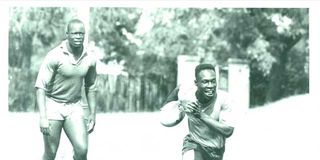
Impala centre Sydney Obonyo training at the Rugby Football Union of East Africa ground in Nairobi in the mid 1990s. He was named the MVP of the 1996 Safari Sevens.
Photo credit: File | Nation
Obonyo ended up with seven tries and 20 conversions and was named the Most Valuable Player of that tournament.
Interestingly, Uganda’s Yayiro Kasasa had better statistics, with 14 tries and four conversions.
Obonyo did his secondary eduction at Musingu High School in Kakamega County where he learned the game of rugby. He joined Impala after clearing school and soon become one of their star players, his mesmerising side step distinguishing him from other backs.
“At the 1996 Driftwood Sevens I was invited by Kenya Harlequins and turned out for them as a guest player in the tournament. A few weeks later I was named in the Kenya Sevens.”
Obonyo went on tour Kelso and Silkirk in Scotland with Kenya Sevens after his Safari Sevens exploits.
He played for Kenya in the 1997 Rugby World Cup qualifiers against the Arabian Gulf and Tunisia. He was also part of the Kenya Sevens team that played in the 2002 Glasgow Commonwealth Games.
He was awarded his honours cap in 2001 for loyal and sterling service to Kenya Harlequins, a club he joined in 1997.
In 2004 he was named the MVP at the national sevens circuit. He coached Quins and Mean Machine after retiring as a player.