The late Robin Cahill is credited with the idea of starting the Safari Sevens whose first edition was held in 1996.
Organisers used to pride themselves by touting it as the premier rugby sevens tournament in Africa, and the fans loved it.
Three decades later, Cahill must be turning in his grave.
The tournament attendance that grew from 8,000 fans a day in the earlier editions to 48,000 at its peak is now at its lowest. Only about 5,000 fans attended this year's final day action at Nyayo National Stadium.
When the tournament was previously staged at Nyayo in 2011 and 2012, long queues snaked along Lang’ata Road as eager fans came for their doze of rugby sevens fix. Over 60,000 fans then attended the rugby bonanza over the three days.
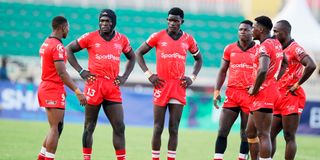
Kenyan fans cheer Kenya Shujaa when the team played against French Renegades during the Safari Sevens at Nyayo National Stadium in Nairobi on October 11, 2025.
Photo credit: Chris Omollo | Nation Media Group
In 2013 the tournament was moved to the giant Moi International Sports Centre, Kasarani where attendance figures of 48,000 on day one and 35,000 on day two were recorded despite the security fears following the Westgate Mall terrorist attack.
The tournament was a must-watch on the sports calendar and even within the entertainment industry in the country. The event has been a Nairobi social event that has been part of the culture of the city for years.
In the field of play, top teams regularly toured. Kenya even put in a bid to have the Safari Sevens as part of the prestigious World Rugby Sevens Series in 2013. Many reckon the West Gate terror attack is what cost the country a successful bid.
The top sides regularly came to the Safari Sevens - like Samoa, winners in 2005 and 2011, Argentina, Fiji, Spain, South Africa, Germany and Portugal - were all core teams in the World Series then.
Last year, the event was moved to Kenyatta Stadium, Machakos County where not more than 5,000 fans attended in a muted rugby celebration as organisers struggled to attract teams.
Zimbabwe, Uganda and Reunion were the only foreign national teams at this year’s event with some fringe sides from Europe.
Safari Sevens Local Organising Committee chairman Moses Ndale, who is also the Kenya Rugby Union (KRU) vice chairman, acknowledged the challenges they are facing.
“We must make this event a whole year affair in terms of planning,” said Ndale. “We only announced the dates four months ago and that for sure can’t attract quality.”
Naomi Amuguni of Kenya Lionesses (left) evades Yvonne Najuma of Uganda as she charges towards the try line during the Safari Sevens at Nyayo National Stadium in Nairobi on October 11, 2025.
Photo credit: Chris Omollo | Nation Media Group
Ndale said that their target is to attract at least four Word Rugby Division I sides but that calls for proper logistical planning that include paying for the teams’ airfare, accommodation and local transport.
“Each team will require at an estimated Sh5 million to invite and to achieve this we require partnerships,” said Ndale.
“We had huge public support for rugby and it was an adventure for the people, who wanted to identify with success. Our biggest ambassador was the national sevens team, Shujaa,” said Mwangi Muthee, who was the KRU chairman from 2011 to 2014.
The 2015 tournament almost failed to take place with governance issues taking centre stage at KRU as title sponsors Safaricom pulled out. Poor attendance returned to haunt the tournament in 2016 at Kasarani.
Former Kenya Rugby Union chairman Mwangi Muthee.
Photo credit: File | AFP
The tournament failed to take place for the first time in 2017, only to return in 2018 and 2019 with the venue reverting to RFUEA.
Covid-19 saw the event fail to take place in 2020, before returning in 2021 with poor attendance and little razzmatazz. In 2022, the tournament was not held for lack of sponsors.
Muthee said he inherited a good product (Safari Sevens) from the Rugby Patrons Society whose membership included the likes of Cahill, Dennis Awori, John Lloyd and George Kariuki, eternal servants of the game.
Muthee noted that they attracted huge partnerships from the government, Safaricom, Kenya Airways and Coca Cola among other corporations.
"The KRU board already has a product and all they need is to give stakeholders, the public and sponsors the trust and confidence they need," said Muthee.
"One can’t manage something they don’t understand. Marketing Safari Sevens isn’t a big deal. It only needs people who understand the game and have passion,” said Muthee
He pointed out that rugby has its own culture and philosophy that most KRU Board members have no clue about, adding that Safari Sevens preparations need a 24/7 approach, not knee-jerk reaction.
Muthee further recounted that they used to post a surplus of Sh20 million from Safari Sevens that went towards supporting the growth of the game, particularly Kenya Cup where teams got funds to honour away matches.
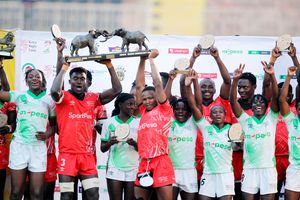
Kenya Shujaa and Kenya Lionesses players celebrate winning the 2025 Safari Sevens men's and women's crowns at Nyayo National Stadium in Nairobi on on October 12, 2025.
Photo credit: Chris Omollo | Nation Media Group
"That was part of our affirmative action that revived Kisumu Rugby Club, Western Bulls among others teams," said Muthee.
That many people were not even aware this year’s tournament was taking place, let alone which teams were participating, is an indictment of how low the tournament has fallen.
One consolation, though, is that the fans who attended witnessed the home sides Kenya Shujaa and Kenya Lionesses put on a good show to win the men’s and women’s crowns.