The Kenya Airports Authority (KAA) has unveiled an ambitious, years-long plan to overhaul Jomo Kenyatta International Airport (JKIA), marking the most sweeping redevelopment of the country’s primary aviation gateway in more than four decades and coming months after collapse of the controversial Adani proposal.
The proposal, presented this week by KAA and global infrastructure consultancy Sidara, lays out a transformative redesign that introduces a new terminal, a second runway, expanded airfield facilities, and an airport city aimed at positioning JKIA among Africa’s leading international hubs.
The Integrated Master Plan 2025–2045 comes at a critical moment for JKIA, which has struggled with ageing infrastructure, safety gaps, overcrowding, and stiff regional competition from modernised airports in Addis Ababa, Kigali, and Dar es Salaam.
Passenger traffic is projected to more than double over the next 20 years - from 8.6 million in 2024 to over 22 million by 2045 - a surge experts say the current facilities cannot support.
The new blueprint seen by Nation is a state-of-the-art passenger terminal capable of handling at least 10 million passengers in its first phase, expandable to 15 million.
Designed in an X-shaped layout, the terminal features four piers, a central processing hall, expanded security and immigration capacity, modern commercial spaces, and fully separated domestic and international flows. It will replace the patchwork of legacy structures that have long been strained under rising demand.
The redevelopment also includes construction of a second full-length runway, ending JKIA’s risky dependence on its single, increasingly fatigued 06/24 runway.
The parallel runway will enable simultaneous landings and departures, reduce delays, and improve resilience to emergencies or maintenance closures - a persistent operational bottleneck in recent years.
Even before the second runway is completed, KAA plans immediate airfield improvements, including new rapid exits and a partial parallel taxiway to alleviate congestion.
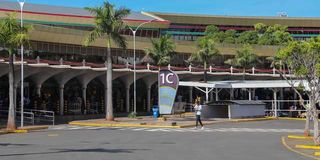
Passengers exit the International Arrival Terminal 1A at the Jomo Kenyatta International Airport on November 7, 2023.
Photo credit: Wilfred Nyangaresi | Nation Media Group
“We are beginning with an upgrade of the existing terminal and the consultant is already on the ground to study and understand how quickly a passenger can be served even as we work on the construction of a new terminal,” KAA acting managing director Dr Mohamud Gedi said.
The move also comes after President William Ruto , in his recent State of the Nation Address, offered an official acknowledgment yet of JKIA’s decline.
He told MPs that the airport had reached a stage where “piecemeal repairs can no longer sustain safe, modern operations,” warning that years of deferred maintenance had left key facilities “dangerously outdated” and unable to meet the demands of a regional hub.
President Ruto said the breakdowns that have disrupted airport operations—including power outages, malfunctioning baggage systems, leaking roofs and recurring airside defects—were symptoms of a deeper structural problem that could no longer be ignored.
In the address, he said modernising JKIA was not a luxury but a national imperative, essential to protecting Kenya’s aviation competitiveness, supporting tourism and trade, and avoiding future safety incidents.
Beyond passenger facilities, the plan envisions a major expansion of cargo operations, maintenance zones, ground handling areas, and firefighting capacity.
KAA says the redevelopment is designed to address long-standing weaknesses exposed in recent safety audits — including insufficient infrastructure maintenance, overstretched fire and rescue teams, and inadequate airfield geometry.
The new JKIA is also conceived as the anchor of a wider airport city, featuring hotels, logistics parks, commercial office districts, and a special economic zone .
The concept mirrors developments seen in Dubai, Doha, and Istanbul, where airports function as economic ecosystems extending far beyond aviation. KAA believes the airport city will attract global investment, diversify revenue, and help Nairobi compete as a continental transport and business hub.
The plan will be rolled out in three phases. The immediate phase focuses on upgrading existing terminals and improving airfield performance.
Medium-term works include construction of the new terminal and expanded support facilities. The long-term phase adds the second terminal expansion, full cargo build-out and final airfield geometry. The proposal also revives a long-running debate about the future of Wilson Airport, Nairobi’s second aviation gateway.
The master plan considers relocating some scheduled domestic operations from Wilson to JKIA to consolidate traffic and improve safety, though KAA also presents an alternative option: a costly dual-runway upgrade at Wilson.
The revival of a large-scale JKIA redevelopment effort comes two years after the controversial Adani concession proposal collapsed following public outcry and presidential intervention.
The rollout still faces big questions chief among them financing, procurement transparency and job security.
Terminal 1A at Jomo Kenyatta International Airport (JKIA) in Nairobi.
Dr Gedi explained that the contracting will be guided by the Public Procurement and Disposal Act, and will be carried out in a transparent manner. The government is currently seeking investors for the project.
“This is a very important project for the nation and there is nothing we will hide. It will change the trajectory of the country in the next few years compared to our peers and we are not taking chances,” he said.
Workers’ unions have already signalled interest in consulting on how the redevelopment will affect staffing, training, and job security, especially given JKIA’s chronic under-staffing in technical and emergency roles. Kenya Aviation Workers Union (KAWU) Secretary General Moss Ndiema said they are yet to be consulted on the new plan.
“They have not yet consulted us on how this will affect the employees…but our position still remains that the funds for the renovation and the construction of the terminal must come from KAA. We do not want them giving away our airport to someone else,” he said.