In a narrow, cobbled alley winding through the heart of Lamu Old Town, a weathered scene tells of centuries past.
Suspended by rusted chains from a wooden rod on one of the town’s ancient buildings, a corrugated wooden signboard sways above the pedestrian path. Its faded cream-white paint barely reveals the lettering of a name long gone.
The sign directs visitors to the German Post Office Museum, Lamu—the first German post office in East Africa. The museum is a window into Kenya’s coastal heritage, offering insights into a little-known chapter of colonial history.
Mohammed Mwenje, curator for Lamu under the National Museums of Kenya (NMK), describes the German Post Office as a vital symbol of historical ties between Kenya and Germany.
“The post office reflects Germany’s brief yet significant presence along the Swahili coast in the late nineteenth century,” he explains.
Originally built as a private residence in the early 1800s, the building became a hub for trade and communication during Germany’s expansion in East Africa.
In 1888, the German East Africa Company established the post office in Lamu as a base for correspondence with the protectorate of Witu.
Exhibitions and other displays inside the German Post Office in Lamu are shown in these photos taken on Tuesday, December 16, 2025.
Photo credit: Pool
“Although it operated for only a few years, the post office played a crucial role in facilitating trade contracts and communications between German settlements and other coastal centres,” Mr Mwenje notes. Operations ceased in 1891 after Germany withdrew from Witu.
Restoration in the early 1990s, supported by NMK and the German Embassy, preserved a vital piece of Kenya’s colonial and intercultural heritage.
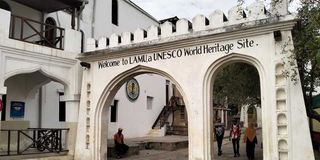
The main entry to Lamu Old Town on November 9, 2025.
Photo credit: Kalume Kazungu| Nation Media Group
Today, the museum houses photographs, documents, and memorabilia illuminating early German–East African interactions.
“The museum has become a key tourist attraction, drawing visitors keen to explore the shared history between Germany and Kenya,” Mr Mwenje adds.
The Curator, National Museums of Kenya (NMK) in charge of Lamu, Mohammed Ali Mwenje.
Photo credit: Kalume Kazungu|Nation Media Group
Between September 2024 and August 2025, Lamu Museums partnered with Berlin’s Ethnographic Museum to curate the exhibition Talking Mats, showcasing traditional Swahili mats (mikeka) and their social, ceremonial, and ritual roles.
The exhibition displayed historically significant mats preserved in Berlin since the early 1900s, highlighting Swahili artistry and cultural continuity.
It also demonstrated traditional mat-making skills passed down through generations. Mats are woven from local materials, including doum palm (Hyphaene thebaica) and wild date palm leaves (Phoenix reclinata).
Beyond their practical use, the mats carry symbolic meanings. Mr Mwenje explained that patterns and motifs act as visual narratives, conveying messages about identity, morality, and social order.
The signboard to the German Post Office Museum in Lamu hangs above the alleyway of Lamu Old Town street on December 4, 2025.
Photo credit: Kalume Kazungu|Nation Media Group
“The exhibition emphasised the strength of intercultural cooperation, promoting dialogue and mutual understanding between Kenya and Germany through shared heritage,” he said.
Collaborations like this foster knowledge exchange among curators and conservationists, while prompting reflection on ethical approaches to colonial-era collections.
Swahili heritage expert Mubarak Abdulkadir Abdalla, former curator of Lamu, Gedi, and Fort Jesus UNESCO sites, called the German Post Office a crucial link, symbolising the enduring friendship between Germany and Lamu.
The German Post Office letter insertion point in Lamu is shown in this photo, taken on December 4, 2025.
Photo credit: Kalume Kazungu|Nation Media Group
He urged Germany and Europe to support building a mausoleum for Ahmad bin Sultan Fumoliti bin Sultan Sheikh Nabahani, also known as Ahmed Simba, founder of Witu Old Town and a close associate of German colonialists. Sultan Fumoliti ruled Witu from 1856 to 1889, and his tomb remains in the southern part of the old town.
“These two historic sites reflect the long-standing connection between Germany and Lamu. Proper preservation is vital to ensure future generations remember this important relationship and shared heritage,” Mr Abdulkadir said.
Together, the German Post Office Museum and Witu’s historic tomb tell a story of colonial encounters, intercultural exchange, and enduring friendships—a legacy that remains alive in Lamu’s ancient streets and cultural memory.