In December 2002, Sudhir Vidyarthi was thrilled, like most Kenyans, that a united opposition led by Mwai Kibaki had defeated President’s Daniel Moi’s Kanu. Sudhir – who died on August 14 at the age of 79 – knew almost all the new Cabinet ministers, having fought with them in the trenches for democratic freedom, frequently risking not only his own freedom and future but Colourprint’s – the joint family’s main source of livelihood.
His brothers Bhushan and Anil were equal partners in that courageous stand.
Sudhir’s eldest son Amar, who had seen many of these new leaders come and go at their home at all hours, recalled this week that he told his father a couple of months later how excited he must have been that finally we had a team that would improve the lot of Kenyans. The reply jolted Amar: “I am not sure of that, so I am still in opposition.”
We know that Sudhir was frequently prescient, but to foresee this slide when there was overwhelming euphoria in the country was astonishing.
It’s worth recalling amid our current woes that after the election of Kibaki, Kenyans were found to be the most optimistic people in the entire world, according to a global Gallup Poll.
That, however, did not blind Sudhir to the ills he saw emerging.
Amar said Sudhir explained that he was horrified because the corrosive national corruption – which had penetrated every section of our economy – was used by the opposition to mobilise the nation against Moi and Kanu, and yet some lower-level officers were already driving brand new cars and proposing profitable “joint ventures valued at millions” to him.
Sudhir’s courage against established power from a relatively small businessperson is rare. For most people who knew Sudhir personally, it was not this courage and integrity that was their main source of affection. For them, what counted even more was Sudhir’s extraordinary, larger-than-life persona that had swept them into his orbit.
His effervescent, charismatic, disarming, all-embracing and welcoming manner was irresistible as was a magnetic story-telling style that was made easier by his adventurous life, followed by the ability to recite verses from his beloved Urdu poets from the Mughal period onwards.
But what kept Sudhir human despite his accomplishments was his shadow of emotional vulnerability. Few highly successful people carry that.
Cabinet Secretary Mutahi Kagwe focused on these social qualities in a note about his laughter, compassion, kindness and lively spirit.
Kisumu Governor Anyang Nyong’o emphasised Sudhir and his family’s strength in printing progressive journals underground pamphlets. Sudhir, Kagwe, Nyong’o and I were in fact the closest of Sudhir’s political friends until I left Kenya.
Indeed, when I called Dorothy Nyong’o to inform her of Sudhir’s death, she cried for a long time. Sudhir was a truly loveable person and a generous host, courtesy of the ever-gracious Nana.
Sudhir’s popularity was underpinned by his obliviousness to the divisive ills that plague humanity, the most potent in our formerly settled colony being race.
Sudhir Vidyarthi with his daughter, Mercy.
Photo credit: Pool
That particular blindness to race and class was highlighted by Sudhir’s eldest son Amar’s Eulogy. The eulogy is, without exaggeration, one of the most vivid ever written about a parent since its Grecian origin with Pericles’ Funeral Oration.
Everyone I shared that eulogy with wrote back to mention their amazement at Amar having miraculously captured the seemingly uncatchable and limitless Sudhir. Former Prime Minister Raila Odinga wrote that as he read the eulogy, it was like Sudhir was in front of him.
Teddy Warria, one of my favourite youthful Kenya polymaths, and author of Son of the Nile, wrote: “We can indeed make Kenya beautiful through our writing.”
Sudhir’s courage, which was shared by his brothers, flowed in their veins from their father GL Vidyarthi, a pro-independence editor who was the first person to be jailed for sedition in Kenya in 1948.
As Peter Muiruri wrote in the Standard, Sudhir belonged to a family of giants that shaped the future of East Africa as printers and political.
When in January 1994, security agents descended on Colourprint to seize 15,000 copies of Kenneth Matiba’s book detailing massive corruption in President Moi’s inner circle, their workers bought time by preventing the officers from entering while others could alert Matiba, who rushed to Colourprint premises.
The Colourprint staff were loyal as there were few employers who treated their workers better. Many remained at Colourprint for decades.
I recall being with the three brothers discussing the new, faster printing technology but they did not want to introduce it as it would require employee layoffs.
Sudhir was the most openly political of the brothers, thanks to his having gone to Uganda in the late 1960s, when they did not have a printing business of their own.
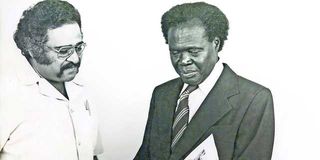
In Kampala, he partnered with his friend (and my close family friend!) Javed Hussein Shah to set up a small shop which was patronised by Ugandan President Milton Obote’s party to publish pamphlets.
The ever-lively Sudhir came to know Obote. Soon, President Obote and Sudhir were playing checkers regularly! The Milton Obote Foundation then began a party newspaper, The People, and Sudhir and Javed’s press grew rapidly.
Sudhir flourished in Uganda socially too. Given his love of poetry, he became early friends with a fledging poet, Yusuf Shah, who described in his beautiful and poetic expression how Sudhir turned a small, struggling Urdu group into a vibrant national forum for poetry readings.
It became so popular, with a Sufi-leaning Sudhi, that soon they were able to invite poets and qawwali singers from India regularly.
The depth of Sudhir’s natural anti-race quality was immortalised by my friend Shashi Tharoor of the United Nations, when he visited Kenya in 2004, before he became the Indian Minister of State for External Affairs.
I suggested he meet Sudhir, who in his typical hospitality and extravagance, invited 50 friends!
In his column, “We Are All Kenyans Here” in The Hindu, India’s most influential paper, he wrote: “Indians abroad are often an insular people, was Kenya any different? I need not have worried. At Sudhir Vidyarthi’s garden and outdoor deck, the 50 guests were a striking ethnic and professional mix.”
Sudhir Vidyarthi was proudly holding a little Black toddler in his arms. “Meet my daughter Mercy,” he beamed. “She’s been with us since she was four months old.” His excitement was as palpable as his affection for the girl. I looked at them – Asian father, African daughter, sharing Indian food and chatting in an East African language – and I raised a silent toast to their Kenyan garden. I only wished I knew the Swahili word for heaven.”
Sudhir is survived by his wife Nana, sons Amar, Arjun and Gautam, daughters Poonam and Mercy, and grand-daughters Amisha, Aaria, Vinny, Saaya, and Zuri.