In August 1983, the Philippines’ Corazon Aquino stepped out of private life after the assassination of her husband, Ninoy Aquino. But her move was never simply about winning an election, but about rescuing a political cause on the verge of collapse.
Ninoy’s political allies, fighting to oust dictator Ferdinand Marcos, were suddenly consumed by grief, rivalry, and confusion, and the opposition risked splintering. Corazon’s decision to step forward gave the movement what it desperately lacked: a single, unifying face that was steady enough to hold together a shaken coalition long enough to fight.
Only a Corazon Aquino-like move can now save Raila Odinga’s Orange Democratic Party from breakup, and history is on her side.
There are reasons for that. Raila’s death, in October 2025, did not just remove a veteran leader. It removed the human infrastructure that held together a party for 20 years. Raila was not only the public face of Kenya’s opposition, but was also ODM’s final referee, the unchallenged arbiter of disputes, and the generator of emotions that kept the followers together. In effect, ODM functioned less as a conventional political party than as a constellation of loyalties, memories, and emotions.
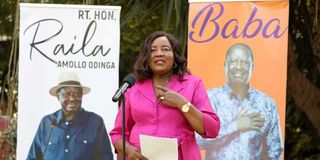
Mama Ida Odinga, widow of the late former Prime Minister Raila Odinga, speaks during celebrations marking what would have been Raila Odinga’s 81st birthday at his home in Karen, Nairobi, on January 7, 2025.
Photo credit: Bonface Bogita | Nation Media Group
That is the same predicament that faced the Indian National Congress when it had to pull the Italian-born Sonia Gandhi into politics after the assassination of Prime Minister Rajiv Gandhi in May 1991. Today, as the Congress party matriarch, Sonia is cited as one of the most powerful women politicians in the world and has led her party to victory, either alone or as a coalition partner. Interestingly, Sonia opted not to become Prime Minister.
Let us look at ODM, which in recent weeks has been drifting toward a succession storm. This is a phase the Indian National Congress went through after Rajiv Gandhi’s death. In that period, senior party figures struggled even to agree on who should chair meetings, while competing factions jostled for influence. Even the emergence of P.V. Narasimha Rao as a compromise leader did not fully settle the question of succession.
Mama Ida Odinga and Siaya Senator Oburu Oginga during Raila Odinga’s funeral in Bondo, Siaya County.
Photo credit: File | Nation Media Group
After Congress lost power in 1996, the party’s internal drift deepened, and it eventually turned to Sonia Gandhi to restore cohesion. Despite the “foreign origin” tag that later became a major point of contention, her leadership provided the Congress with a unifying centre and helped hold the organisation together through a difficult transition.
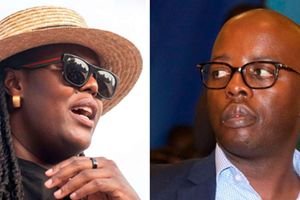
Politically, Raila died intestate. As a result, ODM is turning into a landscape of squabbles, and soon we shall see Oburu Odinga, Hassan Joho, Gladys Wanga, Babu Owino, and Edwin Sifuna engage in a fierce power struggle that will be the start of a breakup.
ODM should learn some lessons fast. First, that a party is built around a giant, and that fragmentation after the giant exits is almost inevitable (look at what happened to Kanu after Daniel Moi’s exit). This is because the unity that existed under Raila was not always the unity of institutions; it was often the unity of authority, maintained through personal arbitration, emotional loyalty, and the founder’s ability to compel ambitious rivals to hold their horses.
The point I am trying to make is that once that centre disappears, rivals stop waiting. Regions stop trusting, the way the Coast region is doing. Finally, generations stop submitting, and they argue with the oldies. This is not an ODM-specific curse. It is a global pattern.
In Sri Lanka, the assassination of Prime Minister S.W.R.D. Bandaranaike in 1959 could easily have torn his party into competing heirs. Instead, his widow, Sirimavo Bandaranaike, was persuaded to step forward, taking party leadership and then winning office as Prime Minister in 1960. Her rise was not just historic because she became the world’s first female prime minister. It was historic because it demonstrated how a widow can be used as political shock absorption. Sirimavo arrived with grief, continuity, and public sympathy, which are important elements in the temporary silence of the knives of internal rivals.
In Bangladesh, the story took a more muscular turn. After President Ziaur Rahman was assassinated, Khaleda Zia rose to lead the BNP, later becoming Prime Minister and one of the defining powers in Bangladeshi politics. Her case illustrates something important for ODM to understand: widow succession does not always remain symbolic. Sometimes it evolves into real power when the widow develops networks, commands party machinery, and becomes a political broker in her own right.
Former Prime Minister Raila Odinga.
Photo credit: File | Nation Media Group
That was also the case in Pakistan, where after Zulfikar Ali Bhutto was executed in 1979, Nusrat Bhutto stepped in to lead the Pakistan People’s Party (PPP) and keep its coalition alive under authoritarian pressure. Not every widow successor wins immediate state power. Sometimes the job is simpler and harder. Some widows used their husbands’ legacies to gain power, as happened in Nicaragua when Violeta Chamorro won the presidency in 1990.
Finally, we can recall how Janet Jagan from Guyana showed that widow succession can also be institutional and managerial rather than purely emotional. After President Cheddi Jagan died in 1997, she was sworn in as Prime Minister and then won the presidency later that year. This is widow succession not as street-level sympathy, but as a controlled transition inside a governing-party structure. It is also proof that grief can be channelled into an orderly transfer of authority when the internal machinery exists.
These are parallels that make the Ida Odinga factor important in ODM’s survival. However, it should be noted that widow symbolism is not magic. It does not erase factional ambition. It does not permanently eliminate the pull of regions, generations, and rival egos. What it does is more specific: it buys time, and it creates a moral ceiling under which internal rivals struggle to justify open civil war.
That is why the Ida Odinga idea carries weight. She is not simply Raila’s widow in the sentimental sense. She is one of the few figures left in ODM who can speak to multiple camps without immediately being dismissed as “their person.” She can talk to the base without sounding like betrayal. She can talk to party barons without sounding like competition. She can invoke Raila’s memory without turning it into a weapon. And crucially, she can embody the continuity ODM supporters crave in a moment when the party risks becoming unrecognisable.
The widow solution, if Ida Odinga is not shy about keeping off politics, works best when it is framed as emergency management, not dynastic coronation. The Sonia Gandhi route succeeds when it is used as a roof over competing barons—long enough to restore party discipline and build a roadmap. The Sirimavo route succeeds when it converts grief into organisational command. The Corazon Aquino route succeeds when it unites moral legitimacy with a clear political direction.
ODM’s challenge is that it is facing both kinds of risk at once: internal factional rivalry and national strategic uncertainty—because President William Ruto wants to lure the party into a coalition that might finally swallow the entire party. Moreover, the party is torn between competing visions—cooperation and bargaining within government structures versus opposition identity and distance from state power. And those visions map neatly onto the emerging factions. That is why the fight feels existential: it is not only about who leads, but about what the party becomes.
Still, even a perfect widow bridge cannot prevent the broader law of post-founder politics: some breakup is inevitable. Founder-parties don’t simply swap founders. They mutate. Some leaders will peel away. Some regional elites will experiment with alternatives. Some factions will decide the party is no longer their best vehicle. That is not failure; it is political gravity.
ODM’s choice is no longer whether it wants change. Change has already arrived. The choice is whether it wants to survive the change in one piece—or be remembered as the party that died of internal ambition after the man who held it together was buried.
For, if ODM does not play its ball well, it can choose early the cemetery in which it will be buried. With Baba not there, ODM can either rewrite itself with discipline—or be rewritten by its own drift.
John Kamau is a PhD candidate in History, University of Toronto. Email: [email protected]