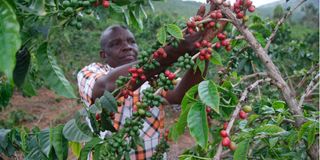
This week, President William Ruto stood before coffee farmers in Kirinyaga and launched yet another coffee revival programme. Déjà vu. We have been here before.
We have seen task forces, rescue plans, price stabilisation funds, new boards, fresh regulations, presidential directives and colourful speeches delivered before anxious farmers whose demand has never changed: pay us fairly for our sweat.
But the tragedy of Kenyan coffee is not merely that farmers are poor. It is that the country still behaves like a colony in one of the crops that once defined its global prestige.
We grow the beans, carry the debt, tend the bushes, endure the vagaries of weather and disease, and then surrender the real value elsewhere: to brokers, millers, marketers, financiers, exporters and foreign roasters who understand coffee not as agriculture, but as power.
This is why the coffee question is not only an economic question. It is a sovereignty question. When Jimi Wanjigi speaks of true sovereignty, he is pointing beyond flags, anthems and presidential motorcades. True sovereignty is the ability of a people to control the value of what they produce.
Safina Party Leader Jimi Wanjigi during an interview at his Kwacha House offices in Nairobi on October 8, 2025.
Photo credit: Evans Habil | Nation Media Group
It is the power to decide who buys, who processes, who prices, who profits and who is protected. A nation that cannot protect its farmers from extraction cannot honestly claim to have liberated them.
Coffee remains one of the last great theatres of neocolonial extraction in Kenya. Independence changed the colour of the administrators, but not the structure of the trade. The farmer remained at the bottom, the middleman grew fatter, and the global market continued to drink Kenyan excellence while the grower swallowed bitterness. Every “revival” programme that avoids this truth is not reform. It is theatre.
But Kenya will need more than speeches to revive coffee. It will need the skin of a rhino to confront the cartels, brokers, millers, marketing agents, thieves and mandarins who have reduced one of the world’s finest coffees to a peasant’s curse. More importantly, Kenya will have to confront a global economic structure that has kept the African farmer at the bottom of the coffee cup.
This is why the new Coffee Act, 2026, must be judged not by the number of licences it creates, the institutions it establishes, or the penalties it imposes, but by one question: does it return power to the farmer and sovereignty to the nation?
Absence of political courage
The Act establishes, once again, the Coffee Board of Kenya and the Coffee Research and Training Institute. It gives counties a greater role. It introduces 17 licence categories and seeks to separate millers, brokers, buyers, roasters and other players in the chain.
On paper, this is progress. But Kenya’s coffee problem has never been caused by the absence of law. It has been caused by the absence of political courage.
Ask Peter Munya what he found when he tried to confront the coffee cartels. Ask the Joseph Kieyah Taskforce what happened when it began to expose the architecture of theft. Ask farmers in Murang’a, Nyeri, Kirinyaga, Kiambu, Embu and Meru why they uprooted coffee bushes that once educated children and built stone houses.
Former Meru Governor Peter Munya.
Photo credit: Courtesy | PSCU
I have, for years, reported on coffee cartels to a point where I felt it was not safe. About the millers who colluded with thieves to steal coffee from cooperative societies and the police who did nothing. Farmers have lost coffee worth billions, and yet there is no big fish in jail.
In Kenya, coffee thieves are hardly caught. The celebrated arrest of MPs Muhuri Muchiri and Jesse Mwangi Gachago in 1978 for stealing the “big man’s” coffee remains a historical curiosity. Today, the thieves are more sophisticated. They do not only break into stores. They sit in offices. They sit in cooperative elections. They sit in milling firms. They sit in marketing agencies. They sit in export companies. They sit in government. They know how to steal without carrying a gunny bag.
The farmer grows the coffee. The cooperative delivers it. The miller grades it. The marketing agent presents it. The dealer buys it. The exporter ships it. The roaster brands it. The foreign consumer pays the premium. At every stage, value moves away from the farmer. At every stage, someone else knows more than the person who produced the crop.
In 1965, Kwame Nkrumah warned in Neo-Colonialism: The Last Stage of Imperialism that Africa would not benefit from increasing agricultural production unless it was politically and economically united enough to force the developed world to pay fair prices for its cash crops. He was right. A nation that cannot determine the price of its premium product has lost control of its economy. Japan cannot allow other countries to dictate the price of the vehicles it manufactures.
A sack of coffee beans.
Photo credit: File
Kenya’s coffee story proves Nkrumah’s point. We produce some of the best coffee in the world, yet the farmer is poor. We export a product that is celebrated in cafés from Seattle to Berlin, yet the villages that produce it are full of frustration. We have a globally respected origin, yet we have not built globally powerful Kenyan brands.
That is why the idea of true sovereignty is relevant here. A country that does not produce, industrialise, control value and free itself from debt colonialism cannot call itself truly sovereign. Sovereignty is not only about having a flag, a president, a parliament and an anthem, as JM Kariuki once told us. It is about controlling the economy that feeds the citizen.
Applied to coffee, true sovereignty means that Kenya must stop behaving like a supplier of raw material to a global factory owned by others. True sovereignty means that farmers must not only grow coffee; they must share in milling, roasting, branding, marketing and retailing. True sovereignty means that “Kenya AA” must not be merely a label used by foreign roasters to sell expensive coffee abroad while the Kenyan farmer waits for delayed bonus payments.
The tragedy is that Kenya’s coffee sector is still organised in the traditional colonial style. The African produces. The foreign market prices. The broker interprets. The state pretends to regulate. The farmer waits.
Why should Mathira, Othaya, Gichugu, Kangema, Kandara, Embu, Meru or Bungoma produce the raw material while value addition takes place elsewhere? Why should a foreign roaster take Kenyan coffee, create a brand, package it beautifully, sell it as a premium product, and return to the farmer only a fraction of the final value?
This is where the new Coffee Act must go beyond licensing. If it only creates a cleaner bureaucracy around an extractive system, it will fail. If it only regulates the chain without changing who captures value, it will fail. If it only punishes small offenders while protecting politically connected cartels, it will fail.
Coffee beans on display for auction at the Nairobi Coffee Exchange.
Photo credit: File | Nation Media Group
Then there was the conflict between millers, marketing agents and dealers. A marketing agent is supposed to protect the farmer. But what happens when the marketing agent and the miller are related? What happens when the dealer belongs to the same multinational family? What happens when companies with different local directors are, in reality, joined at the hip internationally? This was the rigged theatre that I confronted as a writer.
The other problem was the preparation of the catalogue by the marketing agent. The catalogue indicates grades, bags, the miller, the cooperative society and the hidden reserve price. In the real world, the buyer should never know the reserve price. But where the marketing agent and dealer are connected, the temptation to leak information is obvious. That is where price rigging begins.
Then comes the auction. The Nairobi Coffee Exchange was, for years, treated as if it were the temple of market discipline. But many farmers regard it as a crime scene. Coffee can be offered at a very high reserve price to knock out independent buyers. When it fails to attract a buyer, it is marked as a “noted bid.” Later, it can be sold at a lower price. In many cases, farmers were not properly informed. Premium coffee can then disappear at a throwaway price.
This is not accidental, but organised dispossession. That is why the coffee farmer remains poor while Kenyan coffee remains famous.
Ethiopia understood this better than Kenya. When Ethiopia moved to protect names such as Sidamo, Yirgacheffe and Harar, it was not merely branding coffee. It was asserting economic sovereignty over origin. It was saying: this name, this taste, this reputation and this history belong to us. Anyone who wants to trade in this identity must recognise our ownership.
Kenya has not done this with sufficient seriousness. We have allowed “Kenyan coffee” to be a global mark of quality without turning it into a Kenyan-owned wealth machine. We have confused fame with power. We are known, but we are not in control.
That is the heart of neocolonial extraction. Coffee revival should not mean returning to the old days when farmers produced more, but others captured the value. It should mean building rural industries around coffee-growing zones. It should mean roasting plants, packaging centres, laboratories, farmer-owned brands, domestic coffee culture, export promotion and global marketing. It should mean that coffee-growing counties become centres of industry, not graveyards of uprooted bushes.
A sovereign country does not export its wealth in sacks and import it back in branded packets. True sovereignty will begin when that cup carries justice, too.
John Kamau is a PhD candidate in history, University of Toronto. Email: [email protected] ; On X: @johnkamau1