Fifty-seven years after President Kenyatta’s bodyguards opened fire in Kisumu , the memory of that afternoon remains embedded in Nyanza’s politics. Yet its aftermath holds a paradox: within eight years, Oginga Odinga was exploring accommodation with powerful figures in the establishment that had detained him and destroyed his party. By then, he had returned to Kanu and was seeking the Bondo chairmanship.
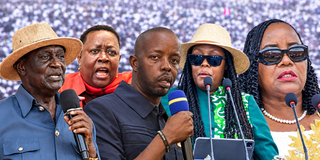
That history comes to mind as politicians lambast Ida Odinga for inviting perceived “Raila enemies” to the first anniversary of her husband’s death. At what point was she expected to inherit Raila’s enemies? Who decided that fidelity to a husband’s memory required a widow to keep a register of people barred from her home?
The criticism suggests we have paid insufficient attention to the Odingas’ history of political mobility. It also exposes a troubling assumption: that a leader’s family must preserve his hostilities even when circumstances change, and he himself repeatedly talked to opponents.
Ida’s explanation was straightforward: the invitations reflected relationships accumulated over Raila’s lifetime. “The Odinga family has no quarrel with any of them,” she said. Turning attendance at a memorial into evidence of political betrayal imposed a partisan test on an occasion whose meaning extended beyond party allegiance.
Police disperse crowds in Kisumu by shooting indiscriminately during a visit by Jomo Kenyatta on October 25, 1969.
Photo credit: File | Nation
To understand why, return to Kisumu on October 25, 1969. The opening of the New Nyanza General Hospital became the scene of a bitter confrontation between Kenyatta and Jaramogi. Presidential security personnel opened fire. People died, others were wounded, and an institution intended to heal became associated with death. The killings occurred in an already poisoned atmosphere. Tom Mboya, the man from Rusinga Island, had been assassinated that July , and Jaramogi’s Kenya People’s Union had endured sustained pressure since its formation in 1966. The confrontation therefore unfolded amid accumulated grief, suspicion and the narrowing of space for opposition.
What followed changed Jaramogi’s choices. He and other KPU leaders were detained, and the party was banned as Kenya became a de facto one-party state. The opposition could no longer organise openly, contest power on its own platform or assume that constitutional rights would protect it.
After his release in 1971, Jaramogi confronted a difficult question: how could he recover political influence within a system designed to exclude him? Staying outside Kanu preserved distance from his persecutors but left him outside the only effective legal route to parliamentary politics and influence over the succession. Raila seems to have learned this lesson from his father, even when he had his own party.
KPU leader Jaramogi Oginga Odinga (with cap) in an exchange with President Jomo Kenyatta in October 25, 1969, shortly before Mzee's bodyguards opened fire and killed about 50 people in Kisumu.
Photo credit: File | Nation
Accommodation was a choice made within an unequal distribution of power. The Kenyatta government controlled access to political participation, and the only way back into public life lay in openings within the very establishment that had shut him out.
By 1977, as word went out that Kenyatta was ailing, the approaching succession created possibilities for unlikely combinations. Jaramogi explored an alliance involving Mbiyu Koinange, Kenyatta’s Minister of State; Defence minister James Gichuru; and Nakuru politician Kihika Kimani, the megaphone of the Change-the-Constitution campaign. These were figures associated with an establishment from which he had been forcibly excluded.
Opposition to Vice-President Daniel arap Moi’s succession provided common ground, and cooperation became conceivable. In politics, as they say, there are no permanent enemies, only permanent interests. Jaramogi understood that an alliance assembled around succession could also serve personal ambition, elite preservation or the search for political rehabilitation. The point is that he himself considered accommodation with powerful figures in the Kenyatta government despite the injuries he had suffered under it.
The question we should ask is this: if Kisumu did not prevent Jaramogi from reconsidering his political relationships, why should his descendants be required to treat every subsequent rivalry as permanent? If the man who experienced detention could reassess his options, why should those who invoke his name today deny his family the same freedom of judgment?
When political hostility becomes hereditary, it acquires a dangerous independence from the dispute that produced it. People are told to distrust someone because their father distrusted his father. An argument over policy, power or injustice hardens into a family identity, and maintaining the hostility becomes more important than understanding its cause.
That is a poor foundation for democratic politics and a poor reading of history. Raila’s own career should make his supporters cautious about declaring enemies permanent. He opposed Moi’s government, later cooperated with it, and subsequently helped defeat Kanu. He competed fiercely against Mwai Kibaki before serving alongside him in the coalition government. His rivalry with Uhuru Kenyatta eventually gave way to the 2018 handshake.
The famous handshake between President Uhuru Kenyatta and former Prime Minister Raila Odinga at Harambee House in 2018.
Photo credit: File | Nation Media Group
Those decisions attracted criticism, sometimes deservedly. Supporters were entitled to ask what the agreements delivered, what compromises they required and whose interests they served. Raila’s stature did not place his choices beyond examination. But his career showed that political relationships could change without waiting for the approval of everyone invested in the previous confrontation.
This is the dilemma that must have faced Ida: which moment should Raila’s family preserve as the final definition of his political relationships? A campaign speech? An election dispute? A handshake? Selecting one and demanding that Ida live within it would reduce a long, complicated political life to whichever episode best serves today’s factional interests.
It would also disregard her own experience as the wife of Kenya’s most vibrant politician. Ida lived through the consequences of Raila’s struggles, sustaining a household through imprisonment and public pressure. Her judgment about whom to receive deserves respect.
The same freedom belongs to Winnie, Raila Junior, Rosemary and other family members. They may draw different lessons from the same history. Kinship cannot require them to reach identical conclusions about every political question. Even Raila abandoned Ford-Kenya to go and build his own political base.
Raila’s contribution to Kenya’s political history was a standard of political mobility, swinging like a pendulum. He could defend constitutional rights and resist exclusion while also dining with the establishment responsible for it. His admirers argued he was better off within such a system than outside it. That is Odingaism as inherited from Jaramogi, who fought to get back to Kanu.
Jaramogi’s history after Kisumu offers a demanding lesson precisely because it refuses easy moral categories. He carried the experience of repression while searching for a route back into national politics. We can examine his choices without pretending that political integrity requires permanent isolation.
For Ida, the immediate issue is simpler. She should be free to commemorate her husband with the people she chooses to welcome. Guests should be able to offer condolences without becoming instruments in someone else’s succession struggle. A family’s grief deserves room to exist beyond the calculations of political competitors.
Those who claim to defend Raila’s memory should remember how often he reconsidered an adversary, and that Jaramogi, after Kisumu, sought possibilities among men whose government had excluded him.
Odingaism, as I understand it, has been sustained by the freedom to make independent political choices. Its heirs must answer for their own decisions but cannot be expected to fight every battle exactly as earlier generations did. If Winnie and Raila Junior choose to practise different forms of Odingaism, they should be judged by the principles they uphold and the public purposes they serve. Fidelity to a political legacy leaves room for different readings of its lessons.
John Kamau is a PhD student in History, University of Toronto. Email: [email protected]