Joshua Ogendo, a professor of stored-products entomology and post-harvest pest management at Egerton University and acting Kibabii University VC, spoke to Seeds of Gold on why grain deteriorates in storage, how to control pests without expensive synthetic chemicals and the best practices for preserving harvest quality:
What happens to maize immediately it enters the store? Why do grains spoil quickly?
Once grain is harvested and moved into storage, it remains a living organism that respires, taking in oxygen and releasing heat, moisture and carbon dioxide. If the grain is not properly dried before storage, high moisture levels create an ideal environment for insect pests to multiply, and fungi that produce toxins like aflatoxins infect and develop on the grains.
The primary insect pests of stored food grains, mainly weevils and the larger grain borer (LGB), are already present in small numbers from the field or leftover grain in old stores. Without proper handling, these insect pests multiply, feeding on the grain kernels and causing damage, weight loss and nutritional degradation.
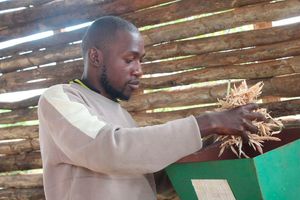
Prof Joshua Ogendo says effective post-harvest preservation and long-term shelf life require timely harvesting as soon as the crop reaches physiological maturity.
Photo credit: Pool
Why do weevils and LGB become such a problem during storage?
Weevils and grain borers are adapted to exploit stored environments where conditions are warm and food is abundant. Additionally, these primary insect pests combine their rapid reproduction, ability to attack intact grain and in case of LGB, an invasive biology that is uniquely suited to tropical storage conditions.
These traits allow the insects to build up massive populations and turn sound grain into dust within months. Adult females bore into intact kernels to lay eggs, and the developing larvae consume the endosperm unseen from the outside.
The LGB is particularly aggressive, boring through maize kernels and turning good grain into flour-like dust. Their feeding activity creates hot spots of elevated temperature and moisture in the grain mass, accelerating pest reproduction, triggering mould growth and rendering the entire stock unfit for human consumption or livestock feed.
Can smallholder farmers protect their grain effectively without relying on synthetic chemicals?
Chemical dusts can be costly, require strict safety handling and carry the risk of pesticide resistance if misused. Small-scale farmers can protect stored grains without expensive chemicals by using hermetic storage technologies (airtight bags or metal silos), inert dusts (e.g. diatomaceous earth) and botanical treatment, provided the grain is properly dried first to the recommended safe moisture content for storage.
Farmers have access to highly effective, low-cost botanical alternatives and hermetic storage techniques like PICS bags. Extracts derived from neem, pyrethrum, Lantana camara, basil and dried chilli contain natural insecticidal repellent and anti-feedant compounds that disrupt pest breeding.
Mixing finely ground, clean wood ash or diatomaceous earth with dry grain acts as a mechanical barrier, drying out insect cuticles and preventing movement.
Combining proper drying with hermetic storage technology provides the most reliable protection without synthetic chemicals.
Why are some storage methods better than others? What technology works best for smallholders?
Traditional storage methods, like open wooden granaries or standard woven polypropylene bags, allow free air exchange and entry for insects and rodents. Modern hermetic storage – such as triple-layer hermetic bags, sealed plastic drums or metal silos – work by cutting off oxygen.
As the grain and any enclosed insects respire, oxygen levels drop while carbon dioxide rises, naturally suffocating insect pests at all life stages. Hermetic bags are accessible, affordable, reusable and eliminate insect pest damage for months when kept clean, sealed and elevated off concrete floors on wooden pallets.
How much of Kenya’s harvested food is lost while in storage? How does this affect food security?
Post-harvest losses in cereal crops across Sub-Sahara range from 15 to 30 per cent. During severe infestations by insect pests like the LGB, losses of up to 100 per cent have been reported.
For smallholders, losing up to a third of their harvest means losing months of labour, investment and food. Nationally, this magnitude of post-harvest loss depresses Kenya’s GDP, erodes strategic grain reserves, drives up food prices and forces the country to import grain to bridge deficits that could have been prevented with better post-harvest management.
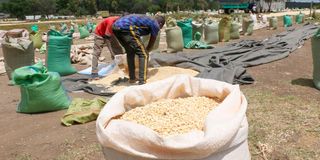
Sirare-sourced maize grains, packed in sacks after drying under the sun, at the Railways Grounds in Nakuru City on July 8, 2026.
Photo credit: Boniface Mwangi | Nation Media Group
With climate change bringing warmer temperatures, are storage insect pests breeding faster or becoming resistant to traditional control methods?
Warmer temperatures act as a biological accelerator for stored-grain insects, shortening their life cycles and multiplying pest populations faster than ever.
At temperatures of 28°C to 32°C, the development of grain weevils and the LGB speeds up dramatically, allowing them to complete a generation in under three weeks instead of six.
This creates explosive population spikes early in the storage season. Heat also accelerates the chemical breakdown of conventional synthetic dusts, exposing insect pests to weak, sub-lethal doses that build chemical resistance over time, especially resistance to traditional fumigants such as phosphine.
To counter these climate pressures, farmers must move away from reliance on synthetic dusts and adopt airtight hermetic storage alongside natural botanical barriers.
What steps should farmers follow immediately after harvest to guarantee grain safety and long-life?
Effective post-harvest preservation and long-term shelf-life require timely harvesting as soon as the crop reaches physiological maturity to minimise field infestation by primary insect pests, such as grain weevils and wood borers.
Grains should be thoroughly dried on clean tarpaulins or elevated racks until moisture levels drop to nine and 13 per cent for oil crops and cereal grains, respectively. Farmers must then carefully shell the crop to avoid cracking kernels and sort out broken, discoloured or infested grains.
Storage structures should be swept, cleaned and disinfected to eliminate latent infestation by insect pests before bringing in new harvest. Finally, the clean dry grain should be sealed in hermetic containers or treated with safe botanicals, keeping the storage units elevated away from damp concrete walls. As a rule of thumb, farmers should store their grains in a manner that allows for “first in, first out” usage.