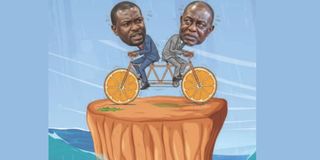
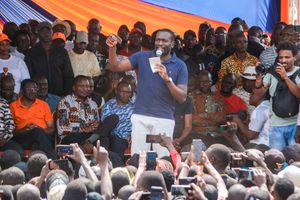
As Edwin Sifuna emerges as the face of rebellion within ODM, he has become a rallying point for supporters who see him as the party’s last internal check against ideological drift.
Now locked in a struggle with Dr Oburu Oginga’s wing, seen as intent on pruning critics of the broad-based government arrangement, Sifuna is confronting a familiar Kenyan political truth: the secretary-general’s office is never clerical.
Long before ODM’s current turbulence, Kenyan politics had already shown that this office is the circuit board of party authority, controlling notices, branch coordination, disciplinary machinery, and legal correspondence. After succeeding Ababu Namwamba, Sifuna quickly learned that the role carries not just paperwork, but institutional memory, process, and legitimacy itself.
Former ODM Secretary-General Ababu Namwamba (left) and immediate former holder of the office Edwin Sifuna.
Photo credit: File | Nation Media Group
The only test he had not faced was that of succession when anxiety turned the secretary-general into both an instrument and symbol. Sifuna now knows that whoever holds that office carries party memory, process, and legitimacy in one hand.
It is at that crossroads that the Nairobi senator has found himself – fearing the cannibalisation of ODM by President Ruto’s UDA and the possible loss of identity if the broad-based government arrangement does not terminate before the general elections.
Sifuna is not facing anything strange. The earliest figure to display the office at full voltage was Kanus’s Tom Mboya. Like Sifuna, he was young, and brilliant, and relentless. But unlike Sifuna, he was internationally connected. Mboya, a former labour leader, transformed Kanu’s secretariat into a machine built for power. He linked labour structures, youth networks, and campaign discipline at a time when the party could have collapsed under ideological and regional contradictions.
Tom Mboya.
Photo credit: File | Nation Media Group
Effectiveness made him feared as much as admired. Inside Kanu, visible conflict with Jaramogi Oginga Odinga’s camp merged with quieter wars around succession, access to Kenyatta, and the political meaning of “nationalism.” He engaged in public arguments which sounded ideological: socialism versus nationalism, anti-imperialism versus pragmatism. The only thing he forgot was that community arithmetic and leadership anxiety supplied the combustible fuel.
As secretary-general, Mboya faced accusations around foreign funding, contradictory narratives in public, and covert alliances. His critics called him “Sungura,” and it was obvious that he stepped on several toes within the party. His assassination at thirty-eight did not only remove a rising national figure but also changed how the ruling party viewed the secretary-general’s office. After Mboya, charisma in the secretariat became a threat to be managed, not a resource to be celebrated.
After Mboya, Robert Matano emerged in that mood – and was lacklustre and uninspiring. Matano was chosen to cool the headquarters’ politics. His role was to preserve routine, absorb factional heat, and prevent open rupture while bigger succession calculations continued above the party ranks where the Kiambu mafia operated beyond the party's reach. For a while, it worked. Matano became the archetype of the durable stabiliser, useful precisely because he did not threaten senior camps. Yet his era also exposed the office’s limits.
Efforts to convene meaningful party elections were frustrated from within, revealing that procedure alone cannot discipline power when informal vetoes dominate. Through the long years that followed, Kanu hardened into camps linked to Moi, Charles Njonjo, Mwai Kibaki, and anti-Moi figures such as Dr Njoroge Mungai. Matano held the paperwork together, but the centre of gravity lay elsewhere.
The transition from Jomo Kenyatta to President Moi pushed the secretary-general ecosystem toward enforcement. Burudi Nabwera, the former diplomat who followed Matano, represented that shift. In his period, Kanu moved from managing disagreement to making disagreement costly. The National Disciplinary Committee, associated with Okiki Omayo, became a visible instrument of terror. Politicians’ careers could end in a single sitting after being summoned, reprimanded, accused of causing divisions, and warned against bringing the party into disrepute. The message was unmistakable: dissent would be answered publicly, and the choreographed terror was meant to deter the next dissenter. In that environment, the secretary-general was less mediator than a custodian of choreography.
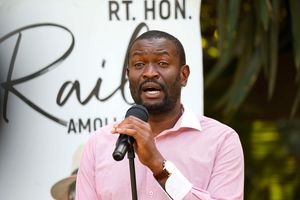
Embattled ODM Secretary General and Nairobi Senator Edwin Sifuna.
Photo credit: File| Nation Media Group
After Nabwera came Moses Mudavadi, whose tenure was shortened by illness and therefore left a lighter institutional imprint. The office soon returned to sharp political force under Joseph Kamotho. By the late 1980s, Kamotho had risen from eclipse to become one of Kanu’s most consequential secretary-generals. If Matano cooled the system, Kamotho fought for it—blunt, organised, and unapologetically combative. His rivalry with Kenneth Matiba became one of the era’s defining confrontations, helping propel Matiba into national opposition stature even as Kanu tried to project internal control. Under Kamotho, procedural changes such as the return of secret ballot in party primaries showed how rules could be recalibrated to manage conflict without conceding strategic command. Kamotho worked through a strong youth wing.
When opposition politics widened in the 1990s, secretary-generals carried the same burdens inside new formations. Martin Shikuku, first secretary-general of FORD, served in what briefly looked like a historic coalition capable of unseating Kanu. But old patterns reappeared quickly. Trust frayed, succession calculations sharpened, and symbolic gestures carried heavy consequences. Shikuku’s State House engagement with Moi, the famous ugali dinner, deepened suspicion among reform supporters already wary of elite bargains.
As camps crystallised around Matiba and Jaramogi over who should face Moi, Shikuku exited with the certificate and helped form FORD-Asili as its secretary-general. After Matiba’s electoral defeat, the split between the chairman and secretary-general deepened. By the run-up to 1997, a party once associated with reformist hope looked fractured and exhausted. And that is a lesson ODM should learn from.
Jaramogi’s FORD-Kenya offered a different secretary-general tragedy through Gitobu Imanyara. Intellectual, combative, and principled, Imanyara challenged what he saw as strategic drift, especially around Jaramogi’s cooperative posture toward Kanu and fallout from the Pattni cash controversy. His allegation that money was intended to soften criticism over Goldenberg detonated the party from within. He was eventually removed, and the exodus that followed weakened reform cohesion at exactly the moment unity was most needed. His case captured a recurring Kenyan paradox: truth-telling can win public attention, but it can still lose headquarters when institutional guardrails are weak.
Mwai Kibaki’s Democratic Party appeared sturdier until its Secretary-General John Keen defected to Kanu. It was the first major defection from a major party. The next was Safina, the civic-minded project associated with Richard Leakey and reform allies, previously in Ford Kenya. While Safina had moral clarity and cosmopolitan appeal, its organisational machine was thin. Thus, Moi was able to lure Dr Leakey back to Kenya Wildlife Service and later as Head of the Public Service and Secretary to the Cabinet.
One of the grand inversions in this history came when Raila Odinga entered Kanu and later became secretary-general after Kamotho. This was not routine succession; it was strategic entry into the ruling party’s engine room by a leading opposition tactician. Raila did not inherit the secretary-general post to preserve the old order. He used it to rearrange coalition chemistry. Alliances were stitched, ripped, and restitched. Camps consolidated and split. The old monolith cracked as the country moved toward the 2002 transition. That episode proved that the SG office can function not only as an instrument of continuity, but also as a tool of internal realignment when broader party legitimacy is already in decline.
This long arc is the right frame for Edwin Sifuna’s current contest in ODM. At forty-three, he has shown unusual durability in a party shaped by a towering founder. He did not disappear under Raila Odinga’s political shadow, and he accepted the risks of speaking publicly. His critique of ODM’s closeness to President William Ruto’s UDA places him in a known lineage: secretary-generals who challenge strategic drift from within rather than quietly adjusting to it. Whether one agrees with his tone is secondary. The central issue is institutional: is party procedure a genuine referee, or a selective weapon?
The nomination of Catherine Omanyo as acting secretary-general, which is temporarily on hold after an order by a tribunal, fits another older pattern. Transitional secretary-general appointments are often presented as administrative housekeeping, but historically they function as political pauses. They lower temperature, prevent sudden concentration of rival power, and buy time while larger camps negotiate direction. In Kanu after Mboya, and in later parties, “safe” secretary-general choices often signalled unresolved succession conflict rather than settlement. ODM appears to be living a comparable moment in full view. One faction, linked to continued cooperation in the broad-based arrangement, favours pragmatism with the government. Another wants greater distance from Ruto’s strategy and a clearer opposition profile. The dispute is not merely tactical; it concerns the party’s future identity.
Seen in this register, ODM’s turbulence is constitutional in party terms. It asks whether internal disagreement will be managed through credible rules or through selective application of rules to settle scores. Every major secretary-general crisis in Kenyan political history has revolved around that question.
Mboya faced it as a mobiliser feared for his strength. Matano faced it as a stabiliser constrained by hidden vetoes. Nabwera and Kamotho faced it as enforcers. Shikuku, Imanyara, and Keen faced it inside opposition formations where moral claims exceeded institutional depth. Raila faced it as a re-aligner operating inside a declining ruling machine. Different eras, same structural test.
Before Sifuna, many secretary-generals stood at this acid test and discovered that the office is a stress position, not a ceremonial title. It demands loyalty without servility, authority without overreach, and discipline without crushing dissent. Parties that fail this balance eventually pay in defections, splinters, and electoral confusion.
Parties that get it right can survive leadership transition without losing their purpose. Kenya’s history therefore points to one final truth: the secretary-general is not the party’s clerk. In times of crisis, he becomes the weathervane, the switchboard, and the last public proof of whether party rules mean what they claim.