Before Alliance became Kenya’s most storied elite school, the Kikuyu compound was built for something else entirely: a medical training college that never opened its doors. As the school marks 100 years, that abandoned beginning gives its centenary a deeper and more unexpected history.
Half-built, bureaucratically battered, and eventually repurposed, the original project has largely slipped from public memory. Yet it is precisely this forgotten story that makes Alliance’s centenary worth more than celebration. It shows how an institution that would later come to define academic excellence in Kenya began not as a polished educational vision, but as a contested project forged in the friction between missionary initiative, colonial hesitation, and African aspiration.
The story begins in the early 1920s, when the newly formed Alliance of Protestant Missions — a coalition of the Church Missionary Society, the African Inland Mission, the United Methodist Mission, and the Church of Scotland Mission — pressed the colonial state to adopt a more coherent policy on African education. Their boldest move was to establish a training institution for Africans on a scale and to a standard the colony had never intended to provide. A medical college, they believed, could meet practical needs while pushing beyond the narrow limits the colonial education had imposed.
Records indicate that the project ran into obstruction that has less to do with bricks than with power. When the building plans were sent to the Principal Medical Officer, Dr Langton Gilks, for approval, he returned them in July 1921 with a refusal: the plans would not pass “until the mortuary and water closets were separated from the main building.”
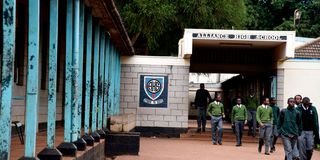
A dormitory at Alliance High School.
Photo credit: File | Nation Media Group
A further draft arrived when Dr Gilks was on leave, and his deputy approved it. Construction began. The compound that would become Alliance started rising in Kikuyu. If approval opened the door, politics tried to slam it shut. In March 1922, as the buildings were going up, the Colonial Secretary dismissed the entire undertaking. Missionaries, he argued, should not be providing medical training while seeking public funds. It was not their role; it was not their mandate. The message was a familiar one: Africans could be educated, but not too much.
The Alliance committee refused to abandon the project, but it did learn to translate its ambitions into a language colonial authority might accept. The proposed college was passed off as a monument to Africans who died in WWI, and when the building was finished in 1924, a plaque was unveiled declaring:
“This building is erected in memory of Africans who lost their lives in east Africa in the Great war of 1914–1919 from funds collected from Africans for the east Africa war Relief Fund for Africans.”
The plaque positioned Africans not only casualties of imperial war but also participants in public life, and funders of public works.
Yet the most formidable obstacle was not the Colonial Secretary or Dr Gilks. It was the reality of an educational system designed to produce very few Africans with advanced schooling. After spending £4,500 and opening the facility in March 1924, the missionaries discovered, with a kind of administrative shock, that there were almost no students ready to enter. After a nation-wide hunt, they concluded that the entire country had only eight African students who had reached Standard Eight.
Frustration followed and Rev W. Hunt, the man in charge of the project, left the country. The colonial government dilly-dallied on training policy denying Alliance a chance to get students. As a result, the buildings, completed at considerable cost and political effort, were left to rot. As the medical college dream collapsed into a stranded compound what emerged was an empty monument whose intentions the colony could not yet tolerate.
In 1925, a new kind of authority arrived. It was the Phelps-Stokes Commission, led by Prof Jesse Jones. The Commission insisted that any plan for higher education for Africans would have to take into account the existing facilities in Kikuyu. The abandoned compound was suddenly reclassified as infrastructure waiting for a purpose. While the Commission increased attention to African schooling, it also entrenched inequality by limiting many Africans to practical and vocational training instead of broader academic advancement.
In the search for a new direction, an Alliance meeting was held in London, chaired by J. H. Oldham of the International Missionary Council. The advice they received was decisive: abandon the medical college and build instead a first-rate secondary school for African boys. Girls, for the time being, remained excluded, a reminder that even progressive projects carried the biases of their age.
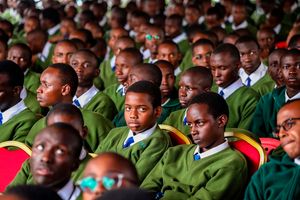
Alliance High School students during the schools Centenary Celebration in Kikuyu on March 1, 2026. The event marked 100 years since the founding of the institution.
Photo credit: Lucy Wanjiru | Nation Media Group
With that decision, Alliance as we know it came into view with a constitution, a board, and a headmaster. But the original problem returned in a new form: how do you build an elite school in a country where the education ladder has been deliberately shortened?
The incoming headmaster, George Grieve, set entry requirements at what was “the highest available to Africans at this time”—the junior secondary certificate—and then checked the 1925 examination list. There were no passes. It looked, briefly, as though even the secondary school might not start. So, Grieve did something both pragmatic and historically consequential: he took students with lower qualifications rather than wait for a pipeline that did not exist.
When the school opened, the first intake defied his expectations. He had imagined “small boys.” Instead, as he later recalled, they arrived “wearing khaki shorts and shirts and barefooted, looked very big and very old.” Alliance’s beginnings were not the neat birth of an elite institution; they were the improvised assembly of a new social category—African secondary students—drawn from a system that had never expected them to appear. The compound still bore the physical imprint of its first intended life. The medical college mortuary was converted into a bathroom; the slabs designed for bodies became ideal platforms for washing clothes.
Among those first “big and old” students was James Muigai wa Johnstone, student No 0001, Jomo Kenyatta’s brother. He had adopted his brother’s baptismal name as a surname. Kenyatta, the story goes, acted as his guardian and paid his fees. The detail is more than genealogical trivia: it shows how early Alliance was entwined with the social networks that would later animate nationalist politics, and how education already functioned as investment—family, community, and future folded into school fees.
Many boys did not know their birth years and manufactured them at Alliance. When Carey Francis replaced Grieve and tried to group students by age, he found “old boys” standing beside small ones.
The rules were strict. No noise-making. No lying. No sleeping late. Punishment was labour: students uprooted the many tree stumps in the compound, an ordeal so common it became legend. Homework was done by the light of fires in huts until a nearby mission acquired a generator. Alliance’s early discipline was not ornamental; it was a regime built to manufacture academic seriousness out of scarcity.
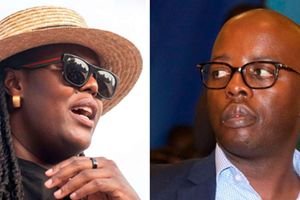
President William Ruto, National Assembly Majority Leader Kimani Ichung’wah, Africa Inland Church (AIC) Kenya Bishop Abraham Mulwa, among other leaders, during the Alliance High School Centenary Celebration in Kikuyu on March 1, 2026.
Photo credit: Lucy Wanjiru | Nation Media Group
As the years passed, the “firsts” accumulated. In 1927, Mbiyu Koinange, one of the early “big boys,” became the first Alliance student to go overseas, joining Hampton Institute in Virginia, and later studying at Ohio Wesleyan and Columbia University, earning an MA by 1938. Eliud Mathu followed abroad. These journeys were more than personal triumphs: they proved that Alliance had become a launchpad into a wider world, producing students capable of mastering—and later challenging—the systems that had tried to limit them.
In 1937, after a mass failure among boys, Grieve admitted two girls—Zibia Wangari and Loise Njeri Koinange—a decision that quietly cracked the school’s gender barrier. Later came Margaret Kenyatta. Alliance remained mixed until 1952, when African Girls High School—later Alliance Girls—was completed nearby, itself built through improvisation from an old army hut purchased in 1948 by Rev R Calderwood and rebuilt in Kikuyu.
At Independence, the government machinery was highly made of Alliance students.
Alliance is a lesson. At one hundred years, the point is not simply that Alliance “beat the odds,” though it did. The deeper point is that Alliance’s very existence is evidence of what was once denied: that African education could be built to a high standard, that African students could meet it, and that a compound designed for one purpose could become something far more consequential.