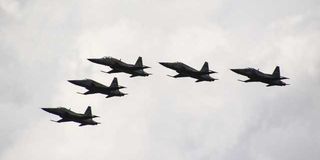
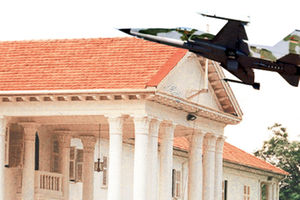
In 1974, Kenya, concerned about the threats posed by its neighbours and the dwindling arms supply from Britain, made a formal request for arms aid from the United States government. Kenya was particularly interested in acquiring the much sophisticated F5s, a family of highly maneuverable supersonic fighter jets.
Declassified documents seen by the Weekly Review reveal that the only problem was the aid Kenya wanted was over the Congressional limit of military assistance the US government could offer a foreign country. However, the US president had the power of latitude to suggest to the Congress to increase the limit if he was satisfied that such assistance would help strengthen US security interests and promote world peace.
At one point to avoid the hassle of seeking Presidential and Congressional approval, and providing such costly military aid, Washington tried to draw Kenya and its then ally Iran closer for a much cheaper deal. In the deal, Iran was to offer Kenya its old US made F5A jets at a lower cost, but this failed after the Shah of Iran Mohammad Reza Pahlavi decided to offer the jets to Jordan.
With the Iran deal having fallen through, the US government had no other option but to go the whole nine yards to assist Kenya, especially in light of the Cold War geopolitical escapades that had become prominent in the horn of Africa.
For starters, the formal request for US military arms aid was lodged on December 20, 1974, when Vice President Daniel arap Moi, acting on the instructions of President Jomo Kenyatta, summoned Anthony Dryden Marshal, the then US Ambassador to Kenya, to his office. He expressed his concerns over high level of armament and hostility of Kenya’s neighbours. Also present was Attorney General Charles Njonjo, the Mr Fix-It of the Kenyatta government.
According to records of the meeting currently held by the US State Department archive, Moi informed Marshall that Somalia’s President Siad Barre was only restraining himself to claim a part of Kenya because of his position as chairman of the Organisation of African Unity (OAU) and that once he relinquished that post in the following year’s OAU summit, he would revert to his expansionist policy of “greater Somalia”.
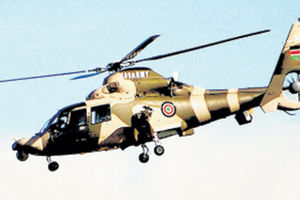
Kenya Air Force Puma aircraft (hoisting a Land Rover) and fighter jets during the Kenya Air Force Golden Jubilee celebrations at Moi Air Base Eastleigh, Nairobi on 4 June 4, 2014.
Photo credit: File | Nation Media Group
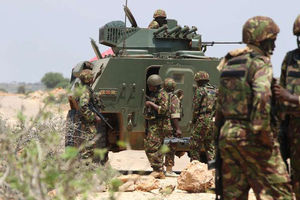
Other factors that Moi and Njonjo mentioned as posing a security threat to Kenya were the erratic behaviour of Ugandan President Iddi Amin, the growing Chinese influence in Tanzania and the fluid situation in Ethiopia, which was Kenya’s closest ally in the region. For these reasons, they stated, Kenya really needed to acquire F-5E jets.
In a telegram informing his seniors at the US State Department about his meeting with Moi, Marshall wrote: “Moi said that president Kenyatta had decided to approach both UK and US for needed military assistance. Moi cited as examples of US hardware Kenya was interested in obtaining: squadron of F-5E aircraft, police helicopters and unspecified smaller arms which would serve as deterrents to possible attack against Kenya.”
Although an earlier US presidential determination allowed strategic partners to purchase US Foreign Military Sales on cash, Kenya’s budget was too tiny to accommodate spending on such expensive military hardware. For this reason, Moi suggested to Marshall if the US could provide either long-term credit at low interest rates or grants to finance the purchases.
But this had its own obstacles, in the sense that the US Congress had imposed a $40 million ceiling on military credits and grants for Africa, yet the cost of the fighter jets Kenya needed was estimated to be around $60 million. The ceiling could only be lifted on the advice of the President of the United States and with Congressional approval.
This was highlighted in the US Foreign Military Sales (FMS) Act, which stated that a foreign country was eligible to purchase defence articles and services from the United States, if the president of the United States was satisfied that providing defence articles and services to that country, “will strengthen the security of the United States and promote world peace.” An identical finding was required for the provision of training on a grant basis, something that Kenya had also requested.
Based on his meeting with Moi, Marshall — who was sympathetic to Kenya — advised his seniors in Washington that because of the country’s strategic position to US interests, it should be offered Foreign Military Sales (FMS) credit or Military Assistance Program (MAP) to finance moderate procurement of US arms and training.
Photo|FILE
US Air Force F-22 Raptor fighter jets.
And in case the president and the Congress could not approve the request, then the US government could use its influence to bring Kenya and Iran closer militarily. According to him, “Such cooperation could conceivably take the form of Iranian financing of Kenyan acquisitions of US arms, Iranian gifts or loan to Kenya of military equipment not needed in Iran, and even eventually some type of mutual defense agreement.”
Indeed, the US government did approach Iran with the latter proposal according to a memorandum of conversation of a meeting in Washington between the then Kenyan Minister for Foreign Affairs Munyua Waiyaki and senior officials in the US State Department.
“We have had some talks on arms. We are trying to put together a military assistance package for Kenya,” US Secretary of State Henry Kissinger revealed during the meeting.
Waiyaki replied, “I hope you can move quickly.”
This prompted Kissinger to ask the other US officials why everything was delayed. In response, Wendell Coote, the Director Office of Eastern and Southern Africa Affairs at the Department of State stated,” We thought we had some F5A aircraft lined up for Kenya. They would have been available immediately at a low cost. This was the big advantage of that package. However, it did not work out.”
Kissinger then sought to know why it didn’t work out, and Coote replied, “We thought we could get the F5As from Iran but unfortunately the Shah had not approved the arrangement and it fell through.”
A further explanation was given by Nathaniel Davies the Assistant Secretary, who revealed, “The Shah believed he had already committed the aircraft to Jordan and he didn’t want to go back on this commitment.”
When Kissinger asked how many F5As Iran was to provide to Kenya Coote replied, 10. Kissinger then quipped “Can’t we find ten F5As?” And Coote replied, “The Defence Department has informed us that no suitable F5A aircraft are available now but perhaps some may become available in a year or two.”
“I find it hard to believe that ten F5As are not available. I will look into this when I get back. Have you found any helicopters which can be sent quickly to Kenya?” Kissinger asked again, to which Coote replied “Defence is looking into this. I think there are some helicopters which can be made available right away.”
Waiyaki stated that Kenya was also interested in acquiring the F5Es and went on to ask the officials whether Mwai Kibaki the Minister for Finance had raised the issue with the State Department during his visit to Washington for the IBRD meeting. But Coote replied “No he did not raise the subject. We are also looking at the F5Es here. The problem is that they are very costly and the package might be so high as to create difficulties for both Kenya and the United States.” When Waiyaki asked about the cost of F5Es, he was told about $60 million.
“We hope the US will be as generous as possible,” Waiyaki said before asking naively, “Are F5Es or F5As better for us?” In response Coote said, “This is a question for the Kenyan government to decide whether the high cost of the planes has a higher priority than your other needs.”
“Are they good aircraft?” Waiyaki sought to know again, to which Coote replied “They are very modern, multipurpose and efficient aircraft containing the latest equipment. This is why they are so costly.” Waiyaki then said “President Kenyatta is anxious to know quickly what will happen.”
As the meeting approached the end Kissinger sought to know from Waiyaki whether Kenya would be voting with the US at the UN General Assembly on the Korean resolution. “Are you going to vote with us on the Korean resolution?” Kissinger asked. “There are two resolutions. We would like you to vote for the one which we support and against the one which Algeria supports.”
In response Waiyaki said, “We will study that.”
Nevertheless, with the Iran deal having collapsed, on May 18, 1975, Kissinger wrote to President Gerald Ford advising him to make Kenya eligible for military credits and guarantees, and for military grants and training. He justified this by stating that Kenya faced Uganda, Somalia and Tanzania, which were better equipped with Soviet arms, and also cited US geopolitical interests, stating, “This new finding reflects our desire for continued and expanded access to ports and other facilities in Kenya, particularly in view of the growing Soviet naval presence in the Indian Ocean and the June opening of the Suez Canal.”
President Ford signed the determination, which was subsequently forwarded to the Congress.
The following year, on March 4, 1976, a Kenyan delegation led by Jeremiah Kiereini, the Permanent Secretary for Defence, visited Washington where Joseph Siso, the US Under Secretary of State for Political Affairs, disclosed to them that the US would be offering Kenya 45 million FMS credits for period 1975 to 1979 pending congressional approval.
On that same day Finance Minister Mwai Kibaki upon receiving the good news from Washington summoned the US Ambassador to Kenya to his office in Nairobi and informed him that Kenya had decided to use the entire $45 million dollars in FMS credit to purchase a squadron of ten F-5E and two F-5F aircraft. Kibaki also requested for an additional $20 million to cover the entire cost of the F-5 programme.
Supporting Kenya’s request for more funds Marshall wrote to Washington, “While I recognize difficulty of earmarking these additional funds for Kenya, I believe it would be in our interest to make this additional offer of credit to complete financing for the aircraft purchase.” The first batch of the supersonic jets were delivered to the Kenya Air Force in 1978.