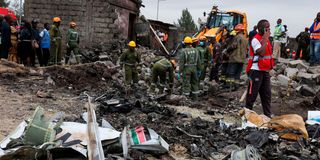
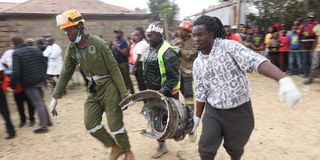
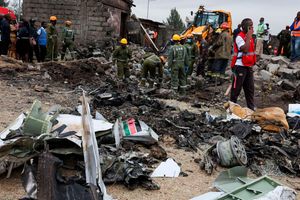
Parts of the plane’s wreckage being carried away from the scene of the crash on Thursday evening. A Cessna plane belonging to Amref Flying Doctors crashed in Mwihoko, killing six people.
Photo credit: Evans Habil| Nation Media Group
Records from the Aircraft Accident Investigation Department reveal 38 incidents between 2020 and 2025. Since 1975, there have been 331 recorded crashes and serious incidents, involving civilian, training, and military aircraft. While some investigations have been concluded, many remain open, with reports still “under investigation.” These cases include both mishaps and major disasters.
Many crashes have happened just minutes after take-off, linked to mechanical failure, bad weather, or loss of control. Others have been blamed on poor visibility, pilot mistakes, or condition of the plane.
Some regions have witnessed more incidents than others. Coastal counties of Mombasa, Kwale, and Taita Taveta top the list. Nairobi and its surrounding areas — including Wilson Airport, Githurai, Embakasi, and Ngong — also feature frequently.
In the west, crashes have been reported in Busia, Londiani, and Migori. In the north and arid zones, Marsabit, Wajir, and Garissa have had their share of tragedies.
A scene where a KDF helicopter carrying Chief of Defence Forces General Francis Ogolla and 11 others crashed at Sindar, Kaben Location at the border of Elgeyo Marakwet and West Pokot counties.
Photo credit: File | Nation Media Group
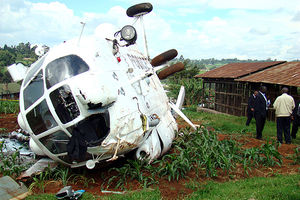
The scene of the police helicopter crash in Kibiku, Ngong forest on June 10, 2012. The Eurocopter was carrying Kenya's Internal Security minister George Saitoti, his deputy Joshua Orwa Ojode along with two pilots and two bodyguards who all died in the crash.
The dangers are not only faced by large passenger aircraft. On March 8 this year, a student pilot died when a training plane crashed in Voi, Taita Taveta County . The aircraft went down during a routine exercise after the trainee lost control, hitting the ground.
A light aircraft that crashed at Ikanga area in Voi, Taita Taveta County, on March 8, 2025, killing the trainee pilot on board.
Photo credit: Lucy Mkanyika | Nation
In September 2024, a pilot and a student were injured when their light aircraft crash-landed in Nairobi National Park during a training flight. Mechanical trouble forced them into an emergency landing.
For the families left behind, each new crash reopens old wounds. For the country, the repeated tragedies raise a pressing question: why are Kenya’s skies still claiming so many lives?