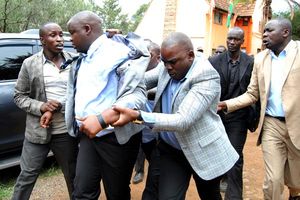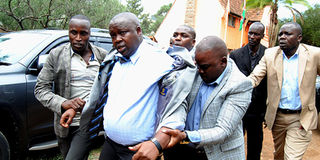
ODM Executive Director Magerer Lang'at being ejected from the party's parliamentary group meeting on October 30, 2014.

Former ODM Executive Director Magerer Lang’at has opened up about what he calls the darkest and most humiliating chapter of his political life, the day he was roughed up and ejected from the party’s headquarters at Chungwa House in 2014.
The incident, which saw his official vehicle vandalised and his authority stripped in full public view, remains etched in his memory as a moment of betrayal within a party that prided itself on democracy.
“It was one of my lowest moments in ODM, and to date, I have never known what motivated the people who did that. Contrary to what many thought, the infamous ‘men in black’ were not involved. The violence was purely carried out by MCAs in Nairobi who believed I was not leading the party in the right direction and that I was secretly talking to William Ruto,” Mr Lang’at recalled.
In an exclusive interview with Nation in Kericho town ahead of the party’s 20th anniversary between November 14 and 16, the former ODM official and ex-Kipkelion MP reflected on how he had been accused of being a mole for then Deputy President William Ruto.
He insists the claims were unfounded. “I still maintain that until I left ODM on October 30, 2014, I had not spoken to Dr Ruto in his political capacity. Ironically, I only spoke to him later, after that debacle,” he said.
More painful
What made the incident more painful, he explained, was the hypocrisy behind it. “ODM had always projected itself as a party of democracy, where everyone was free to speak. Yet here I was, being assaulted and humiliated by members of my own party. It was the height of hypocrisy.”
Mr Lang’at initially suspected that the then ODM party leader, Raila Odinga (now deceased), might have sanctioned the attack.
But with time, he says, he came to learn that Odinga had nothing to do with it.
“Later, I was convinced Raila did not have a hand in it. Unfortunately, the damage had already been done. I resigned voluntarily soon after, because the disciplinary mechanism in the party could not offer me justice.”
Behind the violence, Mr Lang’at says, was a deeper struggle within ODM — a tussle between the old guard and a younger generation eager to take charge.
“Those MCAs represented a clique that resisted the new wave of leadership within the party. Ironically, the very people they opposed, like John Mbadi, Josephat Nanok and Ababu Namwamba, went on to take up top positions in ODM. I was the only one edged out.”
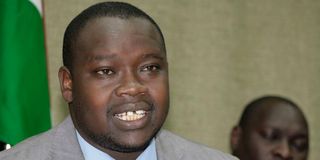
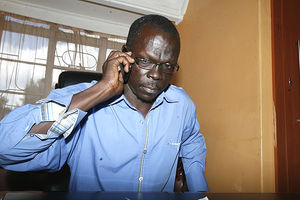
Former ODM Executive Director Magerer Lang’at.
His departure came at a time when ODM was trying to reinvent itself after the contested 2013 election.
Rowdy Nairobi county representatives had ejected and roughed up Mr Lang’at from the party's parliamentary group meeting.
The MCAs claimed that Mr Lang'at was a mole of the Uhuru Kenyatta-led Jubilee coalition.
Mr Lang’at was kicked and slapped several times by the MCAs, who were led by then ODM Majority Leader Mr Elias Otieno.
The group also deflated Mr Langat’s official car tyres.
“He said the ODM party is dead and that the party leader should resign. Why then did he attend a meeting for a dead party?” posed Mr Otieno soon after the drama was over.
“That is why, as MCAs, we have taken that action because our parliamentarians are asleep.
“Magerer Langat has been a liability to this party and doesn’t add any value to the party. We don’t want to see him again here. If he wants to remain in the party, he should do so as a member, not an executive,” added the then Kileleshwa ward representative.
Mr Langat was whisked to safety by police, who were stationed outside Orange House, the party's headquarters.
Then ODM Secretary-General Anyang' Nyong'o said the party would probe the incident.
But as Mr Lang’at sees it today, despite the incident, he argues, the party’s resilience has always come from its strong organs and structures.
“Unlike other parties, ODM’s National Executive Committee and National Governing Council function regularly. These structures are what have kept ODM alive for two decades.”
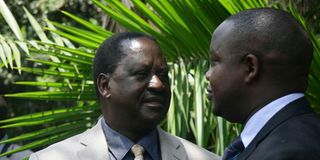
Former ODM Party leader Raila Odinga (left) and ex-Executive Director Magerer Lang'at after attending the party's Parliamentary Group meeting at Orange House in Nairobi on August 28, 2014.
He also warned that, like all political movements, ODM must embrace succession. “In any dispensation, there must be a succession plan. The lack of succession killed other parties. ODM has survived because of strong organs, but it must now prepare for generational transition. The younger people want a stake, and rightly so.”
Mr Lang’at welcomed the current political reunion between President Ruto and the ODM party - now steered by Siaya Senator Dr Oburu Oginga as interim leader, terming it as both “ideological and pragmatic.”
“If you read the ODM manifesto of 2007, it mirrors much of what Ruto’s government is implementing today—housing, agriculture, infrastructure, manufacturing, and youth empowerment. In 2007, ODM carried the aspirations of most Kenyans because it had the right agenda. What Ruto and Raila are doing today is essentially reviving that same vision,” he argued.
He dismissed critics who view the rapprochement as mere political expediency.
“I have worked with both Raila and Ruto. I know how they think. They both put Kenya first. The events of June 2024 nearly tore the country apart. Coming together was an act of wisdom to cool the nation. Otherwise, we could have slid into chaos like other countries.”
The former legislator believes the “broad-based government” is already a functional coalition.
“Look at Treasury — it is headed by someone from the former opposition. That is very unusual but shows the extent of the partnership. It is the formula of Kenyan politics since 2002: broad alliances stitched together from different regions and interests.”
ODM has often been described by rivals as a party of violence. The infamous “men in black” incident of 2014 — where goons disrupted grassroots elections — is one of the enduring stains on its record.
Mr Lang’at, himself a victim of party violence, dismisses the idea that ODM is inherently violent.
“The party’s constitution and manifesto say nothing about violence. Violence is caused by members who refuse to follow party rules, especially during elections. Remember, political parties run primaries with almost no funding. The IEBC needs over Sh40 billion to run a general election. Parties do the same exercise with a shoestring budget funded by members. That’s why chaos erupts. It’s not unique to ODM.”
Still, he acknowledges the party must confront its own weaknesses. “ODM remains strong because it is grassroots-based and champions justice. But it must deal with hooliganism and internal indiscipline if it wants to reclaim its past glory.”
For all its turbulence, Mr Lang’at believes ODM remains consequential because “it is more than just a political party.”
“It is a movement. Even Kenyans outside ODM look to it to fight for justice when things go wrong. That is why many were disappointed when Wiper leader Kalonzo Musyoka joined government in 2007/08 — because they expected ODM to be at the forefront of that fight.”
He says the party’s survival owes to its grassroots networks and the credibility of its leaders. “ODM carries the aspirations of the people. Leaders like Raila (deceased) and Orengo are associated with the second liberation. People trust them to stand for justice.”
Looking back, Mr Lang’at admitted that the most painful chapter of his political life was losing his parliamentary seat under the ODM ticket.
“It was a huge disappointment. But I remain proud of my contribution to ODM and the ideals it stood for — justice, democracy, people power and inclusivity. These remain relevant even as we head to 2027.”
He recently resigned as County Executive Member for Agriculture, Livestock and Cooperatives in Kericho County, amid impeachment threats by MCAs.
On whether he plans a comeback to national politics, he is cautious. “I am serving my people in Kericho now. When the time comes, I will sit with my supporters and decide. But I believe campaigns should not start immediately after an election. Let us implement development first, then campaign when the law allows.”
For now, he says his focus remains service delivery. But he does not rule out a return to the national stage. “Politics is in my blood. When the time is right, Kenyans will hear from me.”
Follow our WhatsApp channel for breaking news updates and more stories like this.