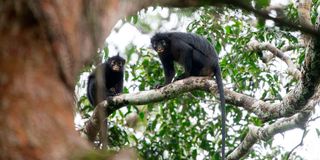
This past week scientists recorded a significant development in the Congo Forest. For only the fifth time in 75 years, they identified a new monkey species in Africa.
The red-lipped primate was first spotted by the scientists as early as 2008, but has only just been confirmed as a distinct species, scientifically named colobus congoensis, in honour of the Congo Basin where they made the observation.
As expected, the development became headline news, topping newscasts and dominating specialised magazines. The preponderant framing in most of the reporting, was that the monkey had been “discovered” in the forest. Other stories said it was found “hiding” in the thick canopies of the world’s second-largest tropical rainforest. The BBC Wildlife magazine took it a notch higher, referring to the animal as a “new mysterious” species.
But to be sure, the monkey already had a name — or names, to be precise. The Balanga people, who live alongside the Lomami and Congo rivers in the region where the species was found, call it Likweli, while among the Mituku communities on the eastern edge of the animal’s range, it is known as kasaba nkoni, which loosely translates to “the branch shaker”. This suggests that these communities living alongside the animal have long known it, given it their own names, distinguished it from other monkeys, and, generally, woven it into their integrated understanding of the forest.
So then, what, if at all, was discovered? To begin with, it could not have been the monkey. Because the monkey was never lost, never missing, and never hiding. What happened was an institution, namely global science, finally catching up to something a section of local communities had known and lived with for generations. This is not an isolated case, and it goes to the heart of many arguments around knowledge systems and how they stack up.
Throughout history, every civilisation has built systems for deciding what counts as legitimate knowledge, i.e what can be trusted, taught, passed on to the next generation, or otherwise, acted upon. Modern science is regarded by many as humanity’s most powerful such system, not least because of its contribution to such human feats as eradication of diseases, and even putting machines on other worlds. For this reason, science has emerged not merely as one system of knowledge among many; but as the certifying institution whose validation determines what becomes globally accepted as real.
This would not invite any real debate if the enactment of science lived up to its reputation as a universal and value-neutral enterprise. Yet, as the Congo monkey saga demonstrates, the institutions that decide what questions are worth asking, whose observations are credible, what gets funded, recognised, published, cited and embraced, are deeply shaped by history, economics and, increasingly, geopolitics. This means that knowledge does not circulate through the world as an equal marketplace of ideas but through a hierarchy in which some epistemologies, like in George Orwell’s Animal Farm, are “more equal” than others.
In our school days, we were taught how John Hanning Speke “discovered” Lake Victoria in 1858, and how Johann Ludwig Krapf and Johannes Rebmann returned the favour with Mount Kenya and Kilimanjaro in the 1840s. But in making these claims, even the European explorers, must have noticed that millions of Africans lived around these landmarks. They had given them names, had spiritual traditions associated with them, farmed around them, traded across them, and incorporated them into their folklore for centuries.
To be fair, the Europeans, indeed, discovered the existence of these landmarks to Europe, which was barely aware of these “other” worlds. But the explorations took place in the context of a Eurocentric epistemology in which knowledge became legitimate only after it entered European maps, journals, and museums. Only after a place or idea had found acceptance in Paris, London, or Berlin, could it finally become “real” regardless of the fact that it had never been unknown to the local people.
Lake Victoria, for instance, had numerous established names among the communities surrounding it, Nam Lolwe among the Luo. Speke’s journey, therefore, did not magically transform an unknown body of water into a known one; it merely introduced it into European geographical knowledge and then renamed it after Queen Victoria. The majestic Victoria Falls was, and remains to the people who live near it, Mosi-oa-Tunya or “the smoke that thunders,” a name that describes the falls rather than commemorating a stranger. But renaming these landmarks was in itself a significant act of power. In the colonial logic, it was meant to assert not just political control but also the power to define reality for the rest of the world.
The inequality extends beyond the language of discovery. It shapes the very boundaries of the scientific agenda even today. Research questions do not rise naturally from the world in order of objective importance. They compete for attention through funding universities, industry, journals, laboratories and governments, most of which are unevenly distributed across the globe. The diseases that attract investment, the languages represented in digital systems, the crops subjected to genetic research and the ecosystems monitored most intensively are therefore influenced not only by scientific merit, but by many other power structures, strategic interest and geography.
The consequence is knowledge from the margins of this unequal arrangement, receives less recognition. And worse still, the problems experienced at the margins may remain less studied, less measured, and therefore, less resourced and less visible in global decision-making. This absence from the scientific record is often mistaken for absence in the real world.
British scholar Miranda Fricker has referred to this phenomenon as “epistemic injustice” in which a person’s knowledge or experience is unfairly dismissed simply because of who they are, constituting a grave wrong. African philosophy professor, Pascal Mungwini, in a famous book calls for the “re-writing and re-righting” of Africa’s position in the global knowledge landscape. This thinking recognises that the Likweli monkey did not suddenly emerge from the forest because scientists arrived. It had always been there, observed by people whose familiarity with the forest exceeded that of any visiting expedition.
None of this should be read as an argument against science. Science offers things that local knowledge, however deep, cannot always provide on its own. For instance, genetic sequencing that can establish, with precision, the connection between Likweli and its other relatives in the forest and the rest of the world, can only be convincingly established by science. What is at issue, is how the different knowledge systems get recognised in the final story.
Conservation biology increasingly depends on Indigenous trackers whose knowledge of animal movement and behaviour exceeds what camera traps alone can capture. Climate scientists increasingly draw on generations of Indigenous observation of seasonal change, ice patterns, and species migration. Pharmaceutical research routinely begins with traditional medicine, working backward from a plant already known to local healers to isolate the compound responsible.
This reality must push global science away from a model where it replaces and, in some instances, obliterates other knowledge systems and toward one where it collaborates with them, and where recognition becomes reciprocal rather than one-directional.
However, such epistemic partnership, cannot be reduced to inserting a few Indigenous names into scientific papers or thanking local guides more generously. The deeper question is who helps define the research problem, who controls the evidence, who interprets the findings, who receives authorship and whose institutions retain the resulting knowledge.
Unless those questions are addressed, local communities while indispensable to the production of knowledge may remain largely absent from its authority, ownership and rewards, and researchers from distant lands will keep “discovering” things that have long been known to local residents.
Dr Ageyo is the Editor in Chief of the Nation Media Group. He holds a PhD in media studies with a focus on science and environment communication. [email protected]