The giant shadow of Raila Odinga will loom large over 2026 as campaigns pick up momentum and political re-alignments take shape ahead of the General Election that will he held the following year.
The death on October 15 of the veteran opposition stalwart was not just the trigger for national grief on the exit of probably the most important political figure of modern-day Kenya, it was also a pivotal moment insofar as it left a yawning chasm in national leadership.
The impact of Raila’s absence is already visible on the Orange Democratic Movement (ODM). He founded the party 20 years ago and oversaw its growth into the most enduring political movement in the land. Without a firm guiding hand, the party presently led by Raila’s elder brother, Siaya Senator Oburu Oginga, is floundering around rudderless, riven by divisions as rival factions feud over the fate of the cooperation pact signed with President William Ruto that birthed the broad-based government.
Other than expected jostling over the party leadership, what will take centre-stage in the coming year is an issue that could determine whether Ruto wins a second term in the 2027 elections.
The absence of Raila will thus be one of the biggest factors on the political landscape, with the party he left behind being critical to President Ruto’s political destiny. The void is also evident in the anti-Ruto forces presently fronted by former Deputy President Rigathi Gachagua.
In ODM, a group coalescing around Dr Oginga, party chair and Homa Bay Governor Gladys Wanga, and Cabinet secretaries Mr John Mbadi and Mr Opiyo Wandayi, is clearly gravitating towards Dr Ruto’s re-election campaign machinery. They claim that the broad-based government deal extends to supporting the president’s quest for a second term. This is despite the fact that the 10-point agenda signed by Raila and Dr Ruto does not contain any clause on a 2027 electoral pact.
The pro-Ruto camp is up against a team fronted by ODM Secretary-General Edwin Sifuna, co-deputy leader Geofrey Osotsi, Embakasi East MP Babu Owino, his Saboti counterpart Mr Caleb Amisi and Raila’s daughter, Winnie. All have been vocal in rejecting the push to back President Ruto in 2027. They say that ODM has the capacity to field its own presidential candidate. Also on the same side are two of Raila’s veteran comrades in the campaign for democracy and human rights, governors Peter Anyang’ Nyong’o of Kisumu and James Orengo of Siaya. The latter has particularly been outspoken, accusing the pro-Ruto camp of plotting to “auction” ODM.
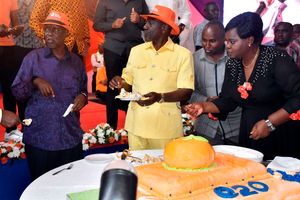
ODM Party leader Dr Oburu Oginga (left), President William Ruto and ODM Chairperson Gladys Wanga share a cake during ODM@20 celebrations at Sarova Whitesands in Mombasa on November 16, 2025
The fight for the soul of a post-Raila ODM obviously extends outside the party as the outcome will be critical to President Ruto’s political fortunes.
Both the pro- and anti-Ruto camps in ODM claim to represent Raila’s wishes, but whatever eventually pans out will have far-reaching ramifications on the political landscape in the coming year.
Enduring impact of the fallen opposition chief will be felt posthumously, as is evident in the recent posturing from Dr Oginga, Governor Wanga and company who have modified their stance on backing Ruto by making new demands for a bigger ODM stake in government to secure their support.
In demanding the position of deputy president, a position presently held by Prof Kithure Kindiki , they are embarking on course that could seriously split President Ruto’s UDA party and the existing Kenya Kwanza alliance.
If that push is serious, it could cause a rapture that could mirror Raila’s enduring history of entering into pacts that ultimately destroy a governing formation from within, as happened in 2002 when he led a mass walkout from President Daniel arap Moi’s Kanu, and handed the presidency to Mwai Kibaki.
Prof Kindiki was selected from the populous Mt Kenya region to succeed the impeached Gachagua, but there have been valid questions on his value to the ticket given the presumed exodus of the regional vote.
The deputy president may have earned a reprieve by successfully delivering on the Mbeere North parliamentary by-election in a region supposed to be solidly under Gachagua’s control, but there still questions marks over whether he has the capacity to reclaim lost ground for Dr Ruto.
President William Ruto (left) confers with ODM party leader Oburu Oginga during the Piny Luo Festival in Senye Beach in Nyatike, Migori County on December 17, 2025.
Photo credit: Alex Odhiambo | Nation Media Group
When the president, in October 2024, orchestrated the impeachment of Mr Gachagua, he must have calculated that the ensuing exit of the Mt Kenya bloc — which provided nearly half of the Kenya Kwanza Alliance votes at the 2022 elections — would be neutralised by entry of the ODM brigade into his support base.
Without Raila to provide firm direction, however, things have changed a great deal. ODM looks likely to split, with one grouping backing Dr Ruto, and the other going back to the opposition and fielding a presidential candidate. It could also join up with the united opposition taking shape under Mr Gachagua and the two leading contenders for the presidential ticket — former Vice President Kalonzo Musyoka of Wiper Patriotic Front and former Interior Cabinet Secretary Fred Matiang’i.
How that scenario unfolds remains to be seen, but the pro-Ruto camp in ODM flexing even a little bit of muscle will unsettle Kenya Kwanza a great deal.
If the Mbeere North by-election provided hope that all is not lost in Mt Kenya, all that could be undone by any seeming move against Prof Kindiki, who is prospecting of winning control of the populous voting bloc depend almost entirely on successful projecting himself as the great hope, rather than Mr Gachagua, for the region’s future recapture of the presidency.
If there are any signs that ODM will persuade Dr Ruto to dispense with Prof Kindiki in the run-up to 2027, any hopes of reasonable vote in the region, even if just 20 or 30 per cent, will go up in smoke.
ODM demands for the deputy presidency, and specifically one from the Luo Nyanza party bedrock, also unsettles the Western Kenya place in the governing alliance power equation.
Other than the Mt Kenya vote, which handed Dr Ruto the presidency, a critical role was also provided by the western Kenya bloc headed by Prime Cabinet Secretary Musalia Mudavadi and National Assembly Speaker Moses Wetang’ula. Both were Mr Odinga’s allies, who abandoned him in the run-up to the 2022 elections to join the Ruto camp, delivering the crucial swing vote that determined the outcome.
Mr Mudavadi, in particular, seemed well placed as a candidate to eventually succeed Dr Ruto if, as appeared likely, the president decided to tilt the pendulum away from the established Mt Kenya and Rift Valley presidential baton-passing games to another populous region. To cement his position in the Ruto camp and succession prospects, and with more than a little nudge from the top, Mr Mudavadi, in a post-election development, dissolved his ANC party and led his troops into UDA.
Some of his supporters were led to believe that he was Ruto’s preferred running mate in 2027, and thereafter the preferred successor. Things changed when Raila gatecrashed into the picture, and relegated him and all hopefuls to the third tier.
However, there still remained hope that if Raila was looking towards retirement, he would back Mr Mudavadi in the absence of a figure with national appeal from ODM.
All that has changed, and Mr Mudavadi in the coming year will be pondering his own political future in an uncertain scenario where the exit of Raila leaves a very fluid situation within Kenya Kwanza.
In the main opposition ranks, there will also be a great deal shifts to unfold in the coming year. This will Raila’s towering figure will not be omnipresent.
Mr Gachagua now stands out as the main figure directing opposition manoeuvres, but he is a polarising figure who still has to shed the tag of an insular ethnic or regional chief rather than a leader looking to push the broader national interest.
Mr Gachagua suffered a major setback with his failure to deliver Mbeere North, and will probably spend the early part of 2026 working to demonstrate that he is still the leader best-placed to champion Mt Kenya interests. That comes with the risk that he might retreat even more into his seeming obsession with the quest for regional kingpin at expense of a national statesmen. It might also exacerbate the duel with former President Uhuru Kenyatta over control of the regional vote. Mr Gachagua, who is barred from seeking political office as long as his impeachment stands, is so far throwing his weight behind Mr Musyoka, while Mr Kenyatta is supporting Dr Matiang’i.
The dynamics within the united opposition will very likely play out loudly in the coming year, where lack of a clear alliance agreement with structures and an electoral line-up could generate a great deal of public infighting.
In the meantime, Dr Ruto will be working towards consolidating his position, taking advantage of the great resources at his disposal, including public funds and State structures, that the opposition can hardly match. The president’s game plan will involve not just refining his political alliance, but also driving development projects which his campaign machinery sees as key to winning voter hearts and minds.
As seen in the past month or so, his information machinery — and there seems to be no line between the government and the electoral campaign structures — has gone the extra mile in generating publicity for various signature projects, such as handover of completed affordable housing units; launch of the Rironi-Mau Summit highway and extension of the Standard Gauge Railway to Kisumu and Malaba.
The highways and railway artery, it is clear, is seen as a great vote catcher targeting the Nyanza and Western Kenya region, Raila’s natural turf which now seems reachable in his absence.
Already, campaign messaging is being refined highlighting extension of development projects to regions which were presumably marginalised by previous governments.
A quick look at Dr Ruto’s recent speeches — including his State of the Nation Address in November, the Jamhuri Day speech earlier this month, and various project launches — sees great attention to his avowed intention to transform Kenya into a Singapore or First World economy.
But there is also the clear sub-text that he is working towards redressing past injustices in resource allocation. In the coming weeks, we can expect to see a president extremely busy launching new projects or checking progress on ongoing works.