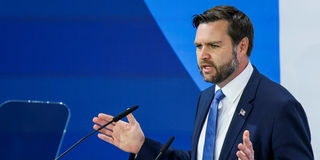
The United States Vice President JD Vance is expected to visit Kenya later this month, putting Nairobi on the global spotlight nearly a year and a half after President William Ruto’s historic State Visit to Washington.
Mr Vance’s visit, expected in the last week of November, comes at a delicate moment in Kenya–US trade and security relations, with Nairobi hoping to rekindle the warm embrace that Washington extended in the final days of former President Joe Biden’s administration.
President Ruto’s administration has remained guarded on the anticipated tour, even as high-level consultations have continued between senior officials of the two governments.
Diplomats on either side have been poring over a wide-ranging framework of cooperation signed between the US and Kenya during the May 2024 visit, covering trade and investment, climate action, technology, governance, and regional security.
“Over the past year, many of these commitments have moved from intent to implementation, and progress has been steady,” said Foreign Affairs and Prime Cabinet Secretary Musalia Mudavadi in response to Weekly Review queries. “Kenya remains a key partner in US-Africa policy, with relations unaffected by the recent US presidential transition.”
According to Foreign Affairs Principal Secretary Dr Korir Sing’oei, the visit underscores the strength of Kenya–US relations and the continuity of dialogue that began after President Ruto’s historic State Visit to Washington in May last year, the first such honour for an African leader in nearly two decades.
Kenya was, during the State Visit, designated a Major Non-Nato Ally of the United States — the first country in sub-Saharan Africa and the fourth in Africa to get the recognition — underscoring its status as one of Washington’s closest regional and global partners.
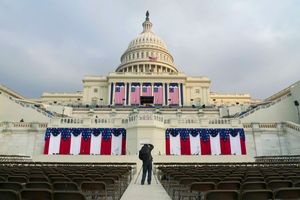
US Vice President JD Vance (left) and US President Donald Trump react during inauguration ceremonies in the Rotunda of the US Capitol on January 20, 2025 in Washington, DC.
Photo credit: Chip Somodevilla | Reuters
Dr Sing’oei, while seeking to underline continued warm relations, said President Ruto has spoken by phone with President Trump, while “other high-level engagements have happened at ministerial level.”
The Major Non-Nato Ally (MNNA) designation granted Kenya privileges such as priority access to US defence training and equipment. However, some Republican lawmakers have called for a review of the status, citing Kenya’s ties with China, Russia, and Iran.
In August, Republican Senator Jim Risch tabled a Bill seeking to reassess Kenya’s status as a MNNA, a designation seen as a diplomatic badge of honour and a facilitator of military cooperation.
The Bill cited Kenya’s trade with Iran, Russia, and China, as well as alleged links to rebel groups and human rights violations, further putting into question the prospects of the US fulfilling its part of the bargain following Dr Ruto’s 2024 historic trip.
Former US Ambassador to Nairobi, Meg Whitman, was instrumental in organising President Ruto’s State Visit to Washington, but she resigned shortly after President Donald Trump’s election.
The Ruto administration’s chief diplomat, CS Mudavadi, is keen to downplay the diplomatic shifts, while keen to extol expanded discussions to include “semiconductor technology and rare earth minerals.”
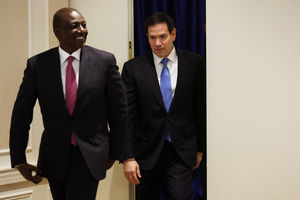
Prime Cabinet Secretary and CS for Foreign and Diaspora Affairs Musalia Mudavadi.
Photo credit: File | Nation Media Group
“Engagement between Nairobi and Washington has continued seamlessly through established institutional frameworks, transcending any single individual. The Diplomatic Mission operates as a team led by the Ambassador, with the Chargé d’Affaires ensuring continuity in the Ambassador’s absence,” he said.
He maintains that it is common for governments to take time to reorganise their foreign services during administrative transitions, citing former Ambassador Kyle McCarter’s resignation in January 2021 following the inauguration of the Biden Administration, which saw Ambassador Meg Whitman appointed nearly two years later, in August 2022.
While briefing Parliament in August, Mr Mudavadi said the US Senate Bill did not amount to a revocation of MNNA status, and pointed out that Washington had just extended Kenya’s leadership of the UN-authorised Multinational Security Support Mission in Haiti.
Trade diplomacy is also expected to top the agenda. With the African Growth and Opportunity Act (Agoa) expiring in September, Nairobi is already in bilateral talks with Washington on a new trade framework.
The Agoa trade framework, in place for 25 years, has enabled duty-free access for Kenyan exports worth over US$700 million annually. The Trump administration has since offered a one-year grace period, buying Kenya time to negotiate a longer-term replacement deal.
“If the US is not renewing Agoa for everyone, then each country must negotiate its own terms,” he said, adding that discussions also touch on tariffs imposed under President Donald Trump.
Another critical agenda during Mr Vance’s visit late this month is expected to be the Haiti peace mission, where Kenya has deployed 800 police officers under a UN-backed initiative.
The mission faces funding uncertainty after Washington hinted it could freeze its US$200 million pledge pending further UN approval. Mr Vance’s tour also comes amid concerns in Washington about China’s growing influence in Africa, particularly after President Ruto’s April visit to Beijing, where he and President Xi Jinping elevated bilateral ties.
The White House is expected to use the Nairobi visit to reassert US strategic and economic engagement with East Africa amid intensifying global competition.
When he strode into the White House on May 23, 2024 for a full State Visit and dinner hosted by then US President Joe Biden, the moment was billed as historic.
It marked 60 years of official diplomatic ties between Kenya and the United States — and the first State Visit by an African leader to Washington in more than 15 years.
The trip ended with a dazzling banquet, photographs on the South Lawn, and a raft of announcements across democracy, governance, health, education, technology, climate, trade, and security.
The White House described the partnership as “delivering tangible benefits for citizens in both nations.”
Now, more than a year later, the question is whether those “goodies” have actually arrived in Kenya, and whether the political atmosphere in both Nairobi and Washington still supports them.
Perhaps the most politically sensitive of the 2024 pledges were in democracy, governance, and human rights — all sectors where Kenya’s international reputation has lately faced challenges.
Washington promised nearly $40 million under the Presidential Initiative for Democratic Renewal to defend electoral integrity, expand women’s political participation, combat gender-based violence, and strengthen “digital democracy.”
It also backed Kenya’s participation in the 14-country Global Partnership for Action on Gender-Based Online Harassment.
Mr Mudavadi told Weekly Review that; “Kenya–US relations remain strong, dynamic, and mutually beneficial, anchored in shared democratic values and a long history of partnership. The State Visit by President William Ruto to Washington in May last year elevated the relationship to a Strategic Partnership, reaffirming Kenya’s position as a key ally of the United States in Africa.”
The Prime CS noted American firms are expanding investments in Kenya’s infrastructure and ICT sectors, while Kenya continues to position itself as a regional hub for US private sector engagement, as well as a reliable global partner in security issues.
“The partnership now stands on more forward-looking terms, focused less on aid and more on innovation, enterprise, and a shared understanding of Kenya’s central role in East Africa’s security and economic architecture,” Mr said Mudavadi.
PS Sing’oei also reaffirmed that the Kenya–US partnership remains robust despite shifting policy priorities under the new Donald Trump administration.
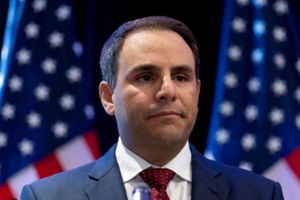
Dr Korir Sing'oei, the Principal Secretary, State Department for Foreign Affairs.
Photo credit: File | Nation
Dr Sing’oei noted that the two countries continue to cooperate on defence, health, trade, and infrastructure, key pillars outlined in the comprehensive White House statement issued after Dr Ruto’s State Visit in May last year — the first for an African leader in nearly two decades.
“We have a strong relationship based on mutual interests with the United States,” Dr Sing’oei said. “Despite the new administration’s shift in focus away from the green industrialisation pathway which Kenya is pursuing, we are pleased with the quality of our defence and security cooperation, including on counterterrorism.”
The PS said the restoration of US financing for health commodities, continued negotiations with the US Trade Representative on a post-Agoa trade deal, and private-sector investments in technology and infrastructure were tangible signs of progress.
The legal instruments operationalising the long-stalled 2013 Public Benefits Organisation Act, signed by President Ruto soon after returning from Washington, were hailed by civil society groups as a long-overdue victory.
US follow-up funding of $700,000 for NGOs and $2.7 million for oversight programmes has begun to reach implementing partners.
But the broader human rights agenda has been overshadowed by persistent allegations of police brutality in anti-tax and cost-of-living protests last year.
Barely a month from his US trip, President Ruto made a fiery charge that anti-government protests that spiralled in June 2024 were being funded by the US philanthropic organisation Ford Foundation. Dr Ruto said the organisation was sponsoring those who had caused “violence and mayhem” in Kenya, but provided no evidence for the claim. The allegation was vehemently denied by the organisation.
Opposition and human rights groups claim that state security agencies have engaged in arbitrary arrests, abductions, and in some cases, killings.
Dr Sing’oei insists that despite the change of guard in the US, its diplomatic ties with Kenya remain intact.
Former Deputy President Rigathi Gachagua, now seen as Kenya’s de facto opposition leader, has openly supported the US Senate’s review push for Kenya as a Major Non-Nato Ally (MNNA).
“I am very excited that a motion was tabled… because of the violation of human rights. I want to urge Kenyans here in the US to get evidence from home and submit to the Senators here to use in Congress,” he said during a media engagement in Kansas during his last US visit.
The remarks highlight how Dr Ruto’s 2024 promises on governance are now colliding with the political realities of his administration’s record, and the partisan battles in Nairobi.
The Biden–Ruto summit had also pledged major funding for security sector reforms and anti-corruption work, including $7 million for modernising the National Police Service, $2.2 million for prison oversight, and $4.9 million to combat transnational organised crime.