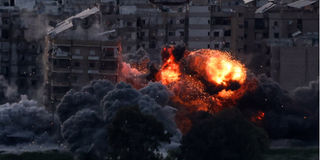
The US and Israel are jointly at war with Iran. But neither is ready to accept that it is a full-blown war, opting to refer to it as an operation. Apparently, this Russian parlance, popularised at the outset of its conflict with Ukraine, is gaining popularity in the rest of the world.
According to Donald Trump's administration, the military operation, codenamed "Operation Epic Fury", is a righteous mission aimed at pre-empting a strike that Iran was preparing to launch against the US as part of the Islamic country's divine plan (Armageddon).
The Israeli Prime Minister, Benjamin Netanyahu, and Defense Minister, Israel Katz, corroborated Trump's sentiments that the strikes (codenamed in Israel Operation Roaring Lion and Operation Shield of Judah) were conducted, first and foremost, to neutralise an existential threat after the US-led global diplomatic efforts to curtail Iran's nuclear and missile enrichment activities failed. Israeli Prime Minister Netanyahu could not countenance an Iran with nuclear and missile capacity, capable of actualising its oft-repeated threats to "eliminate Israel from the surface of the earth."
For these reasons, Israel has opted for a military operation against Iran, hopefully to create conditions for "brave Iranian people to take their destiny into their own hands and cast out the yoke of tyranny." That is euphemism for regime change, to usher in a pro-Israel/USA leadership in Tehran, which can assure Israel of peaceful coexistence. Unsurprisingly, the operation has targeted Iranian nuclear facilities (including Fordow, Natanz and Isfahan), naval assets and leadership compounds.
According to Iranian officials, however, the current conflict (codenamed Operation True Promise IV) is an illegitimate act of unprovoked aggression and Western imperialism, aimed at forced regime change and destruction of Iranian sovereignty. As much as Trump has categorically stated that the US and Israel will not negotiate with Iran unless the latter is prepared to surrender, Iran feels terribly desecrated and aggrieved by the killing of its Supreme Leader, Ayatollah Ali Khamenei.
For that reason alone, the Islamic country feels no obligation to negotiate with "an aggressor who has touched the very essence of its soul by killing the revered leader." This feeling is aptly reflected in the change of heart among those who have, for years, been opposing the Ayatollah, but are now speaking with one voice to defend their country.
Within ten days, the conflict has caused significant disruptions. Iran has responded to the "aggression" by launching retaliatory strikes across the Middle East. Besides, there has been closure of the Strait of Hormuz, fondly referred to as the global oil artery. Roughly 20 per cent of the world's oil (approximately 20 million barrels per day) and 20 percent liquefied natural gas pass through the Strait of Hormuz.
Over 80 percent of oil transiting through Hormuz is destined to Asian markets, primarily China, India and South Korea, to power growth in these aggressively industrialising countries. Up to 70 percent of food imports for the Gulf Cooperation Council countries (Bahrain, Kuwait, Oman, Qatar, Saudi Arabia and the United Arab Emirates) rely on this passage, which connects the Persian Gulf to the Gulf of Oman and the Arabian Sea. Currently, the Strait of Hormuz is the epicentre of a major global energy crisis following a dramatic escalation of the Iran conflict.
The waterway is effectively closed to routine commercial traffic due to Iranian military threats and attacks on ships. President Trump has responded to this closure by proposing US Navy escorts for tankers, and ordered the International Development Finance Corporation to provide emergency insurance as private insurers withdraw coverage. It is, however, highly unlikely that Trump's proposals will be given traction in view of the potential dangers associated with Hormuz in times of conflict. Already, the crude oil prices have surged to approximately $89 per barrel by March 6, 2026, a 22 percent increase in one week. The effects of increased oil prices will soon begin to bite across the world, with poor countries bearing the brunt as their national budgets get pushed off-rail, and fiscal deficits burgeon.
If the conflict persists, many poor countries will see their offshore financial obligations fall behind schedules. As the Iran conflict rages on, the world is wondering why the country's main allies, Russia and China, are not intervening militarily to bring it to an end. So far, the two major military powers have only done a lip-service to Iran by condemning the strikes, but have yet to take concrete steps to push back the "aggressors."
Economic and military resources
Pundits have opined that Russia has too many skeletons in its cupboard to attempt to pontificate to the US and Israel. Besides, Russia's economic and military resources are already overstretched in Ukraine, leaving little capacity for a high-intensity conflict. Moreover, there is a strategic scarcity as both Russia and Iran require the same categories of weapons (missiles and drones) for their conflicts, making it difficult for Russia to export significant hardware while its own stockpiles are constrained.
In terms of economic diplomacy, it is in the interest of Russia to preserve its ties with the oil-rich Gulf states and Israel, which would be jeopardised by direct military support for Tehran. China, on the other hand, is far more dependent on oil from Arab states (approximately 50% of its imports) than Iran (17%).
It is prudent for China to prioritise regional stability to keep oil flowing through the Strait of Hormuz. China typically avoids binding security commitments far from its core interests in Asia. It is not lost on China that the US has a big purse, out of which approximately $442 billion is spent annually on the Asian country's products. In this regard, China has a strategy of infiltrating the American market with more of its electronic and telecommunications goods and high-end cars.
A direct confrontation with the US would therefore not work in its favour. Nonetheless, China and Russia continue to provide direct assistance to Iran, including intelligence sharing, technology aids, and diplomatic shielding by leveraging their UN Security Council seats to call for emergency sessions to condemn the strikes as violations of international law. Russia's case is, however, significantly delegitimised by its presence in Ukraine in total disregard of international opinion.
Some pundits have argued that US involvement in the conflict between Israel and Iran is actually a proxy war against China. According to the proponents of this school of thought, the US is uncomfortable with the high pace at which the Chinese economy is expanding, buoyed by unfeterred access to Middle East oil.
To curtail China's growth, the US is determined to control the amount of oil that the Asian country receives from the Gulf countries. A similar strategy is said to have informed the arrest of Venezuelan President Nicolas Maduro during "Operation Absolute Resolve." China is treading carefully on global conflicts, not to step on the wrong toes.
Professor Ongore is a Public Finance and Corporate Governance Scholar at the Technical University of Kenya. [email protected]