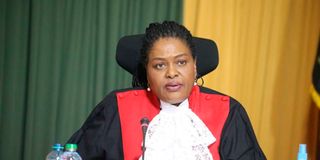
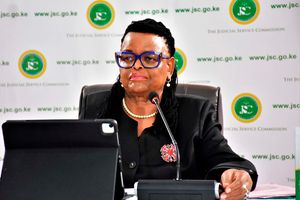
Kenya has made a strategic decision by nominating Supreme Court judge Njoki Susanna Ndung’u as its candidate for one of the six vacancies on the International Criminal Court (ICC) in the 2026 elections.
Listed officially among the nominees by the Assembly of States Parties, her selection reflects confidence in a jurist whose career blends national leadership, international insight and principled adjudication — qualities the ICC needs to strengthen its legitimacy and effectiveness. Justice Ndung’u’s early international experience provides a strong foundation that distinguishes her from many candidates.
Before entering national politics, she served as a national protection officer at the United Nations High Commissioner for Refugees (UNHCR) in Kenya, directly addressing protection challenges faced by refugees and displaced persons amid human rights violations and potential atrocity crimes.
She later worked as a political analyst in conflict management at the African Union, engaging in conflict prevention, mediation and resolution across the continent.
These roles immersed her in the operational realities of international humanitarian crises, forced displacement, mass violations and the political dynamics that often lead to ICC investigations.
Such practical exposure to how global institutions function in volatile contexts is critical for an ICC judge, who must interpret provisions of the Rome Statute with sensitivity to state sovereignty, complementarity and the lived experiences of victims in Africa and beyond.
Building on this international grounding, her legislative achievements demonstrate hands-on impact in areas central to the ICC’s mandate.
As a Member of Parliament (2003–2007) and representative to the Pan-African Parliament, she spearheaded the Sexual Offences Act of 2006, Kenya’s landmark legislation addressing sexual and gender-based violence.
The law strengthened evidentiary standards, victim support and procedural safeguards in cases of systemic abuse — issues that mirror many ICC prosecutions involving sexual crimes as instruments of war or oppression.
Her ability to draft and champion victim-centred reforms gives her practical insight into the challenges of prosecuting gender-based atrocities, extending well beyond theoretical knowledge.
This expertise would enable her to contribute meaningfully to fair, trauma-informed judgments in The Hague. Her role in Kenya’s constitutional development further underscores her suitability.
As a member of the Committee of Experts that helped draft the 2010 Constitution, she contributed to shaping one of Africa’s most progressive constitutional frameworks, incorporating transitional justice, human rights protections and mechanisms designed to balance accountability with national reconciliation.
The ICC frequently handles cases arising from post-conflict or transitional settings where the principle of complementarity requires assessing domestic judicial capacity.
Justice Ndung’u’s understanding of these tensions, gained through direct involvement in constitution-making, positions her to apply complementarity principles thoughtfully and strengthen the Court’s credibility among African states parties. With more than 15 years of judicial experience, including service on the Supreme Court since 2011 as one of the inaugural judges appointed under the new Constitution, she has demonstrated maturity in landmark rulings on constitutional interpretation, electoral integrity and fundamental rights.
Her unopposed election in January 2026 as the Supreme Court’s representative to the Judicial Service Commission highlights the confidence her peers place in her integrity and judgment.
Although some politically charged election petitions attracted criticism, her consistent defence of constitutionalism and judicial independence reflects resilience in the face of pressure — a vital quality for an ICC judge navigating accusations of bias or selectivity.
Justice Ndung’u’s credentials are further strengthened by her Master of Laws (LLM) in Human Rights and Civil Liberties, international fellowships and national honours, including Elder of the Burning Spear (EBS) and Chief of the Burning Spear (CBS). She has also received international recognition, including the UN Person of the Year Award in 2006 and Jurist of the Year from the International Commission of Jurists.
These distinctions affirm her long-standing commitment to protecting vulnerable populations and advancing justice.
For Kenya, this nomination represents a strategic investment. It demonstrates the country’s commitment to international justice, reframes its historical engagement with the ICC in a constructive light and elevates a trailblazing woman jurist whose career may inspire future generations while strengthening Kenya’s global standing.
For the ICC, her appointment would respond to calls for stronger African representation, greater gender balance and judges with contextual understanding of the continent’s political and legal realities.
In a court striving to reinforce its fairness and relevance, her blend of international field experience, victim-focused lawmaking, constitutional expertise and proven judicial service makes her a compelling candidate.
Kenya’s choice of Justice Njoki Ndung’u is not just timely; it is visionary. As the Assembly of States Parties weighs the candidates, her nomination stands as a powerful testament to principled leadership in the pursuit of global accountability.