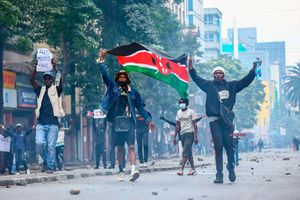
Kenya’s 2027 election is set to be unlike any other in the country's history.
Beyond the rallies, posters and familiar ground operations, a new player is creeping quietly onto the political battlefield: artificial intelligence (AI).
From analysing voter sentiment to disseminating automated propaganda, AI is emerging as both a tool of efficiency and a weapon of deception.
Frustrated by his government's declining public appeal, he prompted his aides to search for controversial spyware, which is now the subject of a legal case.
Mary Wachuka has sued four of President Ruto’s aides , seeking compensation for the botched procurement of a digital propaganda system. In May this year, she filed private communications with one of the president’s aides, revealing the power struggle at State House.
Ms Wachuka, a Kenyan-Canadian citizen, claims that between November 10, 2023 and July 21, 2024, she had extensive discussions—both in person and virtually—with senior state officials, including Mr Eric Ng’eno, the president’s speechwriter, regarding the proposed software.
In court papers, she claimed that Mr Ng’eno had informed her that the president had “expressly sought a bespoke digital communication solution in light of growing concerns over the fragmented and frequently counterproductive messaging of the administration's agenda”.
As voters spend more time on social media than on traditional platforms, politicians are turning to AI-powered tools to predict, persuade and manipulate.
Some well-connected campaign operatives have already begun experimenting with AI-driven software capable of analysing millions of online conversations in real time.
These programmes analyse X, TikTok, Facebook and WhatsApp groups to detect shifts in public mood, popular grievances and issues that excite or anger citizens.
“Traditional opinion polls are too slow and often inaccurate. AI can provide an immediate snapshot of public opinion,” says a digital strategist aligned to one of the major coalitions, speaking on condition of anonymity. “If young people in Kisumu are angry about unemployment today, a candidate can find out immediately and create a tailored message before the anger spreads.”
Instead of blasting one generic message nationwide, campaigns can now use AI to create different speeches, videos and adverts for micro-groups of voters.
“A middle-class professional in Nairobi may receive an attractive AI-generated infographic on tax cuts, while a small-scale farmer in Uasin Gishu County could be targeted with a synthetic video promising cheaper fertiliser,” argues Prof Gitile Naituli of Multimedia University.
However, with innovation come darker possibilities. The same tools that enable campaigns to understand voter needs could be exploited to disseminate misinformation with unparalleled sophistication.
Globally, deepfake technology—AI-generated videos that convincingly mimic real people—has already raised concerns.
In Kenya, where misinformation spreads rapidly via WhatsApp chains and unverifiable blogs, experts fear that deepfakes could become the new frontier of propaganda.
Mr William Kabogo, the Cabinet Secretary for Information, Communications and the Digital Economy, has emphasised the importance of the AI Strategy in ensuring that Kenya remains competitive, secure and prepared for the future in the global digital economy.
“This is a commitment to shaping Kenya’s digital future. Kenya will not be a spectator; we will be the architects of our digital destiny,” said the CS in March during the launch of Kenya’s Artificial Intelligence Strategy 2025–30 at the KICC in Nairobi.
He emphasised the importance of AI as a key pillar of the country’s digital transformation agenda, in line with the Kenya National Digital Masterplan 2022–2032 and the Bottom-Up Economic Transformation Agenda (BETA).
According to court documents, Mr Ashiko was arrested for publishing false information, in violation of Section 23 of the Computer Misuse and Cybercrimes Act. This case is a testament to how political narratives can be manipulated to cause apprehension.
In June, researchers at a local fact-checking organisation identified multiple synthetic images circulating on TikTok that purported to show large crowds attending rallies—images that did not actually exist.
“While most voters may not be able to distinguish between AI-generated visuals and authentic photos, the political impact is enormous,” argues Chris Omore, an advocate.
“Disinformation has always been part of Kenyan politics, but AI is making it cheaper, faster and more convincing,” he warns. “The risk is that voters will struggle to distinguish truth from fabrication. Democracy itself becomes vulnerable.”
Kenya is not operating in isolation. Across the world, AI is disrupting electoral politics.
In the United States, for example, Republican campaigns experimented with AI-generated attack ads.
In India’s elections, parties used AI to instantly translate speeches into multiple languages, enabling them to reach vast audiences at minimal cost.
According to insiders in Kenya’s political camps, several top politicians have hired international consultants specialising in AI-driven campaigning.
The firm was accused of harvesting personal data in order to micro-target voters with fear-driven messaging that stoked ethnic divisions.
This scandal was a precursor to the current AI-driven trend. Analysts say the difference is that the tools available in 2027 are more advanced, cheaper and locally accessible.
“Unlike the expensive Cambridge Analytica playbook, today's AI software can be accessed by anyone with a modest budget and an internet connection,” argues Dismas Mokua. “The rapid rise of AI in politics has sparked debate about how to safeguard democracy.”
Kenya’s Data Protection Commissioner has warned of the dangers of the political misuse of personal information.
Mr Mokua argues that the lack of explicit regulations banning deepfakes or AI-generated political adverts could lead to disaster.
There has been a push for urgent legal frameworks to curb AI-driven manipulation before the 2027 elections.
Proposals include the mandatory labelling of AI-generated content, harsher penalties for the dissemination of deepfake propaganda and transparency requirements that would force political parties to disclose their use of AI tools.
Experts advise voters to exercise extreme caution with digital content, especially videos or images that seem too sensational to be true.
As the 2027 election campaigns gather pace, AI is poised to become the invisible force shaping Kenya’s political narratives.
While rallies, tribal mobilisation and traditional campaigning will remain central, the shadowy world of AI-powered manipulation could be pivotal.
“Whether Kenya navigates this new frontier responsibly or descends into an era of synthetic propaganda will depend on the vigilance of regulators, the integrity of politicians, and the scepticism of voters,” says Mr Omore.