Egypt’s GMED Group has agreed a multibillion-shilling acquisition of the East African business of Dutch medical equipment maker Philips, to the chagrin of local medical engineers, who have moved to court to block the deal.
The train is about to leave the station, with GMED Group securing a $15 million (Sh1.9 billion) loan from the International Finance Corporation (IFC), as Philips East Africa Ltd (PEAL) navigates regulatory approvals for the sale in Kenya.
The Association of Medical Engineers of Kenya (AMEK) wants judges to block the deal, posing questions whose answers will certainly further define the implementation of Kenya’s procurement laws.
Can a supplier lump government contracts with other assets it owns when selling its business? Can an original equipment manufacturer sell their business to an entity that does not design and make the gadgets? Do the seller’s clients have a say in offloading the business?
PEAL, the first respondent in the petition, has been a big player in two controversial medical equipment supply deals in the Uhuru Kenyatta and William Ruto administrations.
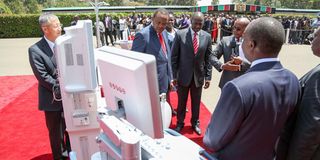
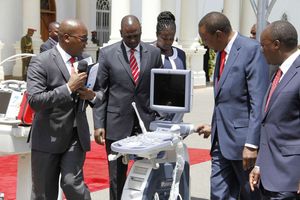
During Mr Kenyatta’s term as president, PEAL was one of the key contractors in the Managed Equipment Scheme (MES) – a programme that saw the government contract firms to lease specialised kits to public hospitals.
The MES project cost Sh63 billion and ran for eight years on contracts that were iron clad in favour of the suppliers. The terms blocked Kenya from calling off the deal.
Philips, GE Healthcare (US), Siemens Healthineers (Germany) and Mindray Medical International (China) were the main suppliers, but sub-contracted local companies.
The agreement was signed before consultations with counties, indicating that the devolved units may have been arm-twisted into agreeing.
Then President Uhuru Kenyatta (second right) and his deputy William Ruto (second left) inspect medical equipment procured through the Managed Equipment Services (MES) Project at State House, Nairobi on February 6, 2015.
Photo credit: File | Nation Media Group
Treasury would deduct money for paying the suppliers from annual allocations before releasing funds to county governments.
Hospitals got the same equipment package, meaning there was no curation based on a county’s needs. No employees were trained to handle some of the sophisticated machines, which led to some remaining idle.
President William Ruto’s administration dumped the MES model for a tweaked version called the National Equipment Service Programme (Nesp).
Nesp is running on a lease-to-own model, meaning the hospitals covered will acquire machines handed to them when the lease period ends.
The deal will cost Sh200 billion over 10 years, with the contractors list being a mix of the traditional multinationals like Philips with a few local tycoons in the frame of BBS Mall owner Abdiweli Mohamed Hassan, Mr Richard Ngatia and Ms Mary Wanja Ibuntu.
Philips also supplies hospitals owned and operated by the Kenya Defence Forces with equipment, aside from having similar arrangements with private health institutions.
Barely two years after being contracted under Nesp, Koninklijke Philips NV – the Netherlands-registered parent firm of PEAL – is exiting East Africa.
GMED is one of the biggest medical equipment distributors in Egypt, parts of the Middle East and a few parts of Africa. It has incorporated a subsidiary in the Netherlands to acquire the East African arm of Philips.
The GMED Group wants to expand its continental presence, and has earmarked the Philips East Africa territory – Kenya, Tanzania, Uganda, Rwanda and Ethiopia – as a starting point.
AMEK says the deal is being implemented without conducting a public consultation of a safety impact assessment of the sale and transfer of Philips’ government contracts.
Service interruptions in hospitals
“The transaction, if implemented before judicial review or regulatory scrutiny, would result in the unlawful transfer of public procurement obligations related to the capital equipment maintenance at national referral hospitals, county referral hospitals, military hospitals and other critical maintenance and warranty contracts, including those under the Nesp, contrary to the Constitution and the Public Procurement and Asset Disposal Act, 2015,” AMEK chairperson Symon Mbakah says in his court papers.
Some medical engineers hired by Philips have sued PEAL separately for “forceful transfer of their employment to GMED Holding BV.”
AMEK says GMED’s inexperience in making medical kits could lead to service interruptions in public hospitals.
“The loss or exit of this highly skilled technical team would paralyse medical equipment maintenance and calibration in national, county and private hospitals, thereby threatening the right to health under the Constitution,” Mr Mbakah said.
The engineers also say PEAL’s business has been grossly undervalued in the sale, though the lobby does not attach a specific value to the Philips subsidiary in the court papers.
“Implementation of the proposed acquisition in the absence of judicial intervention and regulatory safeguards would lead to an irreversible disruption of medical device servicing, jeopardising lives and rendering the constitutional petition nugatory,” AMEK says in an application seeking to suspend the sale, pending determination of its case.
PEAL has been sued alongside Koninklijke Philips NV and Philips Radio BV, GMED Holding BV, the Competition Authority of Kenya, the Ministry of Health, the Pharmacy and Poisons Board and the Attorney-General. The Council of Governors is listed as an interested party.
The IFC in April said the Sh1.9 billion loan to GMED was for the expansion of the Egyptian group’s distribution business into East Africa. The loan is unsecured. This means it will be repaid when GMED makes money as settlement is not tied to a specific timeline.
The loan is still pending approval, according to the IFC website.